Venezuela, quick there and back

15–22 Jul 2001 | Pico Bolivar, Venezuela / South America
Photos
Photos on the map
Text

Venezuela is such a huge country that you'd need several months to explore it properly. As an employee of an American corporation I had a week... So, Caribbean palm paradise and the highest mountain...

After coming back from Czechia I had a week to find out all the screw-ups at work and put out the biggest fires before flying off to Venezuela. Usually when I fly somewhere on business for three days, a ton of work piles up in just those three days. After two weeks it was, as expected, a nightmare. Well, I even pulled an eighteen-hour working day, but I somehow patched it all up and flew to Venezuela. It all peaked with me still sorting out a few server and printing problems on the phone while changing for my connecting flight in Houston.

Landing in Venezuela reassured me that Czechia is civilisation after all, in spite of all the taxi drivers and waiters. Right at the airport, which had bare concrete walls inside (to this day we haven't agreed whether it was unfinished or whether it was on purpose), I'm waiting in the queue for the customs officers and chatting with a Venezuelan woman living in Canada. She immediately started warning me about thieves and rip-offs and so on and I took it more or less lightly. I'd been to Cuba, Russia and Libya, nothing can surprise me. I nip off to the exchange office and I see the guy in front of me ask for a receipt, then spend ages counting the exchanged money and then complain about the shortfall. When it was my turn, I asked for a receipt too, and although I'd forgotten most of my Spanish (and besides, I never knew any :-)) I understood this perfectly. He snatched my Venezuelan dosh with the words: "If you want a receipt, kiss my arse and go somewhere else!" So I preferred to take it without counting and in the end it was right.

I come out of customs and on the advice of that Canadian woman I went to buy a taxi ticket. On the way about fifteen taxi drivers pushed themselves on me, of course...

It was already pretty late and I had a long way to my booked hotel, so a taxi was the only option. You buy the ticket at an office in the airport building according to distance and you just hand it to the driver. A clever way to stop taxi drivers from stealing. Somebody could suggest it to Kasl... By the way, Martin and I saw the same solution in Mexico City.

In front of the airport there was a long row of new black Ford Expeditions (a really big jeep), which were the prepaid taxis. It later turned out that putting a taxi like that into the hands of a Venezuelan driver is like handing him a weapon. With the biggest and most powerful car far and wide he drove me like he was heading for the maternity ward. All those half-falling-apart cars with no lights, with rust holes and a different wheel on each corner, he overtook absolutely brutally, several times even on the pavement, on a red light, or he forced somebody off the road in the oncoming lane. Where other cars had to almost stop for a mammoth trap in the asphalt, he just accelerated. I knew that in such a big car not much could happen to me (which was confirmed to me much later and somewhere completely different), so I quite enjoyed it. We met, for instance, a guy on a motorbike wearing nothing but boxers and flip-flops, with no lights, let alone a helmet. It dawned on me that the best measure of the level of civilisation is probably the state of the roads, the drivers, the waiters and the likelihood of being robbed in the service sector in general. For Venezuela it turned out rather badly :-).

The neighbourhood the taxi driver took me to looked like it had been hit by a big earthquake a few years back and nobody had fixed anything since. It turned out that's almost true, only it wasn't an earthquake but a huge storm whose waves swept away the entire coast.

First I wanted to check in and then go for a walk to see if I could find a pub for dinner. On the way up the stone stairs to my room I was wondering whether it's more dangerous to leave my valuables in the room of this scabby hotel and have them stolen by the staff, or to take them with me and have them stolen when I get mugged in the street :-).
I get upstairs (hot as hell, 100% humidity), open the door to the room and had another dilemma. A messed-up, obviously slept-in bed, dirty towels all over the floor, a cigar butt and the remains of a sausage on the bedside table – is this the normal state of a room in Venezuela before a new guest moves in, or should I go and complain? The cigar suggested to me that I should go and try complaining. It was quite hard to explain to the only-Spanish-speaking receptionist that there are used towels on the floor and the bed is unmade. Out of my once relatively usable Spanish all I could recall was impuestos (taxes) and Donde esta la oficína de coreos (Where's the nearest post office), which in that situation was about as useful as fluent Hungarian :-).
Well, in the end he sent some flunky along with me, who came up and delivered the final verdict. Something along the lines of "Aaaah, yuck, pfrrrrrr". I interpreted it as "well, that's absolutely impossible, I apologise on behalf of the hotel and let's go down for the keys to another room." Apart from the apology I interpreted it pretty correctly. They gave me another room. It didn't look any better, but at least there was no cigar and the bed was made :-).

There was a pub right downstairs in the hotel, so I settled in there for dinner. The advantage of a person living in California is that wherever on the globe he goes, one thing is certain. It'll always be cheaper there than in California. Well, I thought Venezuela would be significantly cheaper, it was only a bit.

I ordered something I managed to translate as baby pork, so I thought it was obvious, it'll be suckling pig. It wasn't, it really was a baby pork rib. That is, a rib from a pig that could have had at most a 15-centimetre waist and 20 across the chest. The ribs were about as thick as knitting needles, but it was pretty good. Along with it some substance with the colour of potatoes, the consistency of melon and the taste of overcooked beetroot.

During the meal some musician wobbled into the room together with his stand and started singing English songs. That wasn't as surprising as the fact that an ordinary slightly tipsy guest detached himself from the people at the bar and asked for the carrot-phone. He whispered something to the professional musician and then started singing. I was expecting some horror, but surprisingly he sang well, Beatles and so on. He won over (unlike the pro before him) the attention of the whole audience and a few people even sang along with him. The worst bit was when he decided to pass the carrot-phone around and everybody would sing something. I was already edging towards an escape from international disgrace, but luckily somebody far ahead of me dug their heels in and broke the chain.

Another curiosity around the bar was a little gang of about three girls who had cuddly toys in front of them on the bar. I watched it uncomprehendingly, then I finally got that they're special glasses the girls drink out of through a straw. What I never found out was whether they really were hookers or just sort of looked like it.

Once I'd eaten, I decided to set out and explore the surroundings. What looked from the taxi like a dangerous neighbourhood full of ruins was, on foot, a dangerous neighbourhood full of ruins. Broken-up pavements, half-collapsed buildings, feeble lighting, the odd stray dog, not a living soul anywhere. Luckily, I'd say. Judging by the horror of all the locals I later told about my little walk, the probability of being mugged was pretty close to 1. Natives all over the world exaggerate when they talk about danger, but even so...

Anyway, I survived and spent the rest of the night deciding whether it's worse to go mad in bed from the heat or from the noise of the air-conditioning fan. I changed my decision about 5 times a night.

In the morning I had a taxi called for me, a half-falling-apart American land yacht from about the sixties came for me and for slightly more than the luxury jeep the previous night it took me to the airport.

Now I also remember what amused me in that crumbling neighbourhood – a butcher's shop with the grand name Clinica plastica. Venezuela is supposedly the country with the highest number of plastic surgeries in the world. I think most of the local girls wouldn't even need it, but it's probably a cult of the body.

Jenny is the former au-pair from whom Kářča took over Lily in San Francisco. Carlos is her husband. They invited us to Venezuela, they live in a town called Barquisimeto.

Jenny's aunt has a summer flat in a luxury gated neighbourhood on the north-eastern coast of Venezuela, that is, right on the Caribbean. I already knew from Cuba that the Caribbean is the most beautiful sea for swimming, so a trip there appealed to me, especially with the prospect of a base in that empty flat.

Like all the countries of Central and South America, Venezuela too is full of cops and soldiers with rifles. During the roughly 2-hour drive they stopped us at their checkpoints about five times and peered into the car. They held us up the most when entering the complex by the sea where the flat was supposed to be. They strictly check everybody who enters the complex and they couldn't grasp that somebody had lent us the flat. For the first time in my life I let somebody else arrange things for me while travelling and it was bliss. Nobody here speaks human (English) and as I've already said, my Spanish had become unusable over the years of not using it. And it never was usable before that either :-).

The very next morning we set off by car from the complex with swimming pools and a water slide to find the real, natural Caribbean, some island you were supposed to get to by boat. After about an hour in the car, spent in a total traffic jam where the only traffic rule was "Shove yourself wherever you can!", we forced our way through to the port. We tumbled out of the car and my vague idea of hell started to take on clearer outlines. Unbearable heat, dust, wrecks of boats, boat touts on scooters in between, locals arguing, a few confused tourists, chaos, shouting, stench and heat and heat and despair. Jenny and Carlos tried to negotiate with the boat owners in all that chaos and kept coming back with news like: $100 per person one way. In a minute, it's $70 for everybody. After about half an hour of haggling we paid about $35 in various currencies, sharing a motorboat with a bunch of some other tourists. With that, hell ended and the fun began. I'd never ridden in a motorboat before, so a little experience. What's more, the boat went hellishly fast, which cooled us down nicely, and as soon as it left the stinking port we were weaving through a maze of bush-covered islets, gorgeously clean sea, parrots on the branches, the vision of a tropical island ahead of us, bliss.

After about 45 minutes of speeding we reached an island whose looks exceeded all expectations. It looked like something out of a Čedok catalogue, one of those holidays that cost two years' average salary for a week by the sea with a quarter-board :-). Amazingly blue sea, white sand, palm trees, gorgeous tanned native girls dressed in swimsuits sewn from about four square centimetres of fabric, thousands of colourful little fish and fish in the sea, and above all, the most important parameter for a shivery type like me, water at a temperature such that even after an hour of splashing about I didn't look like I was on my way back from picking blueberries! After the previous definition of hell, this was a real tropical paradise, further improved by a fridge full of the local Polar beer, which says Tipo Pilsen on it and the brewery was supposedly founded by a Czech once upon a time.

Of course we didn't forget to get sunburnt :-).

The next day we went to the island once more, and by then I'd managed to register that it's called Cayo Sombrero and lies inside the Morrocoy national park. We even found time for a walk around the island and discovered a beach full of washed-up corals in the most incredible shapes. Judging by the presence of corals, I conclude that Cayo Sombrero is an atoll (crossword solvers and the wise already know, atoll = coral island). We couldn't help ourselves and like little kids we collected a whole bag of corals and lugged them all the way to the USA. What'll happen to them next, we'll see.


Besides the Caribbean, Venezuela's biggest tourist attraction is the jungle. I've read a bunch of reports from Venezuela on the Internet and the one that grabbed me most described how the locals set them up with piranha fishing and then with hunting crocodiles in a river deep in the jungle. I decided right away that I couldn't leave Venezuela without a crocodile scalp! On top of that, on the plane they were showing Crocodile Dundee in LA, which made it clear to me that hunting crocodiles is a stroll down a cherry-tree lane!

Well, the hard laws of American capitalism turned out to be stronger. When you go somewhere for a week, you just can't fit everything in. From Barquisimeto (to this day I don't know howthehellyouspellthatdamntown) it was almost 1000 km to the jungle and we had a mere three days left... Extending the holiday, which I was already taking on credit as it was, was out of the question. (They even made me have roaming set up for Venezuela, so I dragged a mobile around with me everywhere, waiting for something to crash again and for me to have to deal with it from Venezuela :-). Luckily nothing happened. Nothing serious.)

So we ditched the jungle and the crocodile handbag and went for another Venezuelan attraction, the mountain Pico Espejo, a couple of metres short of 5 km high.

Pico Espejo, 4765 m above sea level
Getting to Mérida (a lovely little mountain town at the foot of Pico Espejo) wasn't much closer than getting to the jungle. Especially in Venezuela, where even a straighter second-class road gets called a motorway and where you can occasionally get bogged down on the road even with a big jeep.

My thinking went like this. Renting a car in America for three days doesn't cost anything terrible, everything here is cheaper, so we'll rent a car and won't have to rely on the whims of the local social (read: public) transport. On top of that Venezuela is an oil superpower, so petrol should supposedly be pretty cheap.

Here's how it turned out:

The smallest car on the globe (a Daewoo Matiz, 900cc engine, 3 cylinders (which is, by the way, 200 cc and one cylinder less than the motorbike I got for the summer and which then spent the whole summer out of action)), so this micro-car with a top speed not exceeding that of an enraged donkey cost $20 a day more to rent than the most luxurious Jeep you can rent in America!!!! Well, what could you do, there wasn't much time for other experiments anyway. At least you could pay for it by credit card, which is usually a problem in these parts. For example, ATMs are, according to some mysterious random number generating formula, willing to hand out money on a foreign card only to the x-th tourist out of a hundred, where x is a whole natural number somewhere between 15 and a hundred. Once we got lucky and I drew x-1, so Káča, who completely illogically tried after me, drew x and beat the machine out of the desired amount. What discouraged us from tempting lottery X too often was a story from one of the reports, where an ATM generated the mysterious number Y, which means the machine spits out a slip about the money being deducted from your account, but doesn't spit out the money and refuses to talk to anyone after that. Luckily (I hope) that didn't happen to us.

Well, I've digressed from union holidays almost to praising the Party and the government for the corn harvest, so let me get back to the Mérida of the matter! (That's not a typo, that's the name of the town.) We got to Mérida after a desperate eight-hour drive in that three-cylinder donkey, and the experience from Mexico was confirmed again: with altitude it's not only the oxygen that disappears from the air, but the power from the engine too. When Martin and I lost a third of the power on that American six-cylinder, it was annoying, but it still went. But when you lose a third of the power on something that never had any power in the first place, not even the fact that a full tank cost 115 Czech crowns and lasted for almost the entire trip can cheer you up. At about two in the morning we pulled up at some little hotel which unfortunately had a steep driveway and the Matiz showed us what's what in Korea (or wherever the hell they make them). It simply didn't make it up that hill. Not even on the third go with a big run-up. The last time I saw that was when I was twelve and a mate of mine was trying to get a Kozí dech up a hill in Čermná in the woods...

In the end we found another little hotel without a hill, but with a nice shower and a bed full of ants. They didn't bite, so we slept blissfully and only found out in the morning.

The next day we calmly set off for that cable car.... Hang on, I haven't even said that there's a cable car up that five-thousander! So the poor reader must have thought we wanted to climb up there on foot in half a day and, after hearing about the crocodile hunting, dismissed this pamphlet as utterly untrustworthy in the data it presents!

The cable car up Pico Espejo

Record no. 1: The cable car reaching the highest point of any cable car on the planet (4763.7 m above sea level)

Record no. 2: The cable car with the greatest vertical rise (starting at 1639.5 m, finishing at 4763.7 m above sea level)

Record no. 3: The final stage of the cable car has the longest freely hanging span of cable between two pylons, 3 km long.

These facts can be verified at http://www.guinnessworldrecords.com/

There, the reader's shaken trust is hopefully back in my hands :-).

So we calmly walk up for the tickets for that cable car, wait an hour for the lady to get back from lunch, whereupon she calmly informs us that the nearest free reservation is in about 5 days... Our plane to the USA leaves in less than two days and from the other end of Venezuela at that... Crushed, we shuffle away from the cable car and it occurs to me that only corruption can save us now... At that moment a comely attendant sidles up to us and when we explained our troubles she advised us to turn up early the next morning, around seven. A horrific thought, but better than leaving the world's biggest cable car empty-handed.

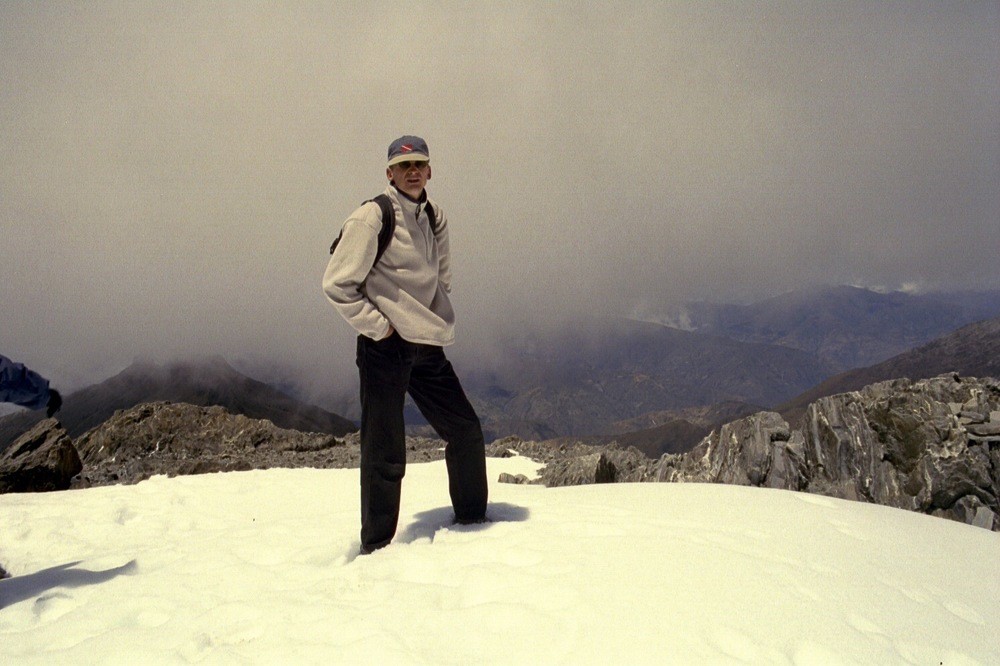
In the end we did manage to get the ticket in the morning, ride up to the top of the mountain, experience the misery of altitude sickness (me right on the verge of puking, Káča less dramatically), get our photos taken in the snow, and ride back down from minus 10 to plus thirty.

The cable car has four independent sections, so five stations; the ride up, including waiting at the changes, took about 3 hours, and we even managed a walk to a lake just below the summit. From the top, in flashes of clear weather, you can see the summit of the neighbouring mountain Pico Bolívar, which is not only a proper five-thousander (5007 m), but also the highest mountain in Venezuela. At least.

Since we're on the subject of Bolívar, that's the name of some national hero who liberated Venezuela and a few surrounding countries from the oppression of, I think, the Spanish, and that's why they celebrate him like mad here. Besides the highest mountain, the local currency is named after him, along with every other square, street etc., and recently they've smuggled him into the name of the country too, something like the Bolivarian Republic of Venezuela or whatever it is.

I haven't been everywhere in Venezuela by a long shot, but I'd dare say the only place where you can buy a winter hat is Mérida, at the stalls right by the cable car. In that heat I saw little kids sitting in the queue for the cable car with their hats pulled down over their ears and I wondered what makes them do it in thirty-degree heat. I came to the conclusion (and for a moment I even believed it) that since they were born in the tropics and had never seen a hat before, they have no idea about the hat-cold connection. So they're convinced that having that sack with 'Mérida' written on it on your head and putting up with the trickles of sweat running down your head is simply part of the local attraction, a bit like the helmets when you crawl through a cave. Well, hopefully it dawned on them up there in the snow :-).

In the afternoon after the first unsuccessful cable car hunt we set off on a little trip around the area. On the way we see a bull marching freely along the road dragging a rope behind him. Unsatisfied by the crocodile hunt, I decided to at least bag a bull! But how to pull it off and stay in the relative safety of the inside of a tiny car? I went for a circus acrobatic-driving stunt. The bull was moving along the road in our direction and dragging the rope on the asphalt. So in theory all I had to do was almost match the car's speed with his and, at the moment the right front wheel ran onto the rope, stop and hope that the weight of the car could stop the power of one horse, or rather bull, power. Surprisingly, the plan worked. Slowed down, drove on, braked, stopped, jerked, looked back, bellowed, snorted, pulled a nasty face, tried to scare us, gave up, started grazing. Phew.

Then I just got out and tied the bull to a tree. Hopefully somebody picked him up there.

On that same trip, up on the hill, where there was some tourist centre with horses and stalls with goodies, I'm looking at two young Venezuelans on a huge new motorbike, just sitting there sunning themselves, him a hotshot, a tough guy, her with long blond hair and a show-off (and shown-off) body.

Then we drove back down the hill and we're standing there by the road and the two of them ride past, doing about a hundred I reckon, both without helmets, her just fluffing up her hair. Given the sharp bends and the narrow little road here in the mountains it struck me as a bit much, but then I think to myself, he knows the road and knows what he's doing. A second later a mad crash. Then silence. Loads of locals immediately ran over there. I was pulled in exactly the opposite direction. They'd obviously slammed head-on into an oncoming car in the first bend and at that speed and without helmets... It made me sick, and Káča no better, I think. We drove back up the hill and went for a walk in the hills. No fun at all seeing two twenty-year-olds a couple of seconds before death...

After about an hour, maybe more, we worked up the courage to drive past the spot, there was no other way home. We hoped it would all be long over... It wasn't. You'd think I should say unfortunately it wasn't; I say luckily it wasn't. Otherwise we'd never have found out.

As we drove past the ambulance, I look, and the kid's lying on a stretcher, laughing, only he's got a splint on his left leg. The girl was even running around! I deduced from that that they did hit the car, but sort of sideways, they just clipped it and then rammed it straight head-on into thick bushes. There was even a tunnel driven through them :-). The bike was standing by the road pretty much undamaged... Reeeelief....

a v

On the main square in Mérida, right by the cable car, there were loads of attractions for tourists, like candy floss, local fruit liqueurs, various kinds of food and so on. What was interesting was a ten-metre climbing wall, just built out of scaffolding in the middle of the square. Surprisingly there was quite a lot of interest in it, even though it had a negative overhang and looked brutal. There was also a poster next to it advertising paragliding over the local mountains, in tandem. That was our backup plan if the cable car didn't work out. I was just trying to work out whether, since my mum banned me from paragliding at Raná near Louny five years ago, that ban also covers tandem flying in Venezuela :-).

I still keep Czech time as the second time on my watch. Partly so I know what time it is back home when I call there and partly so it reminds me that I'm here temporarily. So I've got American time on the hands and Czech time on the digital display. The annoying thing is that when I set the alarm, I first have to work out in how many hours of American time I'm getting up and then add that to the Czech time and set that as the alarm. That would still be okay. But Venezuela was on yet another time. So I had to subtract 3 hours from American time, then work out in how many hours we want to get up for the cable car and add that to the Czech time and set the result as the alarm :-). Well, surprisingly it turned out fine :-).

The journey back was planned down to the minute. We'd set off from Mérida at one, be back in Barquisimeto around eight or nine, have one last party with Jenny and Carlos, at six in the morning our plane leaves for Caracas, then at nine a connection to Houston and sometime after lunch the last flight to San Francisco, where Jeff would pick us up. So we set off from Mérida right on schedule, drove two kilometres and squat. Traffic jam. Half an hour, forty-five minutes, an hour, then I couldn't take it anymore and started looking for another route on the map. I found one, it could be summed up as "It's further, but the road's worse". Still, on the map it was only a short stretch on the bad road and the rest on the motorway. So I turned around and headed off towards new adventures. The map I'd bought at the airport was probably drawn by Columbus when he passed through once as a kid. It only had the bigger towns and a few roads on it.

At the start the driving was fine. The road was winding and constantly uphill, but perfectly passable. After about an hour it started getting worse. By then we'd climbed to a rough guess of about 3000 m above sea level and our four-wheeled moped was running out of its last breath again, the road got narrower and narrower until it turned into a treacherous trap for small cars. Every time I thought the broken-up stretch was finally behind us and picked up speed, there'd be another pothole, a rut like a bloody canyon, brakes, faces on the windscreen, a bang, then another bit of decent road and then another pothole...


When we crossed the top of the mountains, every sign of civilisation, or at least of anyone living there, disappeared and real, genuine jungle began, with an impenetrable wall of greenery, lianas and screeching. And they say the jungle is 1000 kilometres away. I remembered reading somewhere about a huge project where they spent insane money building a motorway across South America through the jungle, and how in less than two years the jungle swallowed it up again completely until it was totally impassable. Of course after a few kilometres the local jungle didn't want to be outdone and the already narrow little road started getting narrower and narrower as the greenery closed in from the sides. And there I was thinking the battle with the green enemy in Čermná was something special :-).

Average speed in these conditions was no more than twenty kilometres an hour, so our travel plan was looking pretty grim. On top of that we had no idea where we were or how far it was to anywhere. The first village we came across was supposed to help us work out the situation. My sentence in Spanish aimed at a local in the middle of the jungle, "Which way do we get to the motorway", was probably the most absurd thing I've ever uttered, and the local's face said as much :-). He looked at the map as if it were a three-dimensional model of a perpetuum mobile, so we gave up and moved on. There was only one road there anyway.

When we finally made it out of the jungle into some little town, we had dinner, called Jenny to say the party probably wasn't happening, got our bearings and carried on merrily. On the way only one of the pile of police checkpoints bothered us by demanding our documents, and we got to Barquisimeto sometime around two in the morning. Finding one block of flats in a city where I'd spent half a day, with something like 200,000 people living there, at two in the morning and without a map... Rough. But I was so desperate to sleep that some kind of bed magnetism must have guided me, because we found it.

If I laughed at the tiny plane that took me to Frankfurt, the plane from Mérida wasn't funny at all. Torn seats, filth and a missing chunk of plastic here and there didn't throw me off too much. What could I expect for a 30-dollar ticket, right? It got worse when the plane reached what's known as cruising altitude. That's the moment when it stops climbing and the pilot can therefore reduce engine power, which naturally cuts down the noise in the cabin and everything sort of calms down. Not in Venezuela, though. The pilot apparently intended to reduce power, except the right engine hit some sort of rpm where it caught a vibration and set the whole right half of the plane shaking, the very half where we were sitting, of course. He wanted to fix it, so he added a bit of power, which made it even worse, so he eased off again, and by then I was looking out of the window to see which meadow he was going to splat us into. Then it occurred to me to have a look around the cabin and I calmed down. None of the locals showed the slightest sign of unease, so, all good. And we really did make it all the way to Caracas safely through those awful vibrations. The rest of the trip was boring, boring, grey, grey.