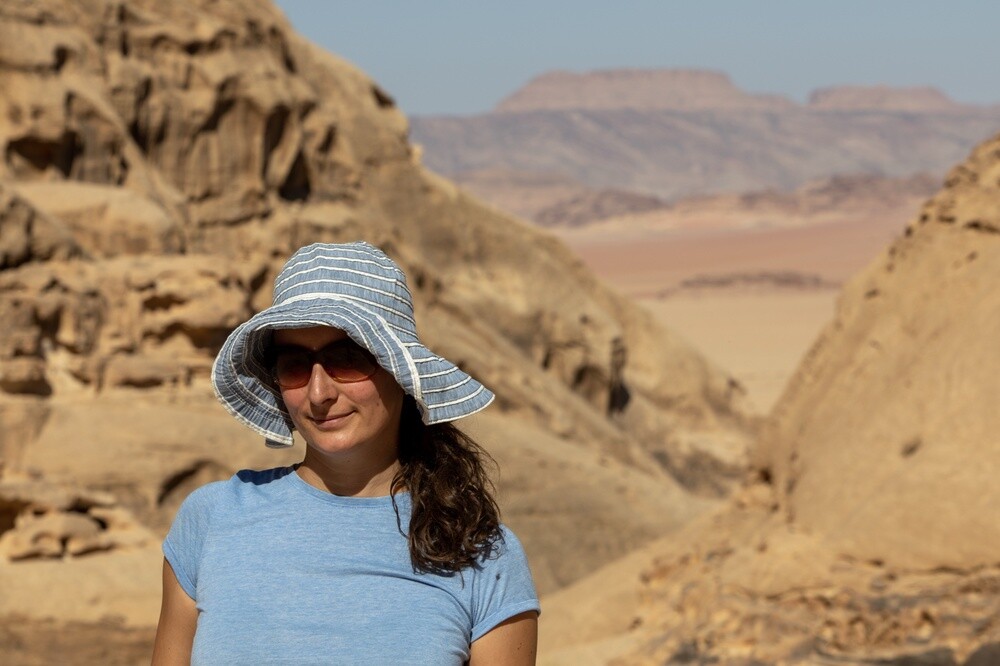
Jordan 2019: Petra, the Dead Sea and a Night in Wadi Rum

Photos
Photos on the map
Text
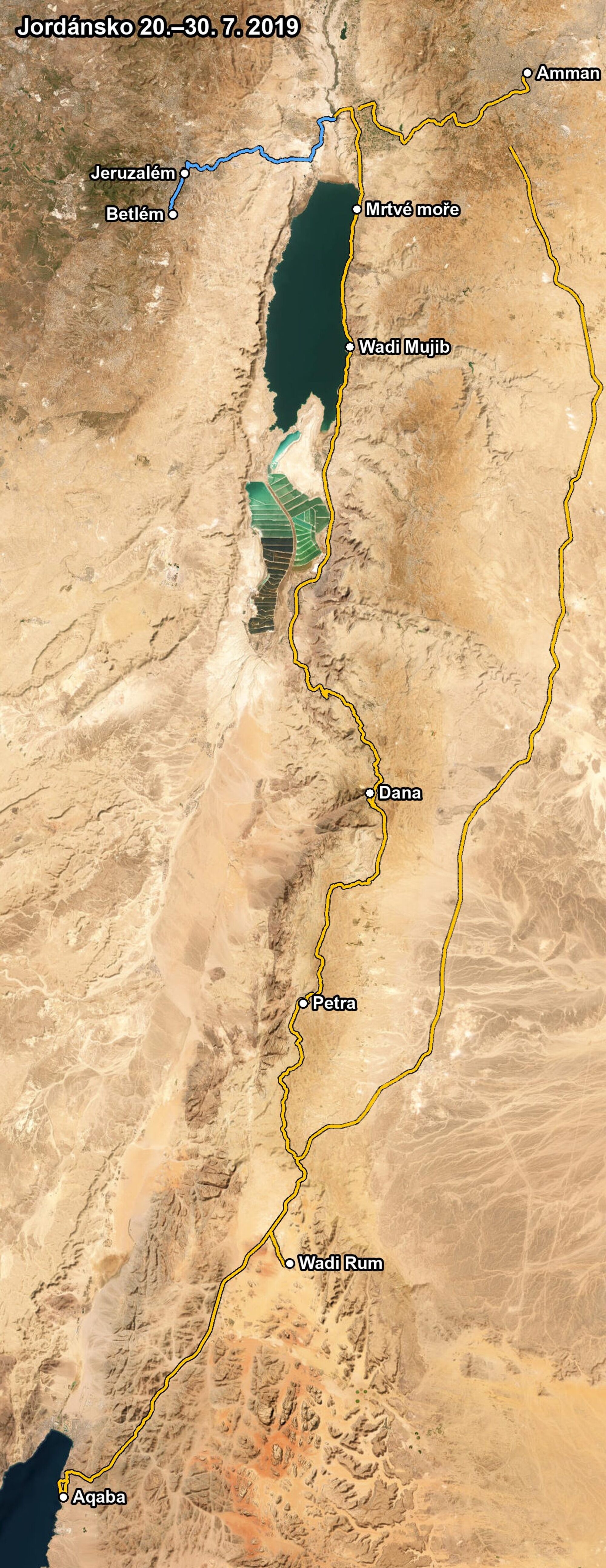
Map of the trip around Jordan on a satellite image
The trip 20–30 July 2019: in yellow by car along the roads (Amman, the Dead Sea, Wadi Mujib, Dana, Petra, Aqaba, Wadi Rum and back to Amman), in blue a side trip to Israel without the car. The line follows the roads between the places where the photos were taken.

Once a year Hanka and I head off somewhere without the kids, it's our tradition. In July 2019 we picked Jordan: eleven days by car from Amman to the Dead Sea, to Dana, Petra, Aqaba and the Wadi Rum desert.

In the middle of it we nipped over to Israel for two days, to Jerusalem and Bethlehem. That's a separate article.

Saturday 20 July 2019, Amman

In the morning Grandma Madla helped us out with the kids and before ten an Uber took us to the airport. The flight took about four hours. From the plane Jordan looked like a brown dry plain with maybe three trees growing on it. The car the hotel promised to send to the airport of course never showed up, but after a phone call somebody did come for us after all.

We stayed in a little hotel just a short walk from the Roman theatre. The room stank like a men's toilet, so I sniffed out a hidden scented ball and evicted it out of the window 😄

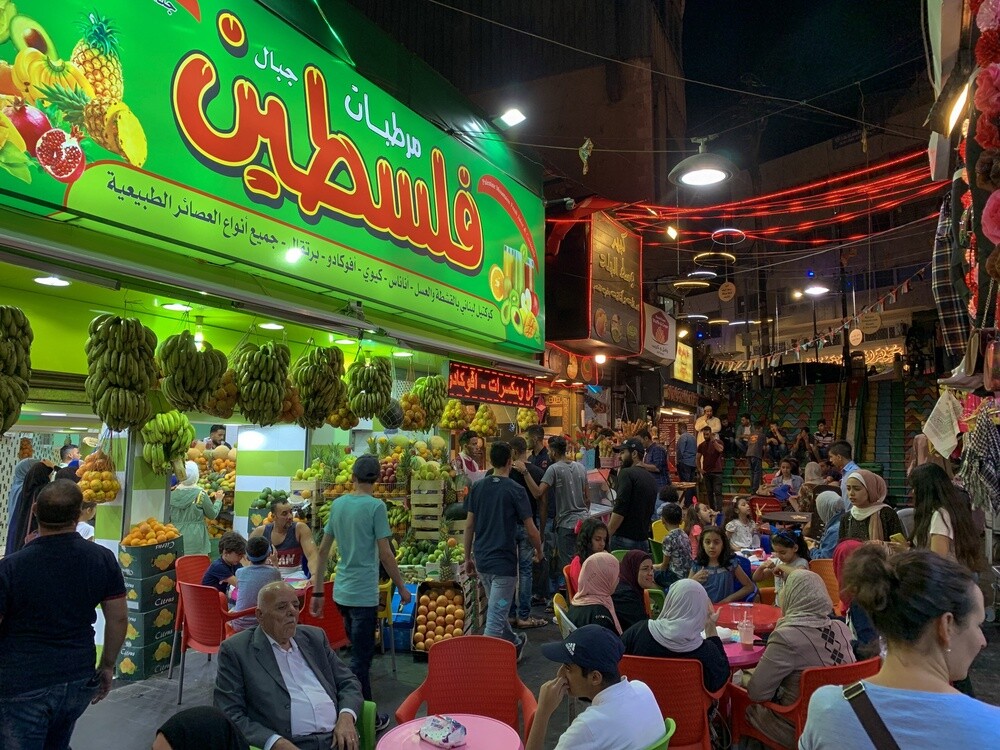
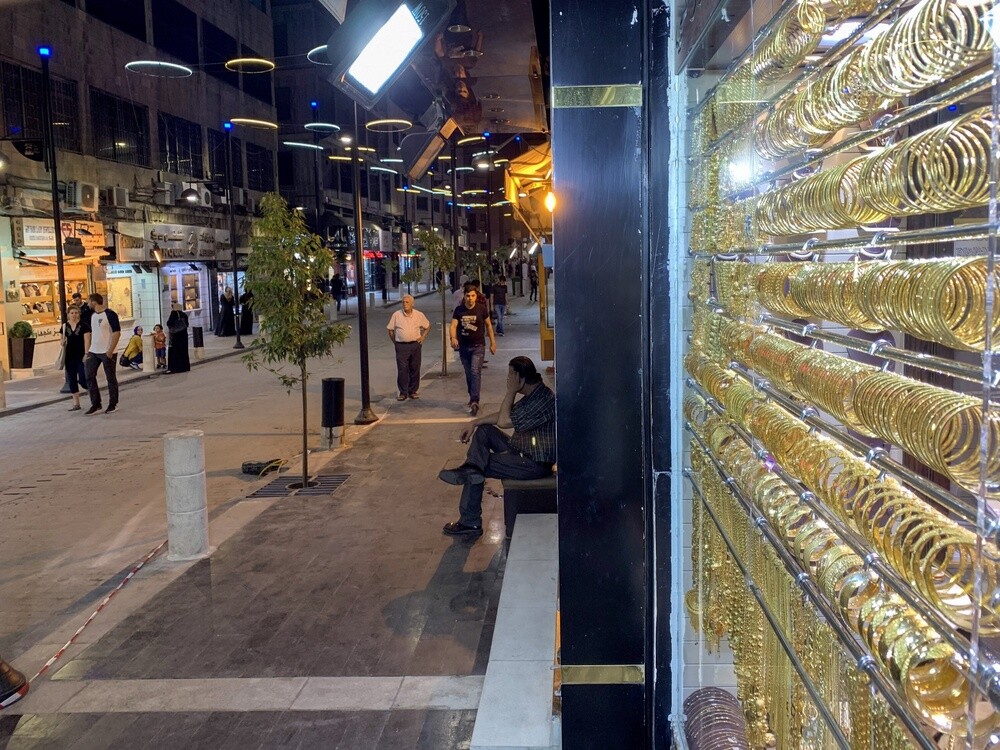
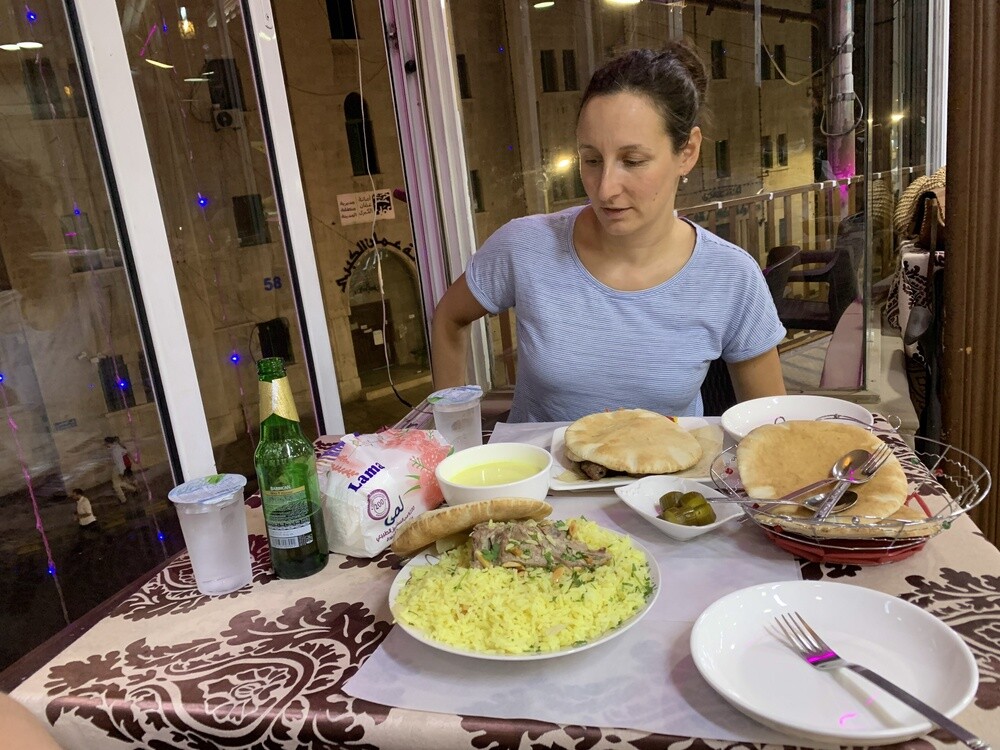
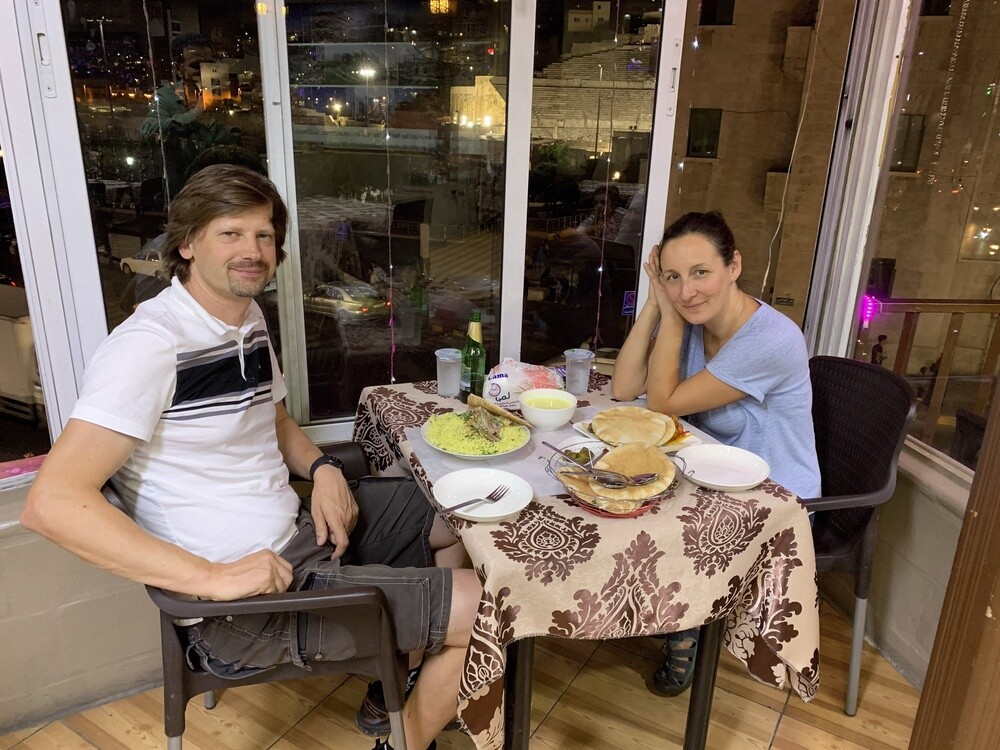
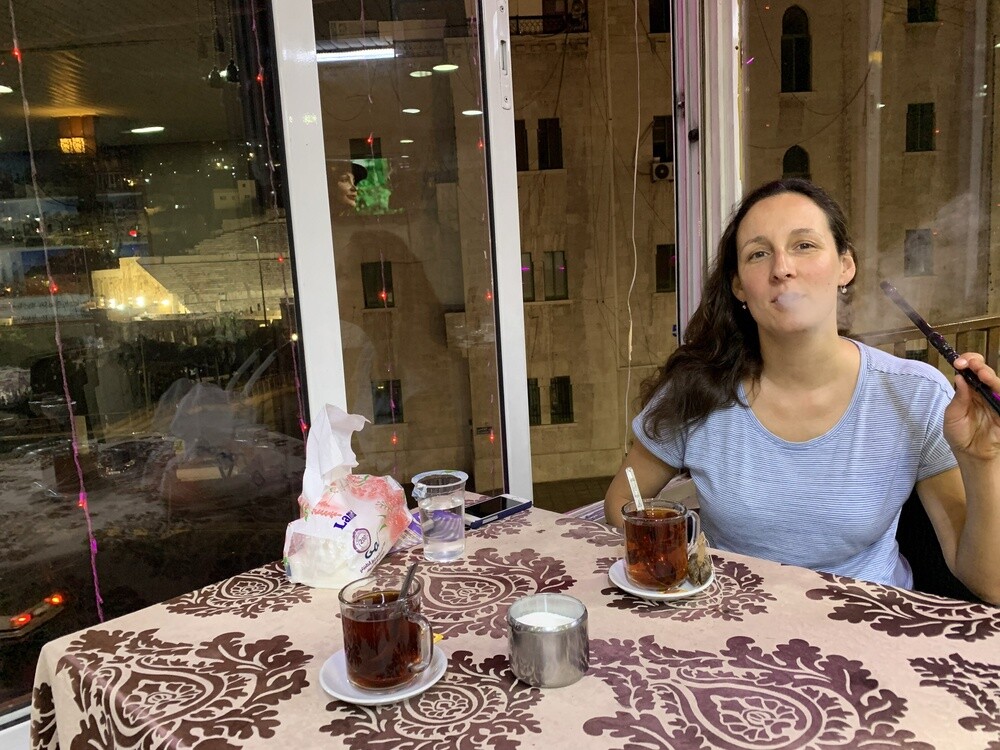
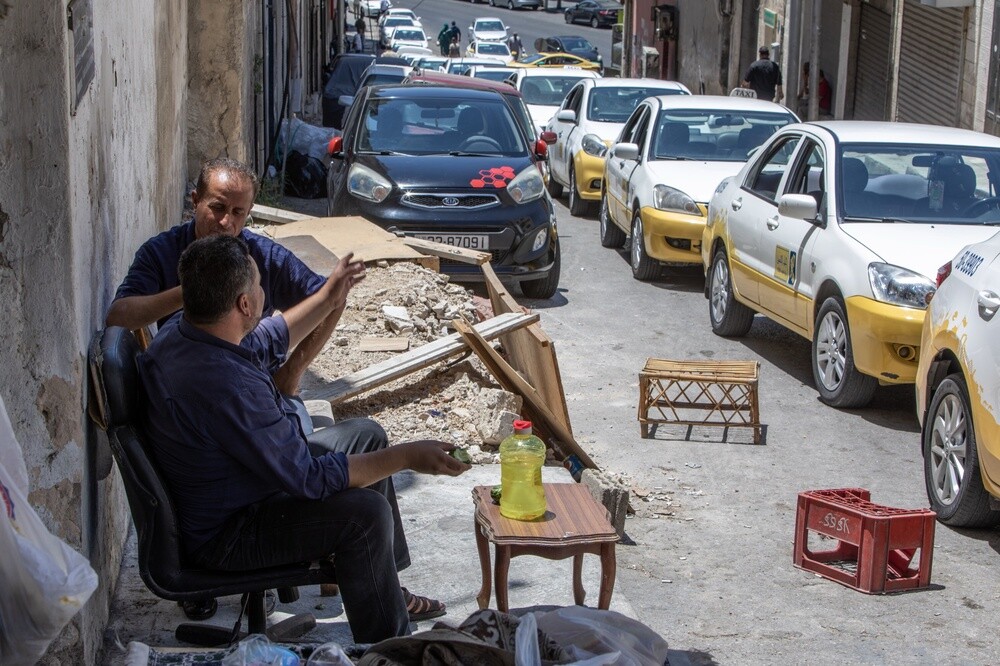
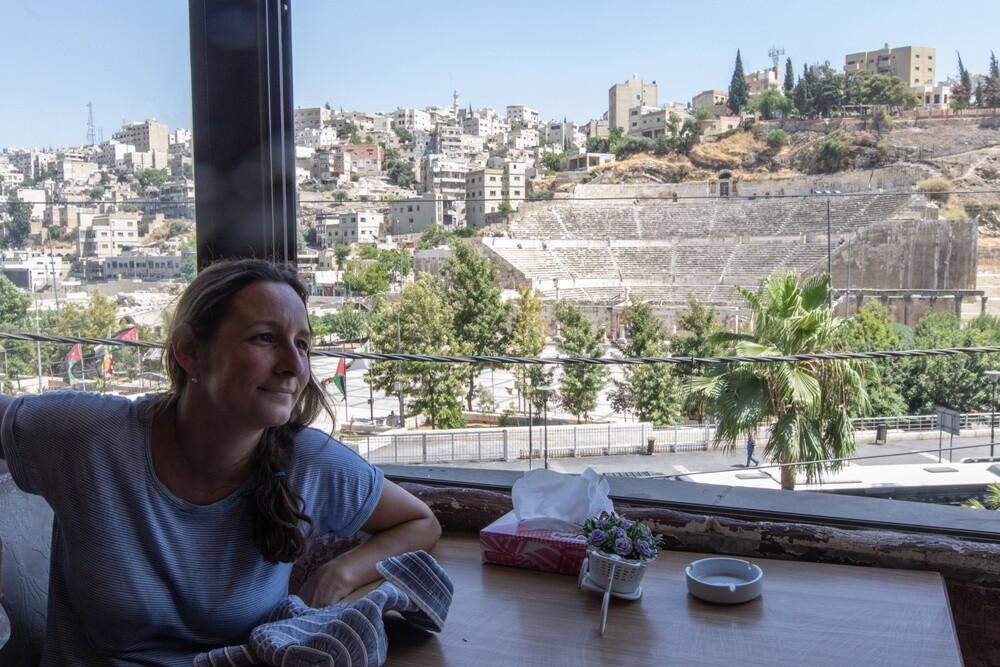
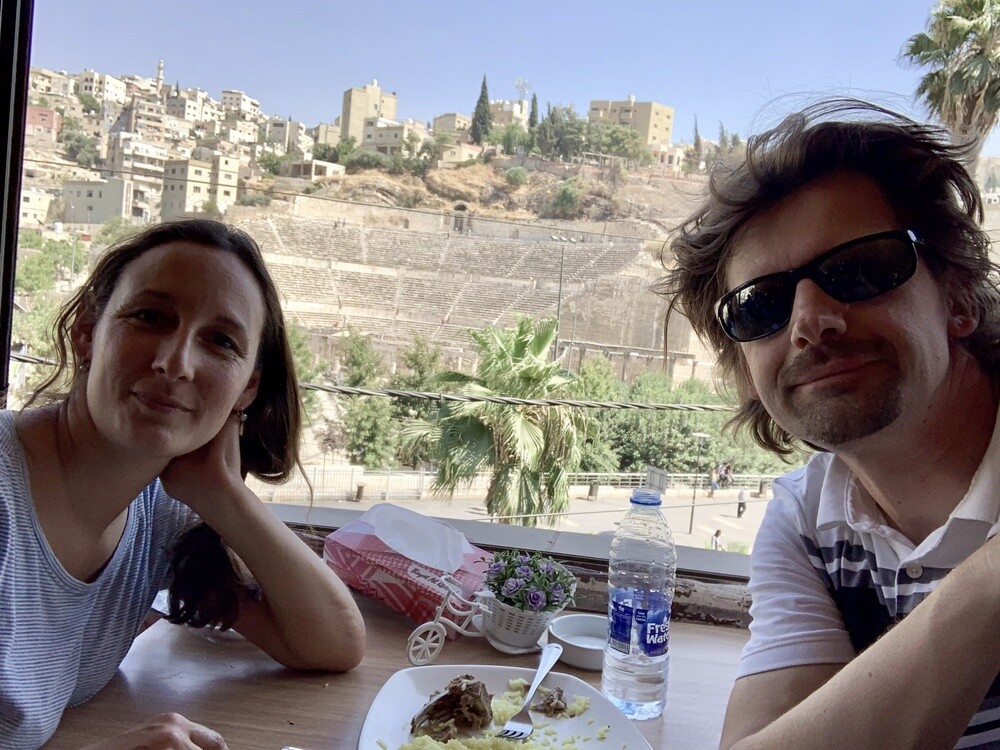
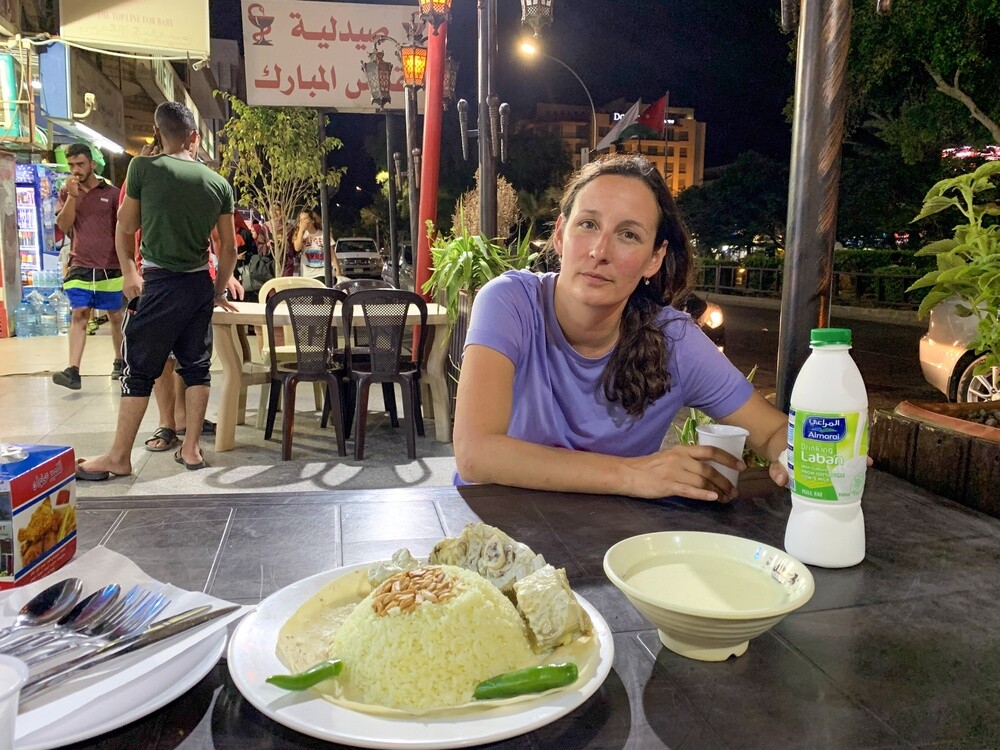
In the evening we walked into the centre. The streets were full of people, fruit stalls, a shop window with gold bracelets, honking and loads of kids. We had dinner in a restaurant on the second floor with a view of the night-time city and the theatre: rice with lamb and a water pipe to go with it. Otherwise I disapprove of smoking, but for a water pipe I make an exception.

Hana's diary: Jordan, day one. Packing finished at 3:30, when the youngest started crying and I discovered I had a tick on my belly, a tiny one you could hardly see and could hardly pull out. In the morning Grandma Madla came to help, which we really appreciated, as the Uber arrived before ten and took us to the airport. Meanwhile a complicated logistical operation awaited Grandma Madla at home: at 11 our daughter was leaving for camp, at 15 Monika was leaving, at 16 our son was coming back from camp and at 18 it was off to another camp. Poor Grandma Madla then also tidied the whole house, took both boys and drove them along with Grandpa to Kamenice to Tereza's. She was brilliant. On the whole it all worked out, except that on the plane I found out our daughter's camp hadn't been fully paid for. Luckily they let us off and we can bring the rest when we pick her up, which poor Grandma Madla will be arranging too.

Our taxi driver was an awful chatterbox, but quite funny. He slagged off Babiš like mad, told one story after another and stopped being likeable the moment he started slagging off Václav Havel too. Luckily we were almost at the airport by then, so we didn't even argue with him.

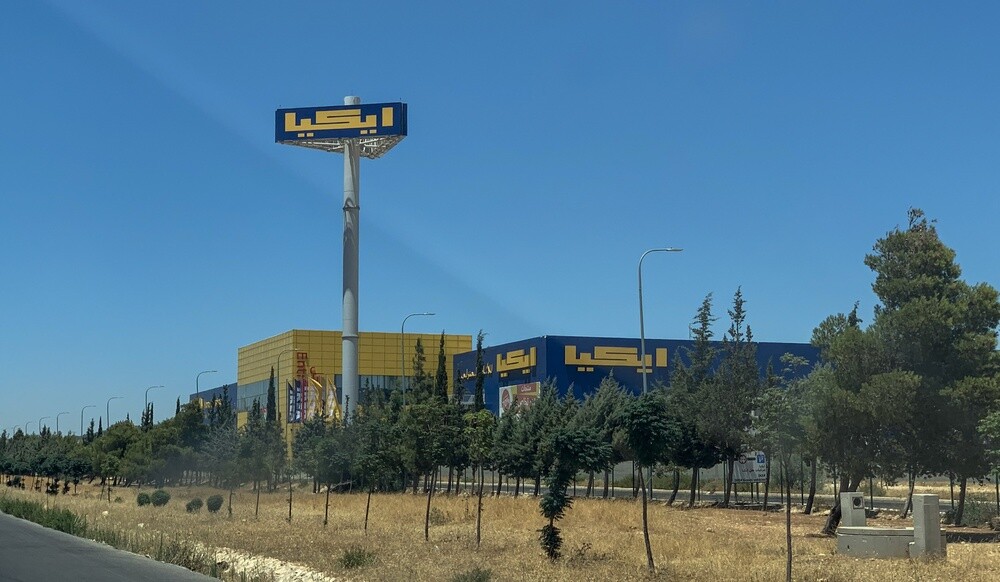
The flight was standard, no turbulence, about four hours. On the descent you could see Jordan and it looked pretty bleak. Completely brown, dry plains, nothing anywhere. It looked like there are about three trees in all of Jordan. The hotel promised to send a car for us to the airport, but nobody came. After a phone call a bloke turned up and drove us to Amman. On the way we saw an Ikea, which amused me, they had it written in the Latin alphabet and in Arabic.

Honza had booked a tiny little hotel right in the centre, a short walk from the amphitheatre from Roman times. The hotel was quite nice, quite clean. We had a tiny little room with golden curtains and our own bathroom. An insane stench wafted through the room, well, it was supposed to be a fragrance. It smelled like those balls they put in urinals. Honza went hunting until he sniffed out the ball hidden in the bathroom. We carefully wrapped it in a bag, put it out of the window and over the course of our stay it almost faded away.

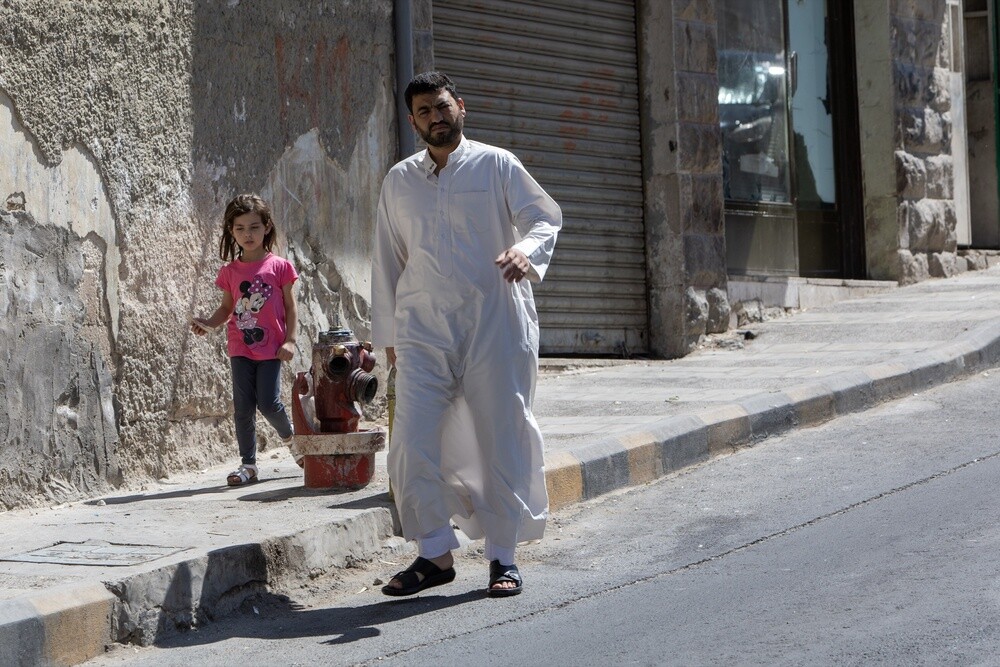
In the evening we went into town, on foot straight from the hotel. As in most southern countries, people come alive in the evening. Everywhere was packed, crowds, kids in pushchairs, loads of cars, honking, shouting. Millions of little shops open, crammed with goods spilling out into the streets. And of course the traditional dirt, mess, rubbish. Some houses in nice condition, some derelict. Stray cats and kittens, filthy pavements. It probably almost never rains here, but something has been spilled everywhere, so everything is sort of grimy.

What is surprising, though, is that all the people are absolutely well groomed. Mostly slim, combed, neatly cut hair. The men have very carefully trimmed hair and beards and are cleanly dressed. The women mostly wear a hijab. Either just a headscarf with ordinary clothes, or a robe down to the ground. Sometimes their mouths are covered too, sometimes only a slit for the eyes shows, the so-called letterbox. But they're all terribly clean, well groomed, usually heavily made up and they come across as confident. The women here aren't downtrodden poor things. We don't know what goes on at home, but they chat away cheerfully in the street with men and women alike, drag their children everywhere with them and talk on the phone.

There are terribly many children here and they're all carefully barbered. We didn't meet a single child with overgrown hair like for instance our kids. Washed, in clean clothes, but then they play outside in the dirt and the rubbish. On the first evening we saw about two children smoking a water pipe. I don't know if it's harmful, but it took me aback.

We walked the streets for about two hours. All sorts of smells and odours wafted around, from food, from rubbish and from the drains, all mixed together. It was interesting. And on top of that endless shops selling absolutely everything: modern nice shoes, suits, trinkets, spices, perfumes, all kinds of food. Sometimes it's more like stalls and sometimes they're quite posh, well-fitted shops.

In the end we sat down in a restaurant on the second floor with a view of the amphitheatre. We had rice with lamb and Arabic bread stuffed with meatballs. To finish we had a shisha, that is a water pipe. Otherwise Honza disapproves of smoking, but for a water pipe and a cigar he makes an exception for some reason. A water pipe is fun, the smoke is supposedly filtered through water, it bubbles away in there, it's pretty good. When Honza puffed too much his head spun terribly, but he blew out the smoke with delight through his mouth and especially his nose and felt like a dragon in a fairy tale.

At the next table sat a mother, maybe a bit older than me, insanely made up, powdered to a deathly pallor, in a hijab, and with her a daughter of about twelve and a younger son. The son spent the whole time playing games on his phone and the daughter sipped a soft drink and occasionally took a puff on the water pipe. This restaurant was quite expensive, probably a posh place. Otherwise the prices here are similar to ours, the hotel was rather cheaper. We'll see how it is outside the capital.

Sunday 21.7.2019, Amman

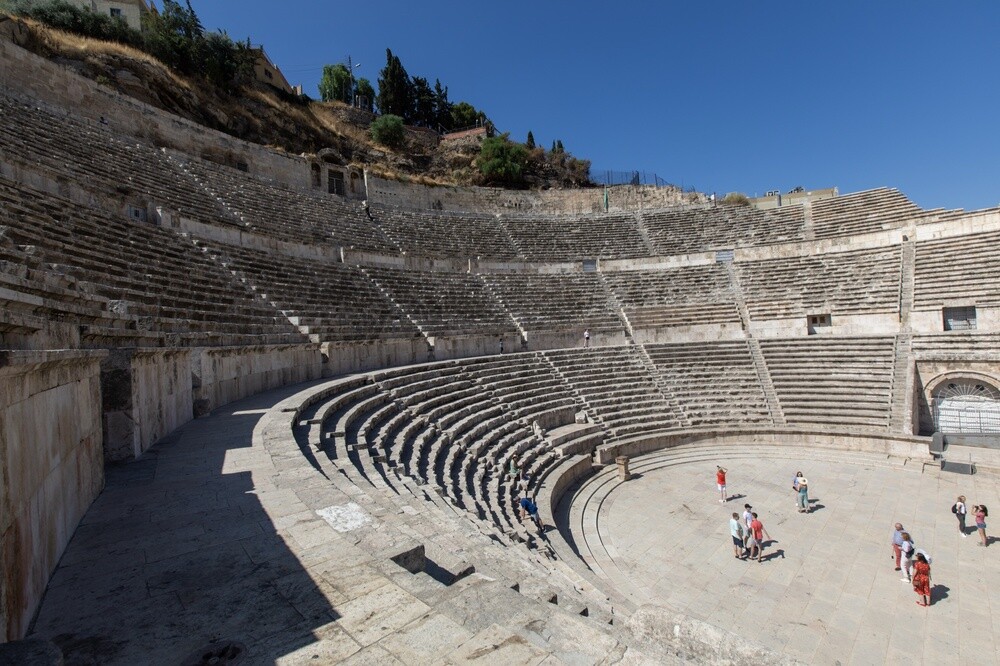
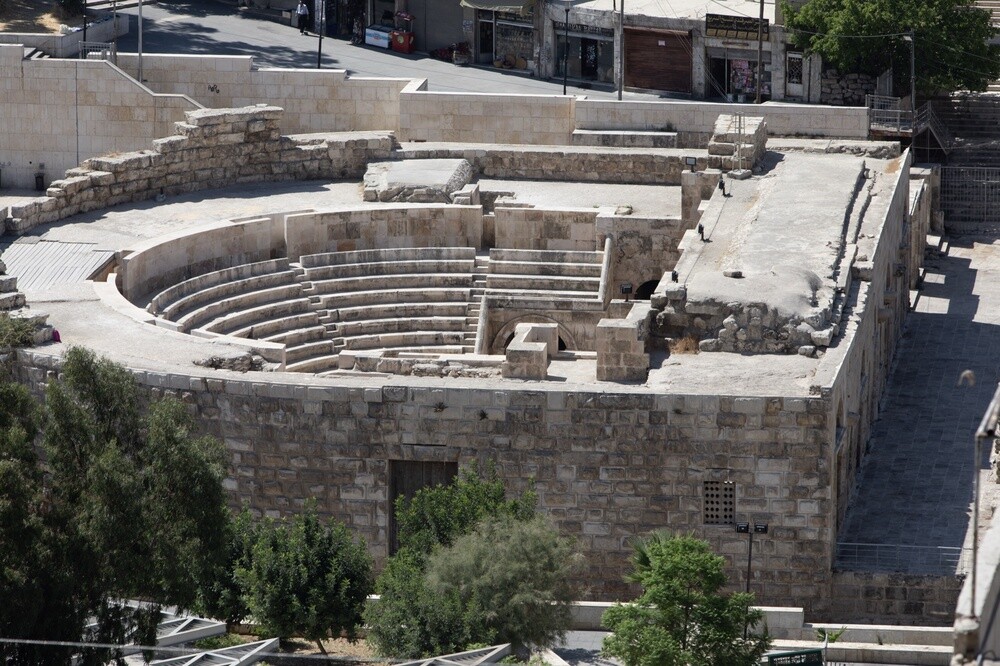
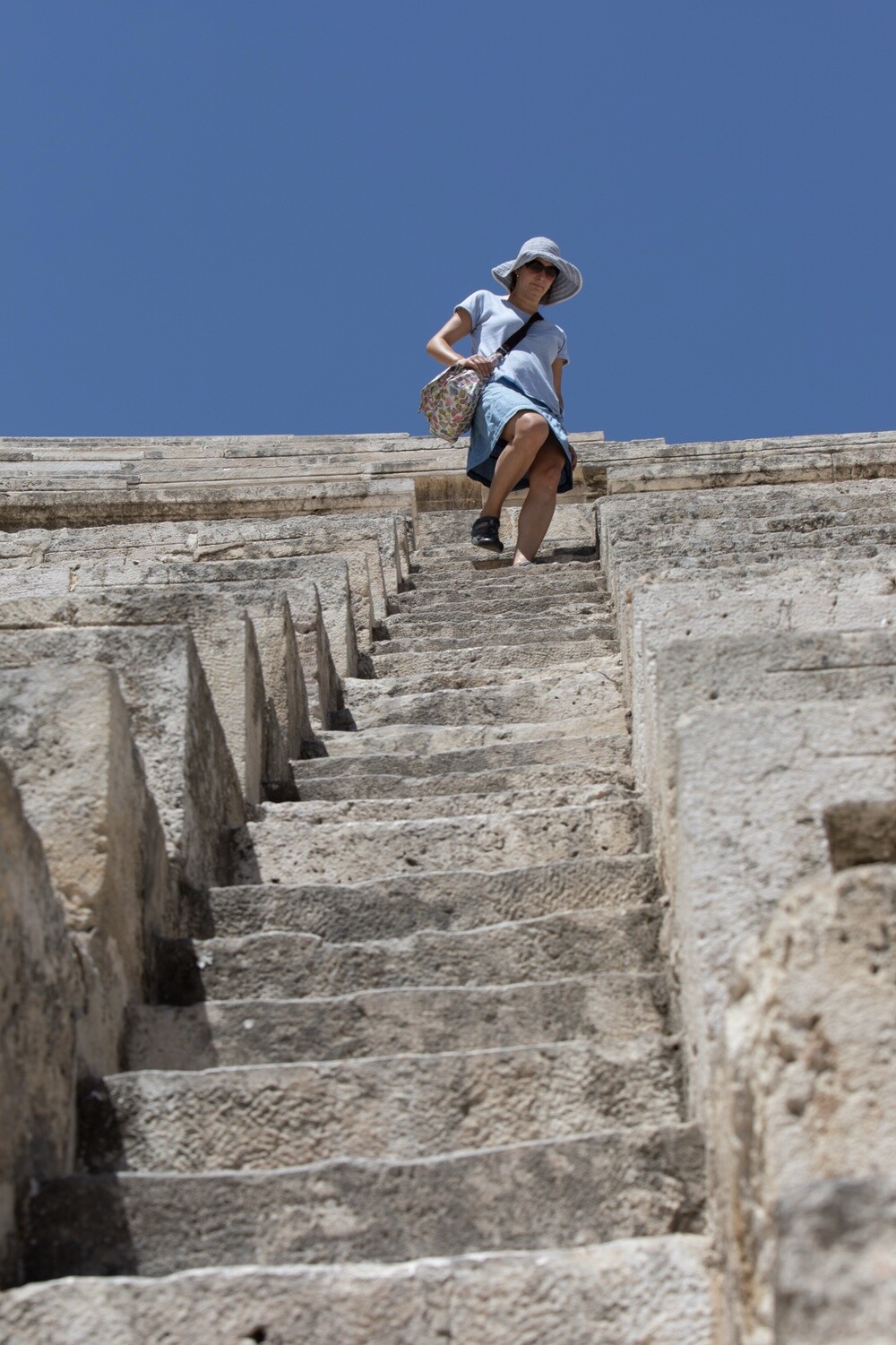
In the morning I went out to photograph the back streets and then Hanka and I met up at the Roman theatre. Climbing up to the top rows is hard work, every step is a different height. Right next to it stands a smaller odeon.

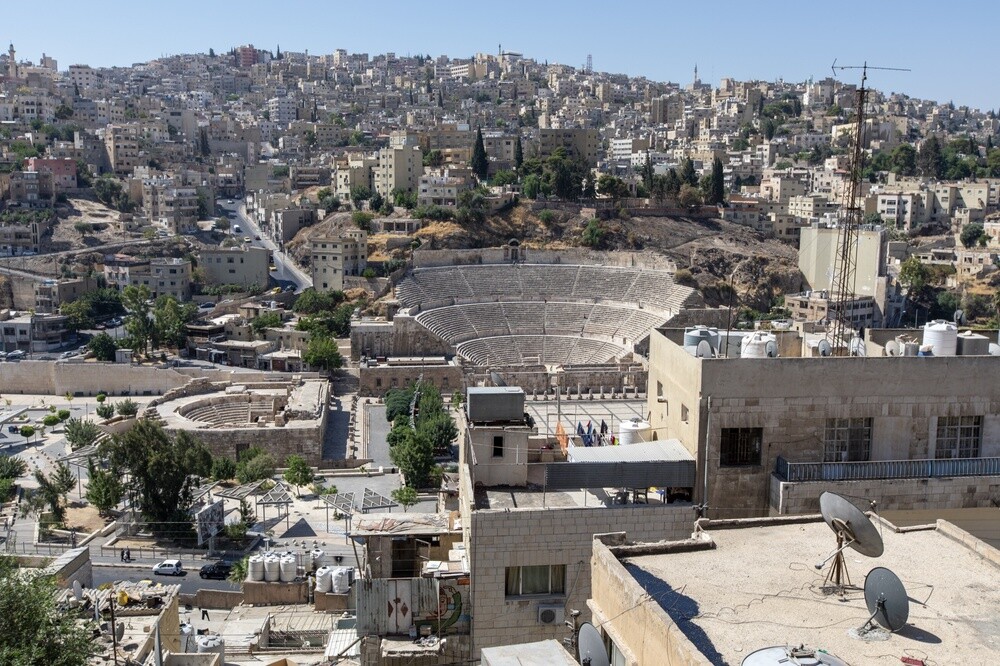
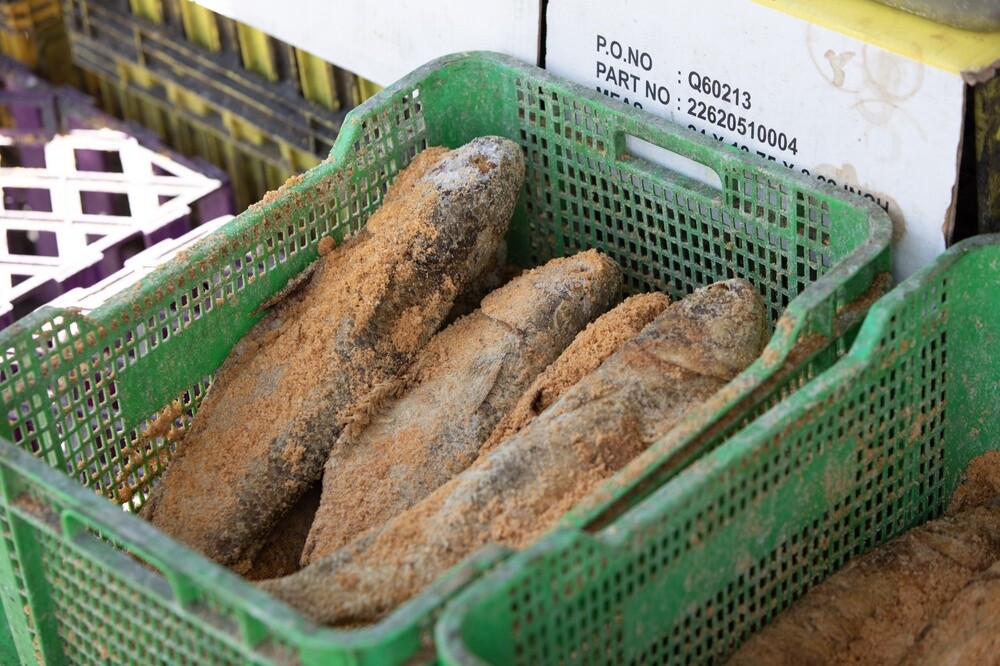
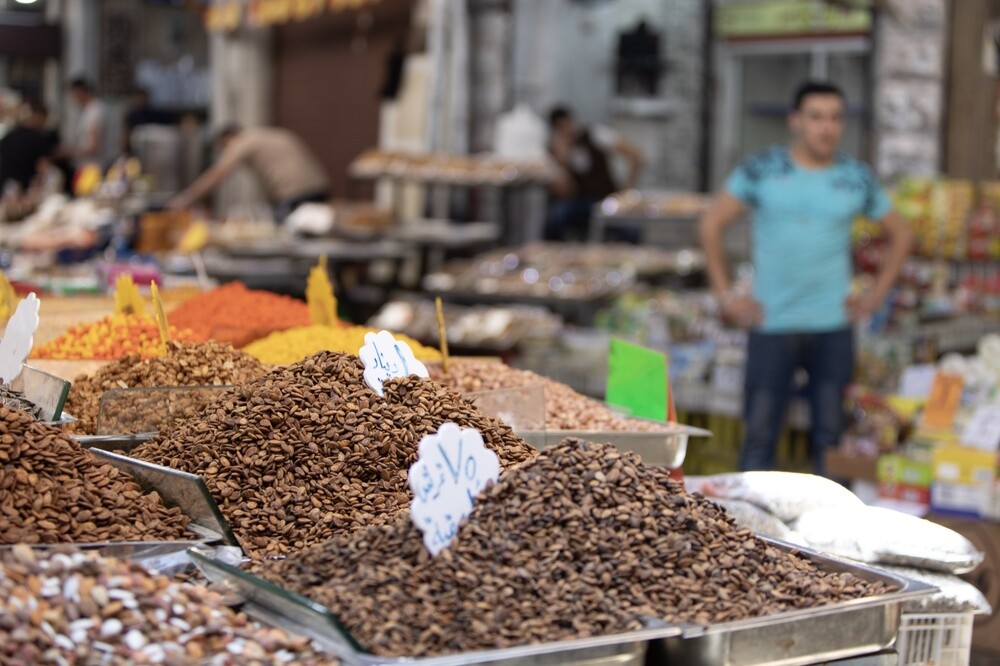
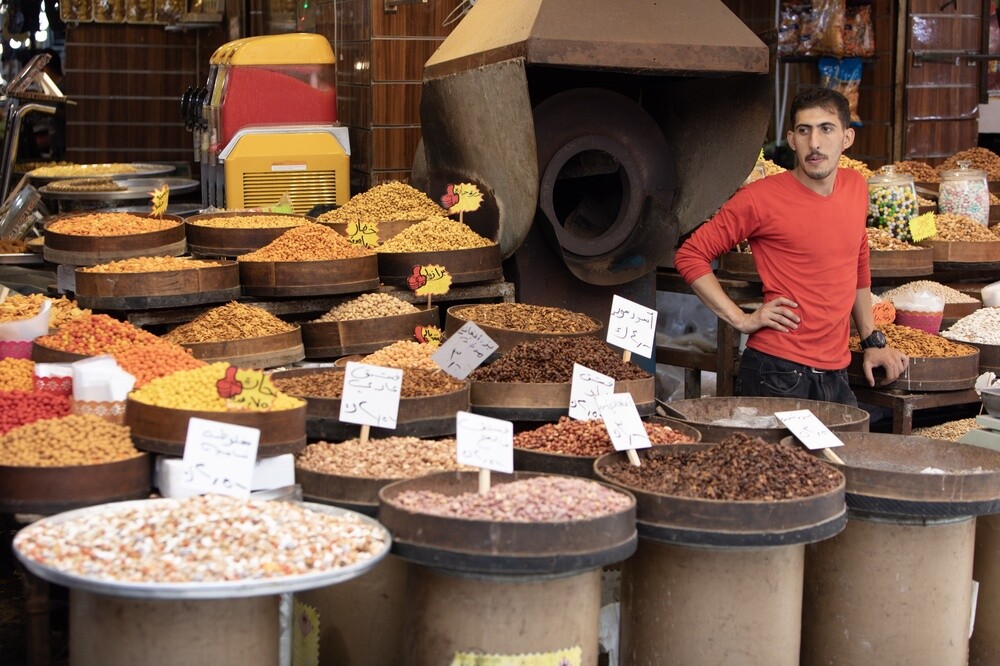
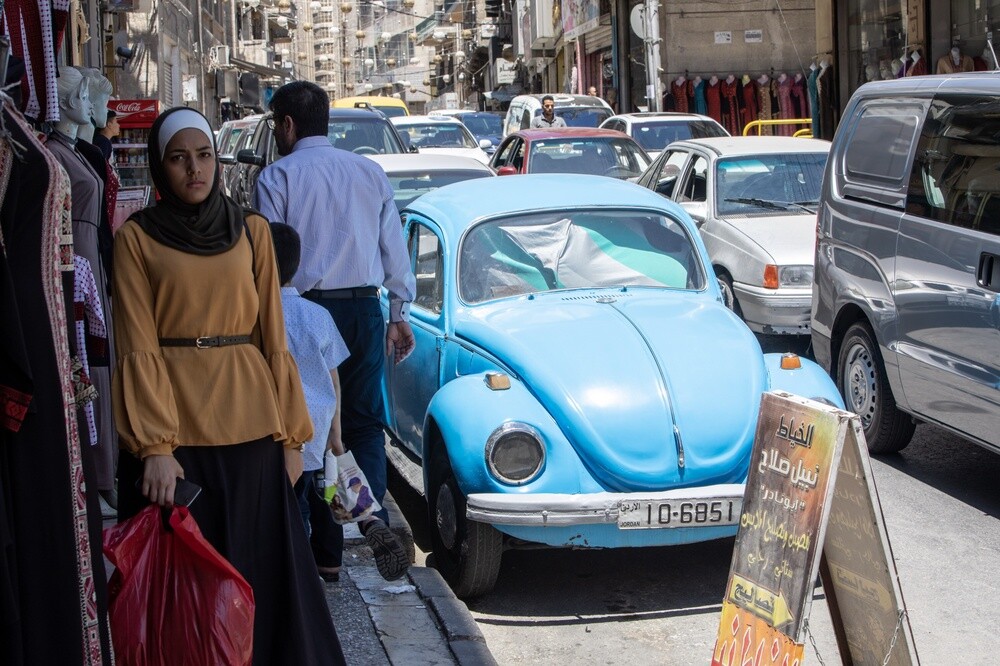
We climbed up through the lanes above the theatre. Crumbling houses, steep stairs and views of a city made of beige cubes stacked over the hills. Down at the market bread in crates, nuts, spices in sacks, meat on hooks and an old blue Beetle parked among the cars.

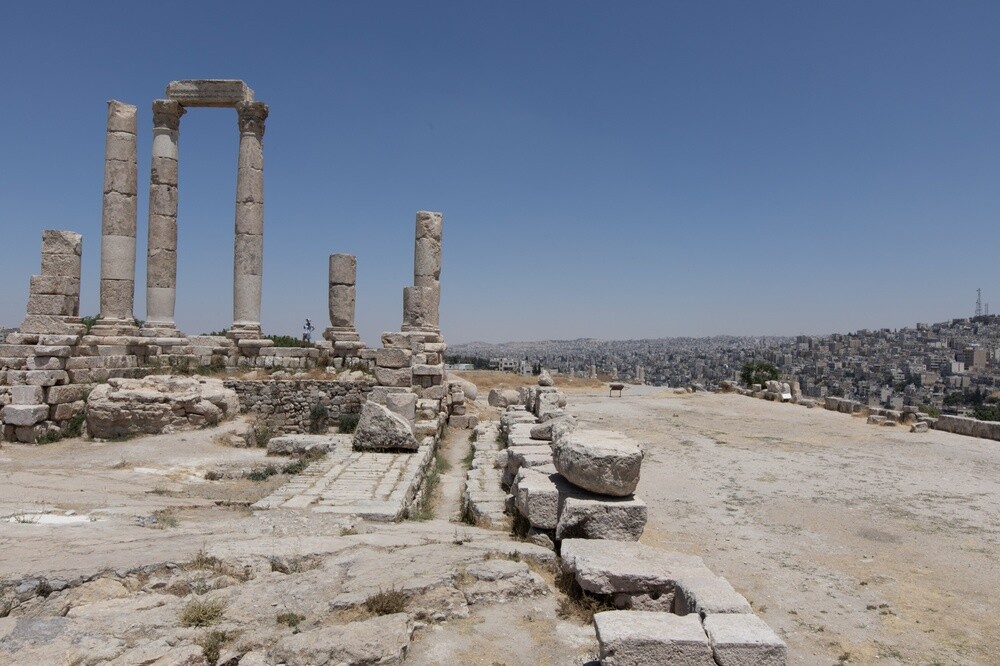
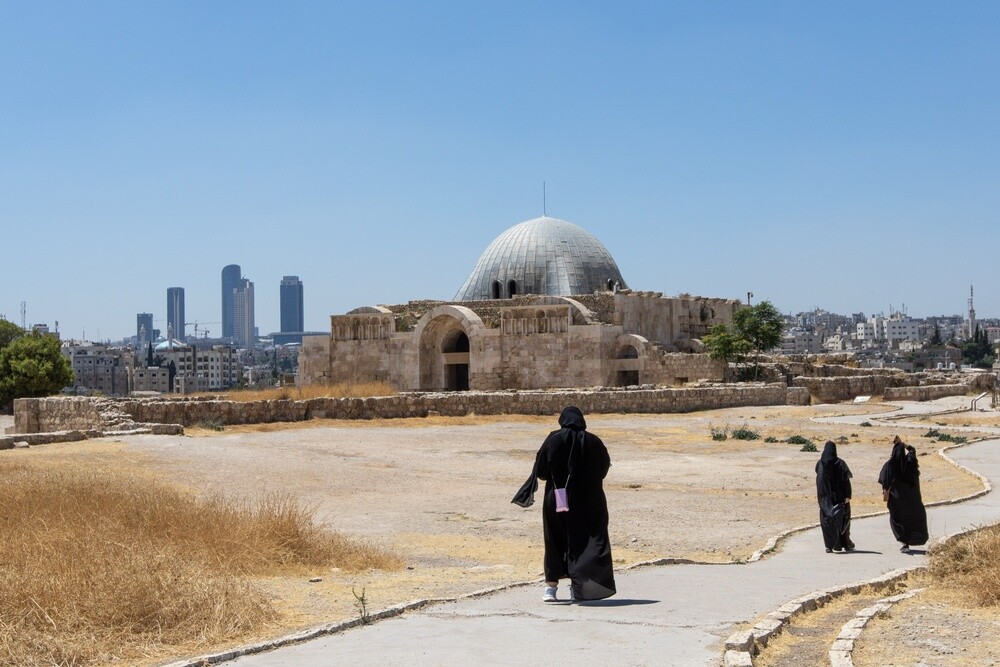
Up on the Citadel stand the columns of the Temple of Hercules and the Umayyad Palace with its dome, and there's a piece of a giant stone hand lying there, bigger than Hanka. In the archaeological museum we met two Czech women from the same plane. Then a break in a café with a view of the theatre.

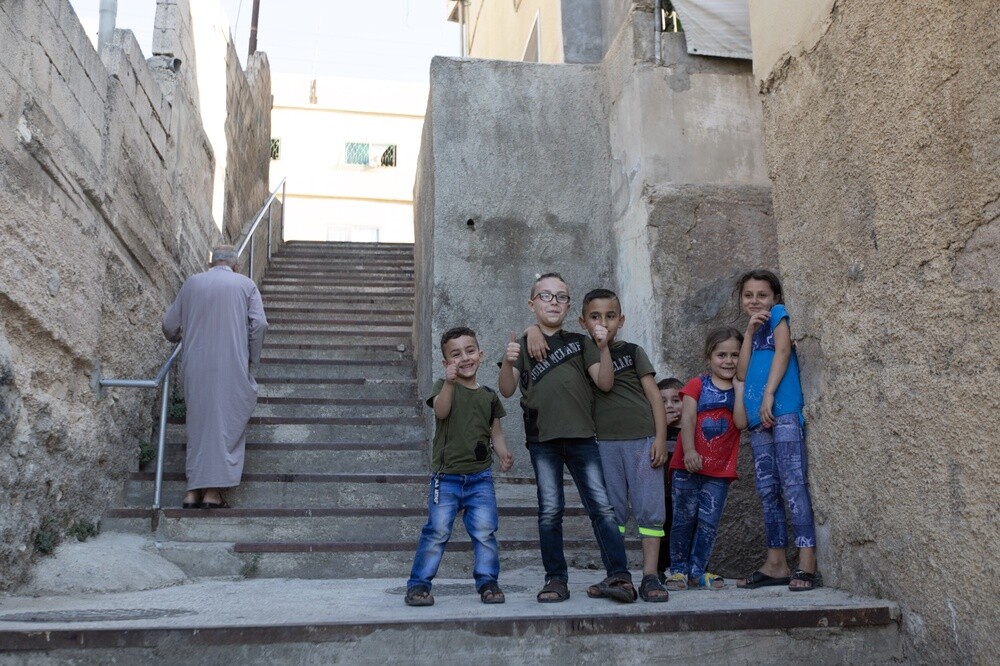
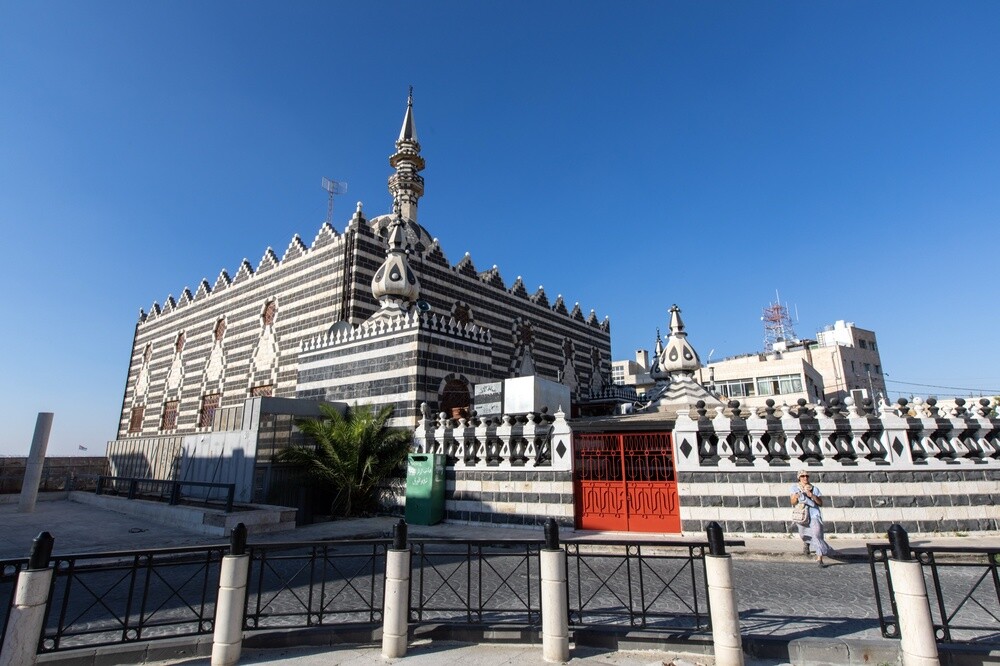
In the afternoon came a cold shower. At the rental place where I'd booked a car back in Prague they told us they'd rented it to somebody else. Elsewhere they wanted three times as much. In the end a mate of our landlord lent us a jeep. Then we walked all the way up to the mosque on the hill, which was already closed. On the way through neighbourhoods where tourists don't go, kids shouted hello at us and two of them something ruder, boys rode their bikes around a black-and-white striped mosque and one gang was getting ready to ride a plank down a long flight of stairs.

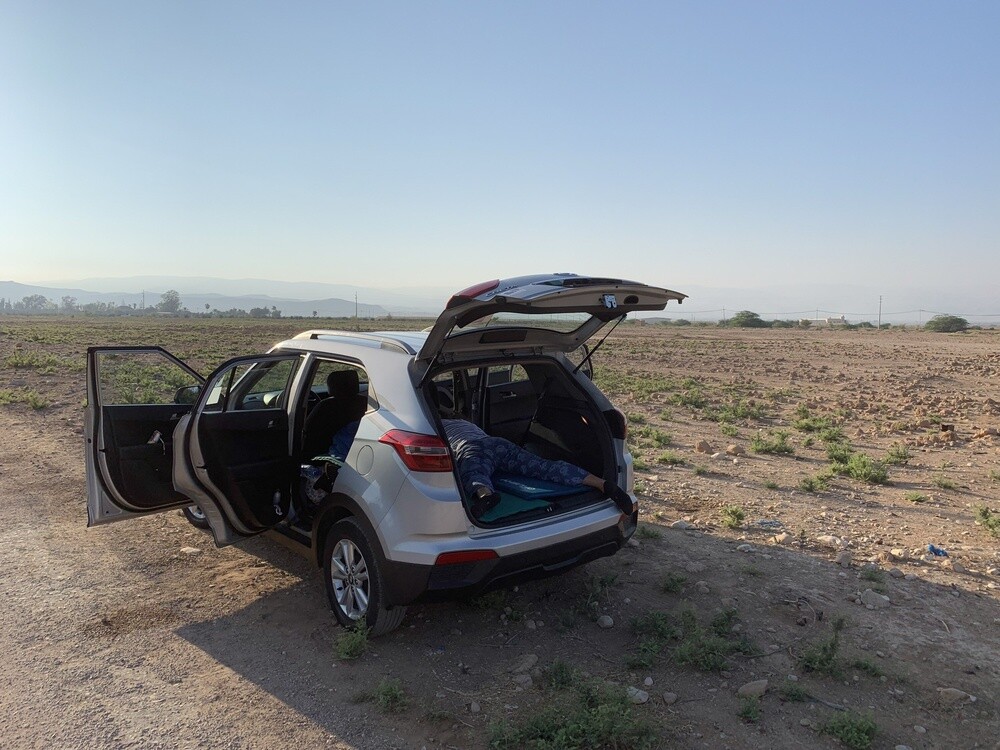
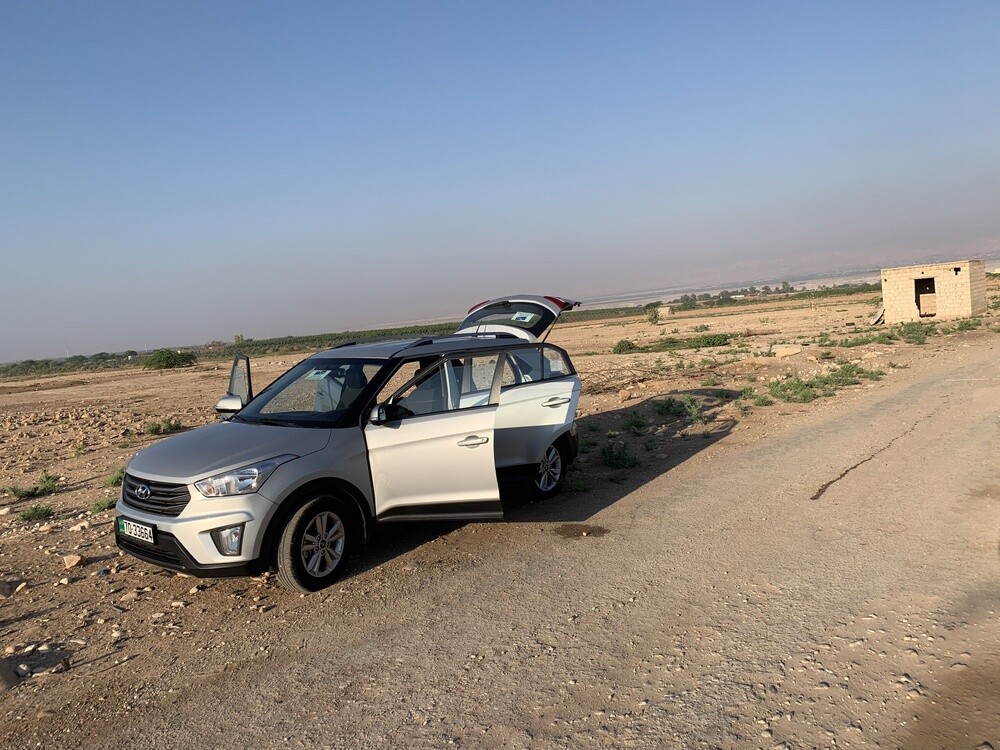
In the evening we drove out of the enormous Amman towards Israel. The border closes at nine, so we pulled off onto a dirt track and slept in the car. It was the worst night of the whole trip: heat, doors open, a barking dog and above all the midges, which chewed up every uncovered centimetre of Hanka. At four in the morning the muezzin topped it all off.

Hanka's diary: Jordan, day two. In the morning Honza went off to take pictures in the local back streets. Then we met at the amphitheatre, which is just round the corner from our hotel. It's beautiful, huge, completely preserved, probably restored a bit. Hauling ourselves up to the top row was hard work, every step is a different height and some are really high. The people who sat up there must have been pretty fit and must have watched out not to tumble down. But the view is lovely even from the highest tiers, maybe back then they watched the actors from above.

Then we walked through the city, bustling everywhere, though not like at night, and we got to the Citadel, where there are remains of a temple from Roman times. Not much is left after all those centuries, but some of the columns are truly magnificent, enormous. There's a piece of a hand from some statue, huge, just that bit of hand is bigger than me. And an archaeological museum with loads of interesting things. We met two Czech women there and it turned out they'd flown in on the same plane as us.

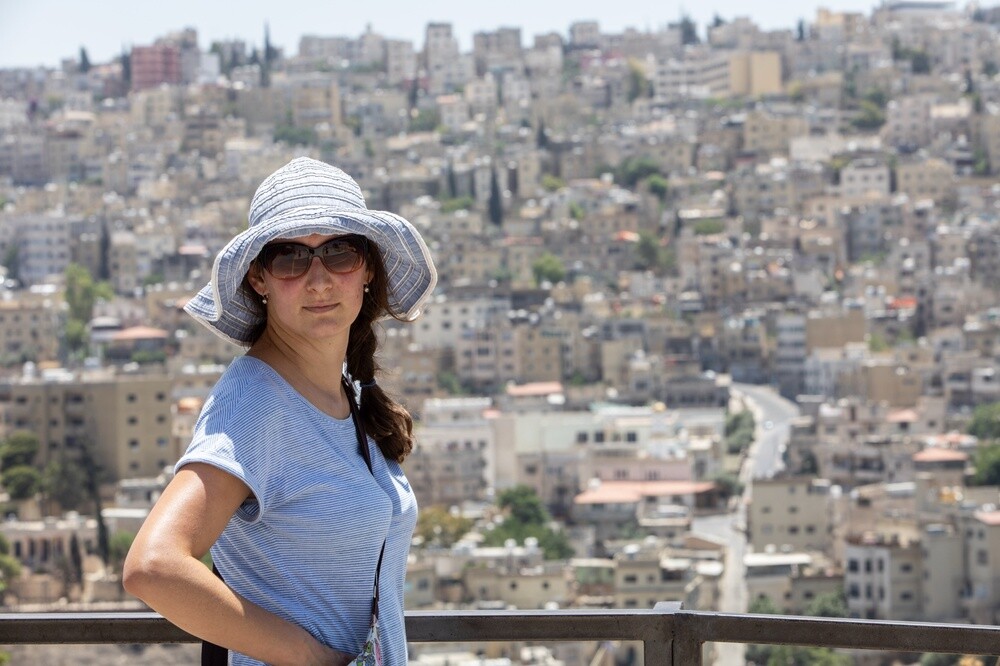
From the Citadel, which is supposedly on the highest hill in Amman, there was a lovely view, even though other hills looked just as high or higher to me. Amman is built on hills and it looks nice how they all fit together. What's interesting is that all the houses are one colour, a sort of light sandy, beige or greyish-beige. There wasn't a single house rendered in a different colour. Either they're rendered in this colour, or not at all, just bare stone. It feels pleasant, they all have a similar shape, cubes, blocks with a flat roof. And as far as the eye can see, little houses all over the hills. In one spot a huge Jordanian flag hangs from an insanely tall mast, maybe seven metres by four, above all the houses.

For lunch we went to a restaurant where we got basically exactly the same food as yesterday: a piece of lamb on the bone and rice. It was good. At the car rental place, where Honza had booked a car all the way back in Prague, they told us the car was gone, they'd simply rented it to someone else, and weren't even embarrassed about it. Unbelievable. Honza found another rental place online with a fairly cheap car, big enough that you could even sleep in it. He called them and it turned out they might have the car, but it costs about three times as much. That annoyed him. And both were pretty decent brands, ones you get in America too. In the end some buddy of our landlord offered to lend us a sort of jeepy car for 40 dinars. One dinar is a bit more than a dollar.

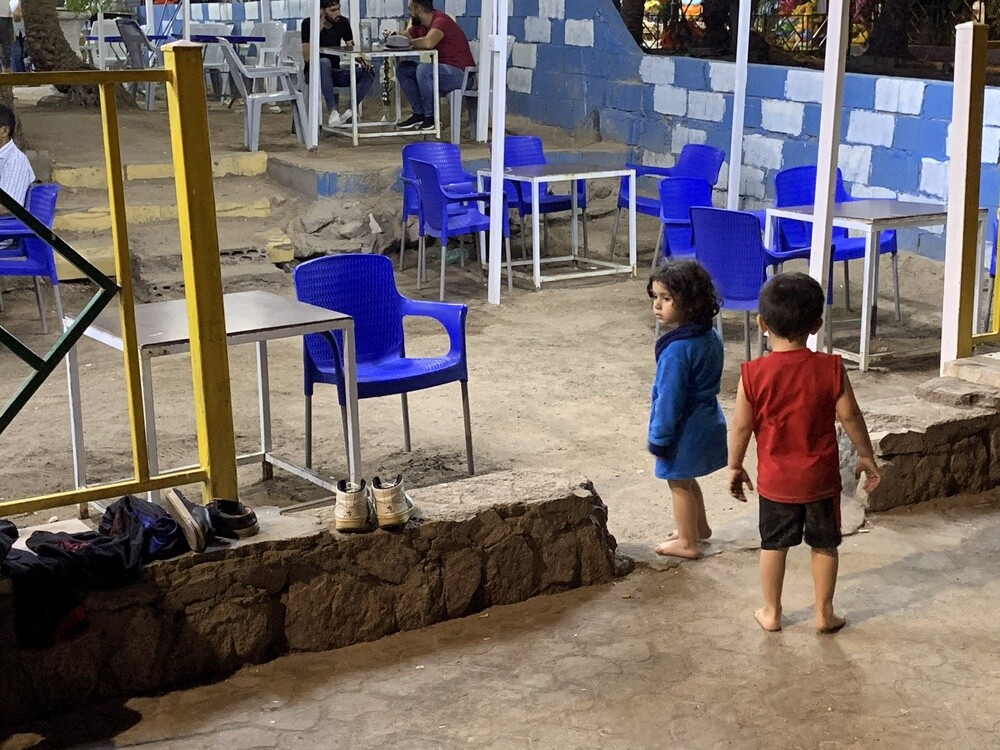
We also went to one mosque, which was quite far up a hill, but unfortunately it was already closed. They probably wouldn't have let me in anyway, even though I had a long skirt and long sleeves. I need to find out whether women are even allowed in. On the way we went through neighbourhoods that aren't for tourists. There was insane filth, mess and terrible numbers of kids. Beautiful children, all of them clean, carefully cut hair, combed, and they play in that mess among the rubbish. They were quite sweet, they called hello, how are you at us, and two kids one after the other yelled fuck you, man, at Honza and cackled about it enormously. We also met kids who, since the poor things don't have snow here, had laid a big plank on a never-ending flight of stairs and were about to ride it down. Whether they killed themselves we didn't see, we preferred to leave.

Arab children are terribly pretty, all curly-haired, mostly with captivating black eyes with long lashes, sometimes light brown and sometimes even blue-green. Most Arabs strike me as good-looking people altogether. The women would surely mostly be beautiful, but since they're covered up you can't tell. They have nice faces, nice eyes, little mouths, cheeks, but that awful rag on their heads and usually on their bodies too. We noticed that young lads from about 16 to 25 are here in terrible numbers sort of scrawny, hunched, even if they have those captivating long-lashed eyes. Older men are mostly hunks, that hairy, bearded, dark type.

Finally we picked up the car and packed our things. Our landlord was dreadfully pushy, but kind and sweet, he kept forcing something on us and stressed a thousand times that we should feel at home with him and that we have a home there forever. And he hugged us, that was awful, with Honza a handshake is enough. We stocked up on water, but of course we're afraid of the local tap water, so only for washing, since we were going to sleep in the car. Honza also stopped for petrol and food at a Carrefour, which was no different at all from a European one.

Then we got a shock. We were still in Amman, but suddenly it was as if we were driving through a completely different city. Several kilometres of terribly wealthy houses, government buildings, offices and luxury shops of European and American brands. Maybe the dirt just wasn't visible in the dark, but it seemed to us there was far less of it or none at all. Then we drove out of it again and had falafel at a stall, chickpea balls coated and fried, in pita bread with vegetables. I keep wondering whether to eat this stuff here or not. We don't drink the water, Honza isn't really afraid of the food, I'm a bit afraid of vegetables, but I'll probably risk it too. At the market we bought apricots and peaches, we washed them in that contaminated water and so far nobody's shat themselves.

It took us ages to get out of Amman, it's a giant city. It's about 40 km to the border. The speciality of the Jordanian-Israeli border is that you can't drive across it, you have to cross some other way, and it's only open until nine in the evening. We'd have got there after nine, so we decided, as we'd originally planned, to spend the night in the car near the border and cross in the morning.

We pulled off onto some dirt track and what followed was one of the most horrendous nights of my life. We were congratulating ourselves on how nicely we'd snooze, we made up our nest, folded the seats down, even though there was a sort of tooth sticking into us. All day it had been bearable and in the evening at the stall almost chilly, but then we apparently dropped into a valley and it got terribly hot, that dull, unpleasant kind of heat. We each used up one bottle of water from the hotel and washed ourselves naked, which was great. Hopefully nobody saw us, only a dog kept barking at us from a distance.

Then it started. Firstly it was terribly hot in the car, so we had to keep the doors open, otherwise you couldn't breathe in there. I was a bit on edge about whether someone would jump us. Secondly mosquitoes were biting, but mainly these tiny midges that didn't buzz and were almost invisible, but bit like hell, the hellish bastards. Now, on day two, their bites are far worse and itch horribly. I was wearing pyjama trousers and a T-shirt, but they chewed up every millimetre of my body that wasn't covered. I put on socks, but around the ankle between the sock and the trouser leg I had about 60 of them on each leg. They crawled under my T-shirt too, onto my neck, my hands, I've even got them on my fingers. I feel for Ondřej and for anyone who ever had eczema and was forbidden to scratch, it really is enough to drive you mad.

During the night I got up, hunted for the repellent in the dark and the heat and meanwhile more of the little swines were eating me. Then it turned out my sleeping mat had a puncture, so that lump was digging into me horribly. On top of that the mutt was barking. I shone a light at him, his eyes glowed in the dark and he kept inconspicuously coming closer, he was somewhere between 20 and 50 metres away. I absolutely couldn't fall asleep, I kept tossing and turning and swatting at those disgusting midges. At four in the morning the muezzin started calling people to prayer from the minaret. I don't know if I slept an hour. At least I was lying down, but it really was an awful night.

Amman
The capital of Jordan, built on many hills. In antiquity it was called Philadelphia.

Roman theatre
Built in the 2nd century under Emperor Antoninus Pius, it has about 6,000 seats and performances are still held there occasionally.

The Citadel
Jabal al-Qala hill above the centre, inhabited since prehistoric times. The remains of the Temple of Hercules from the time of Marcus Aurelius and the 8th-century Umayyad Palace stand here.

Monday 22.7.2019, to the Israeli border

Morning in the Jordan Valley, 279 m below sea level, boot open and sleeping bag out. We left the car on the Jordanian side and took a bus across the King Hussein Bridge into Israel. Our passports passed through seven pairs of hands on the way and Jerusalem is only 40 km from here, but the crossing took about four hours. Two days in Jerusalem and Bethlehem are in the article about Israel, together with Hanka's diary.

King Hussein Bridge
A border crossing over the River Jordan between Jordan and the West Bank, on the Israeli side it's called the Allenby Bridge.

Wednesday 24 July 2019, the Dead Sea and Wadi Mujib

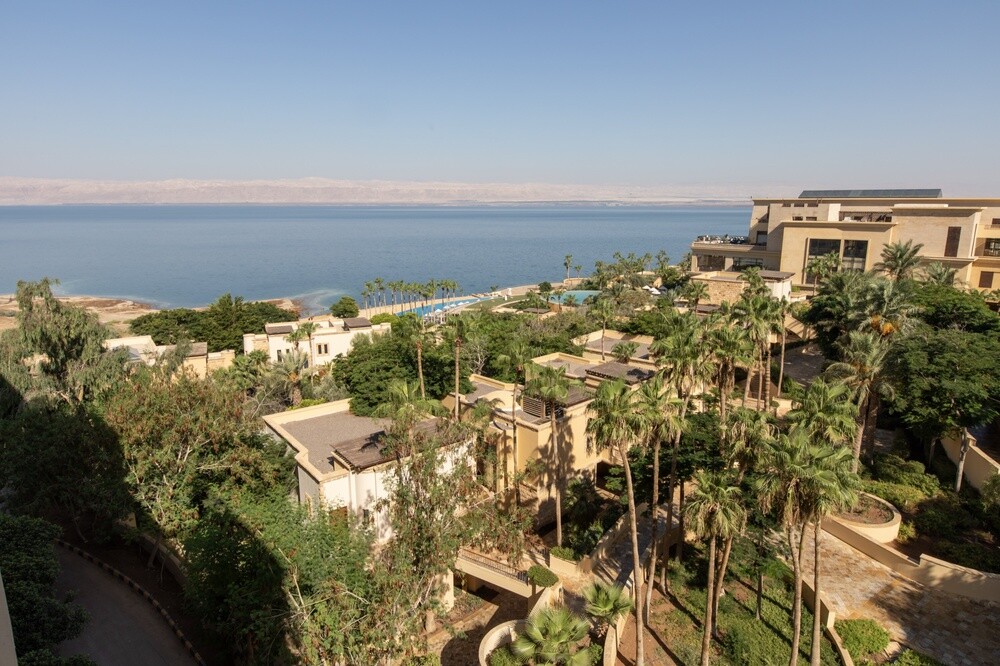
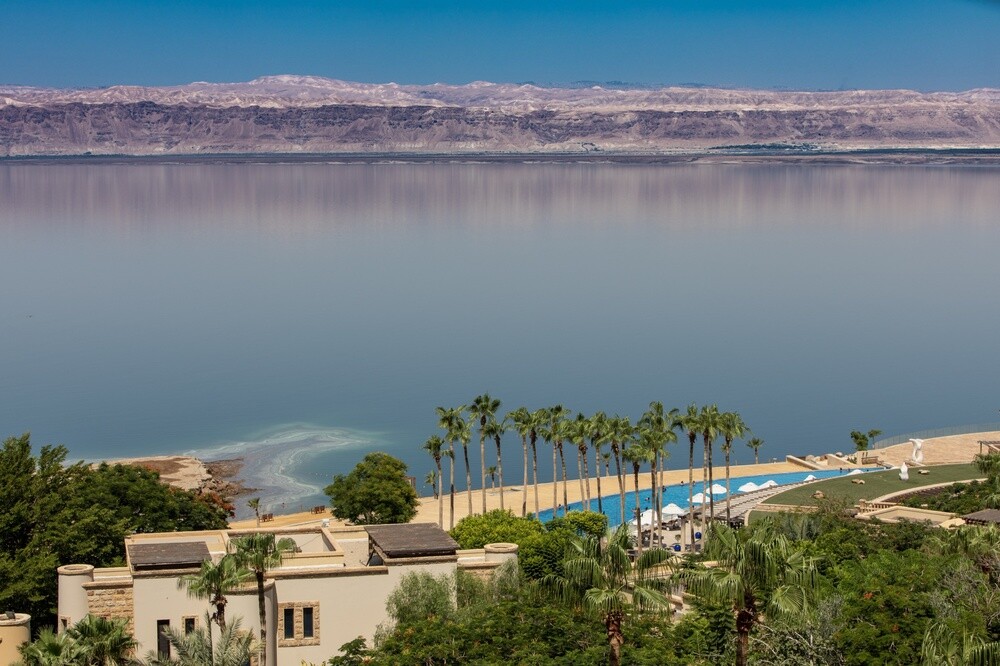
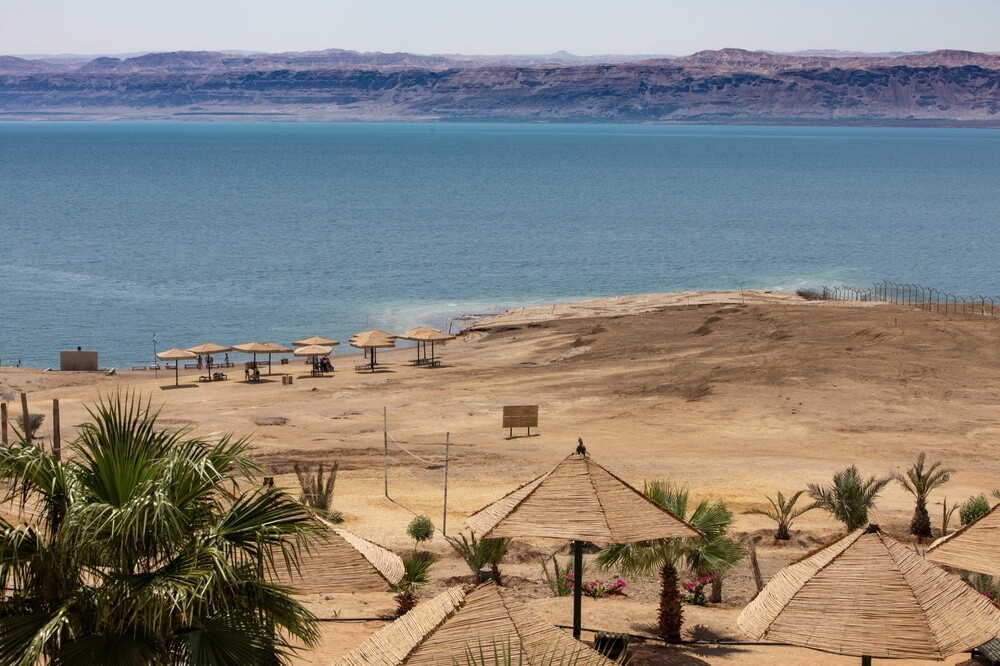
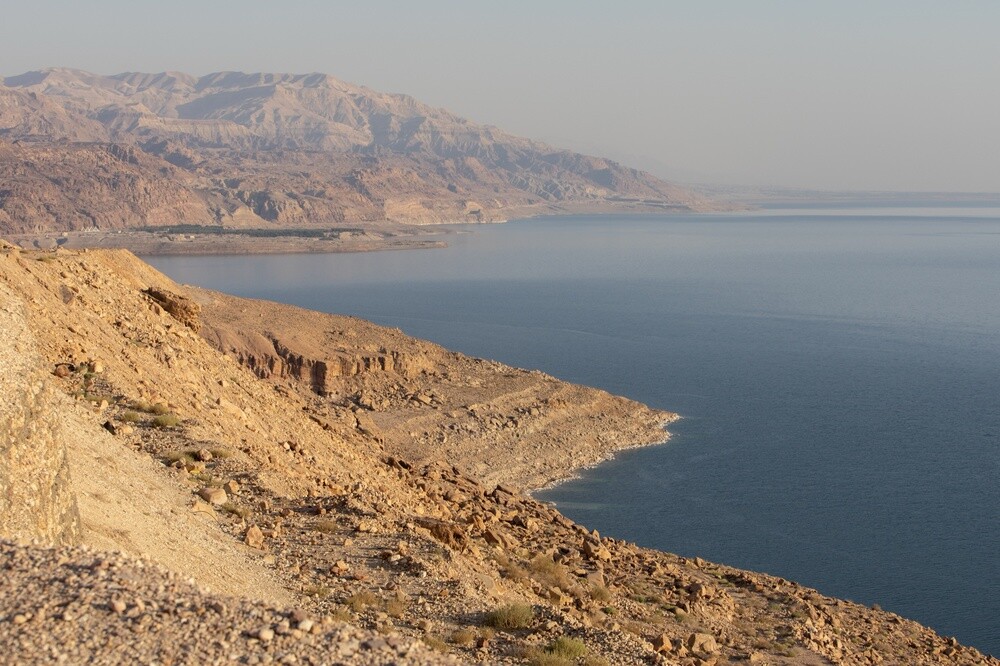
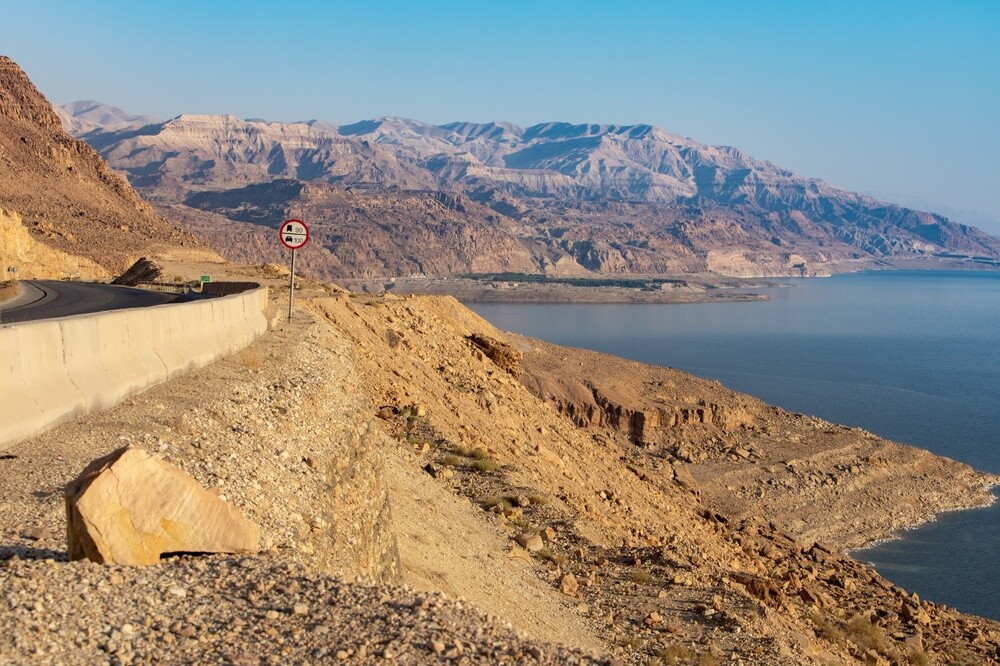
The previous evening we came back from Israel and at the last minute found a nice hotel by the Dead Sea on Booking, dinner with a belly dancer included. In the morning, the view from the balcony: palm trees, pools and Israel in the haze across the water. Salt lay along the shore in lacy deposits.

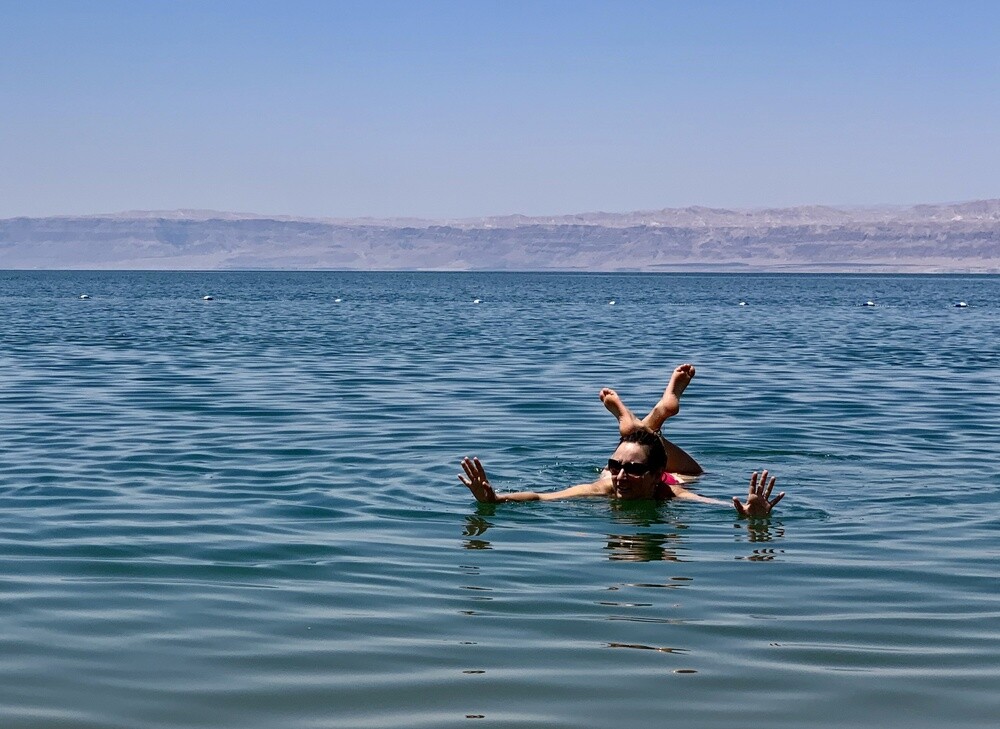
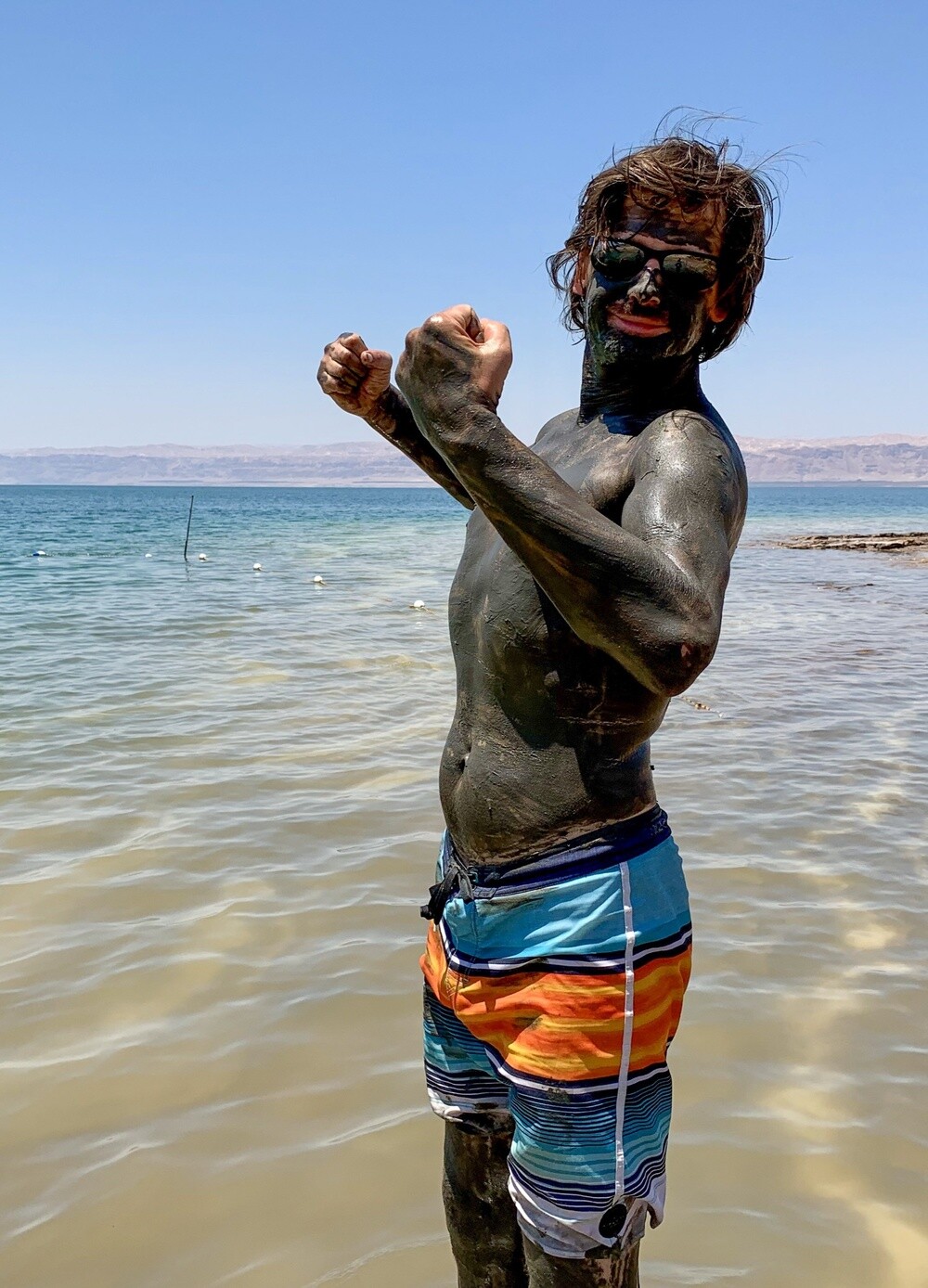
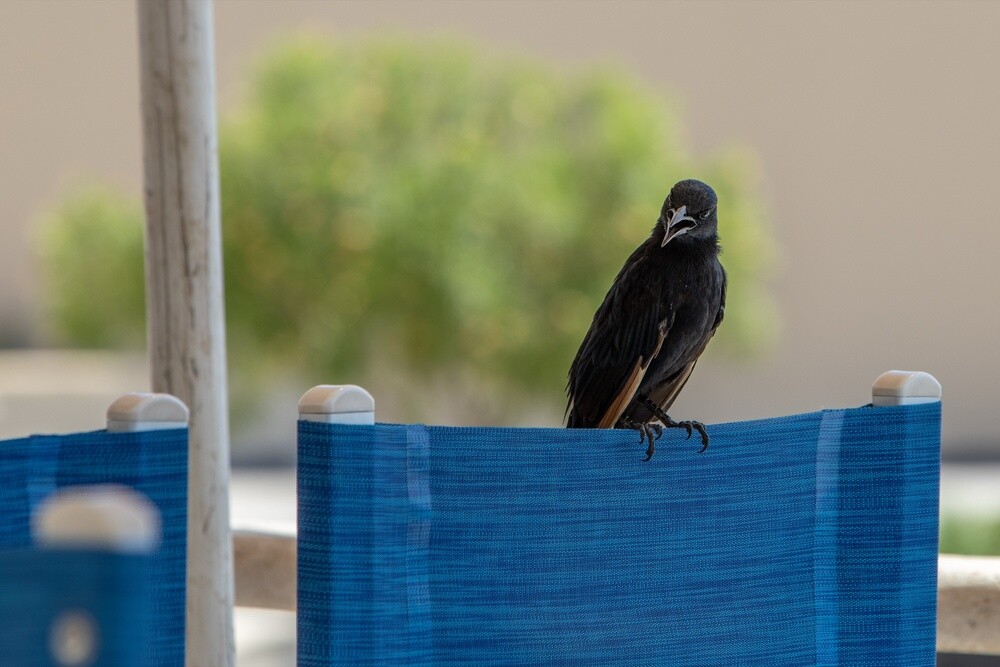
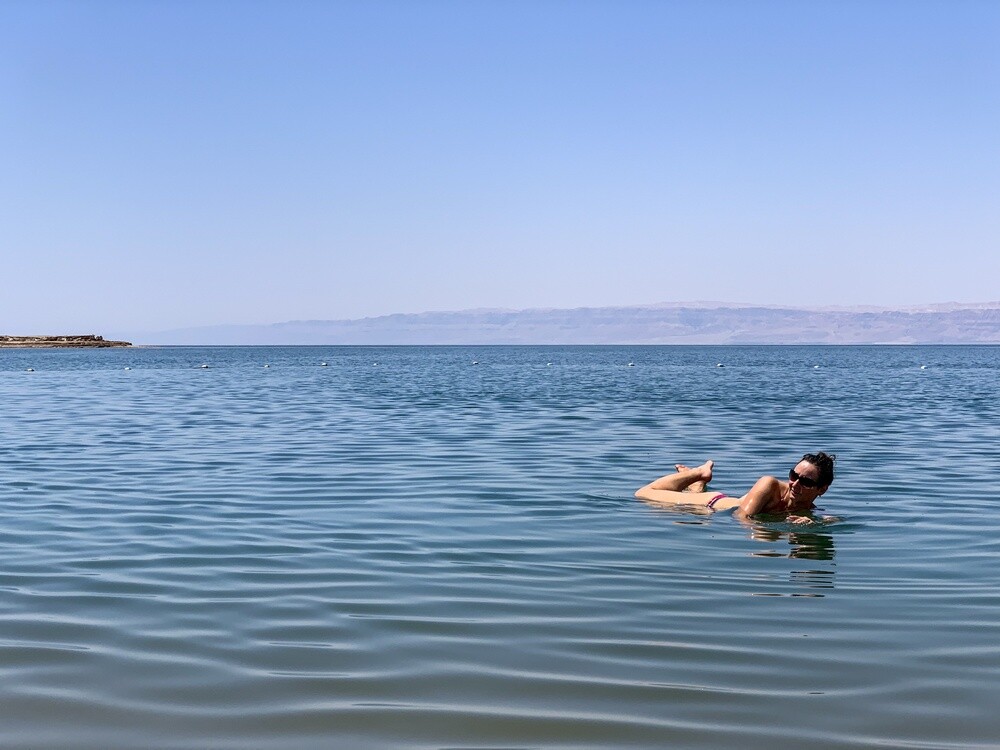
You can't sink in the Dead Sea, you just lie on the surface like on an air mattress and above all you mustn't splash it in your eyes. I covered myself in black mud from head to toe and Hanka scooped a little bottle of mud to take home. We spent the rest of the day lying by the pools, which were almost as warm as the sea. A crow sat on the back of a chair.

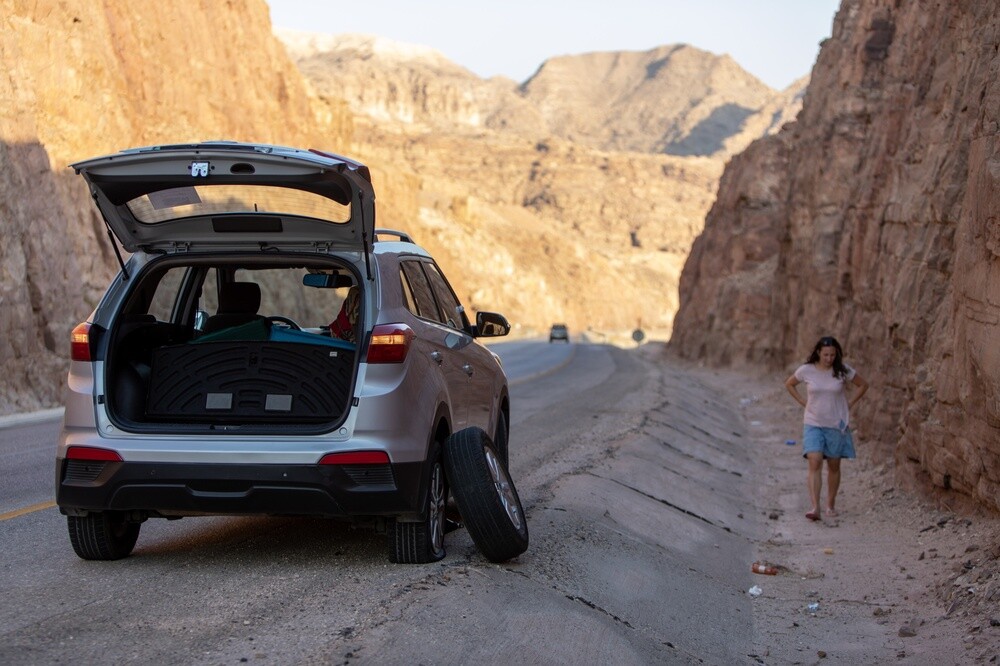
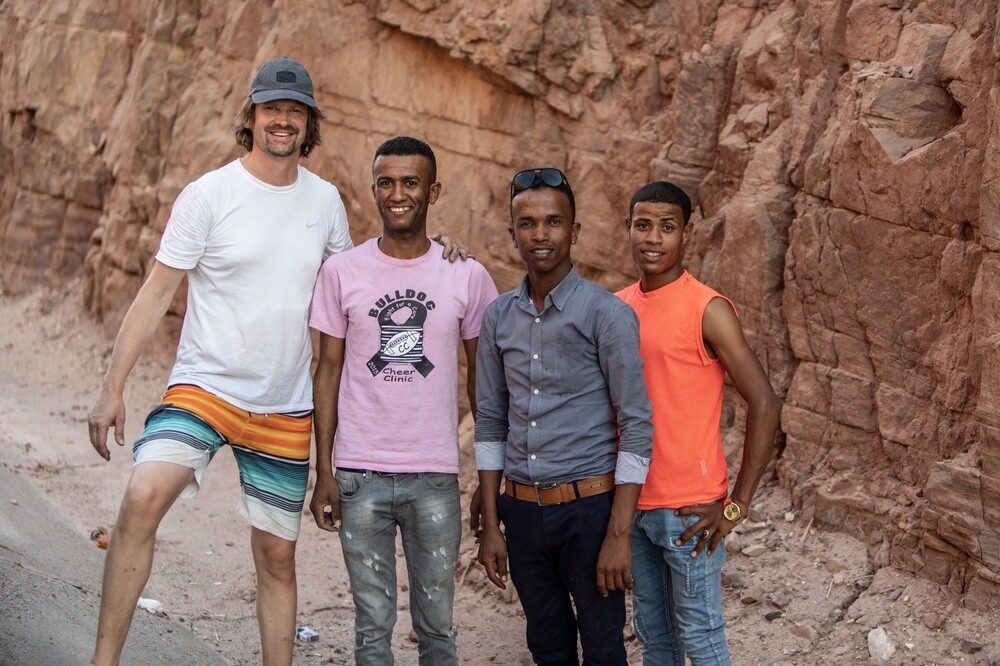
Towards evening we set off south to the Wadi Mujib canyon and got a flat tyre in the middle of the desert. We had a spare, but no wheel wrench. Hanka waved down the first car, out jumped three young lads, changed the wheel, refused any money and one of them took my Facebook.

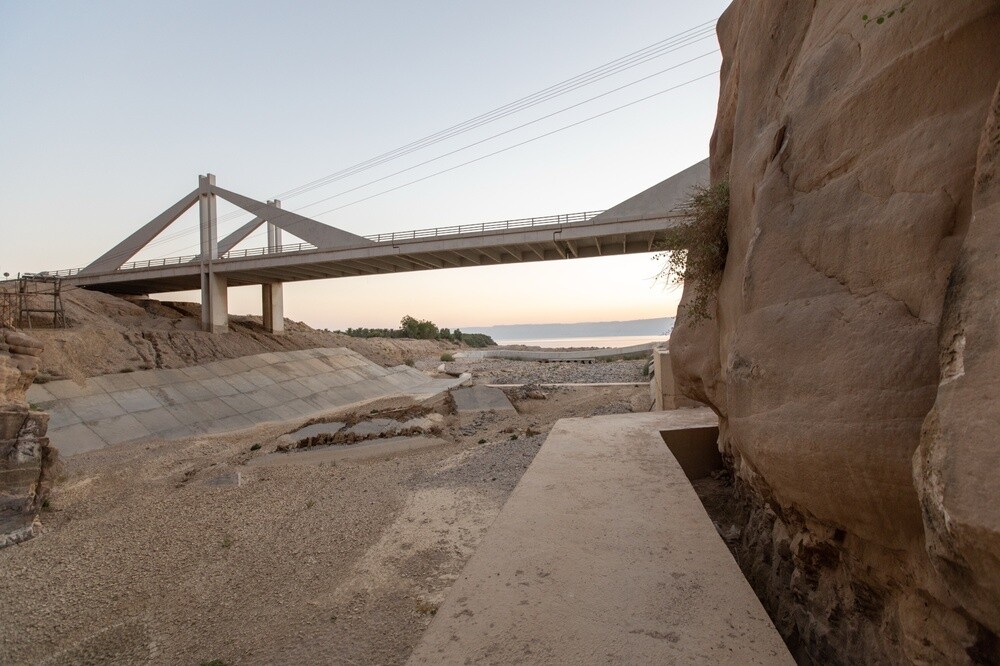
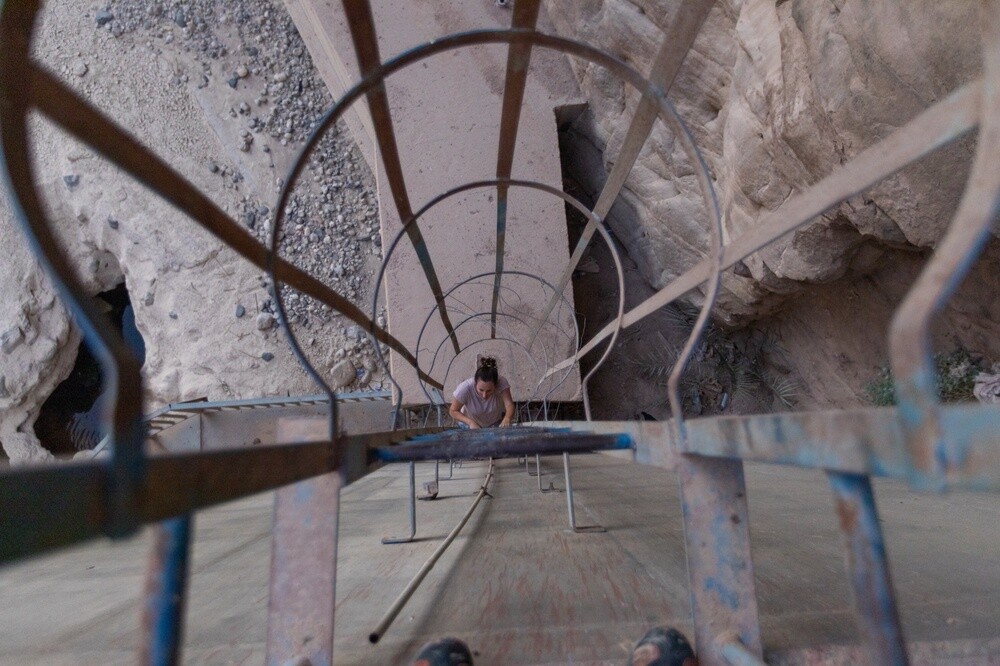
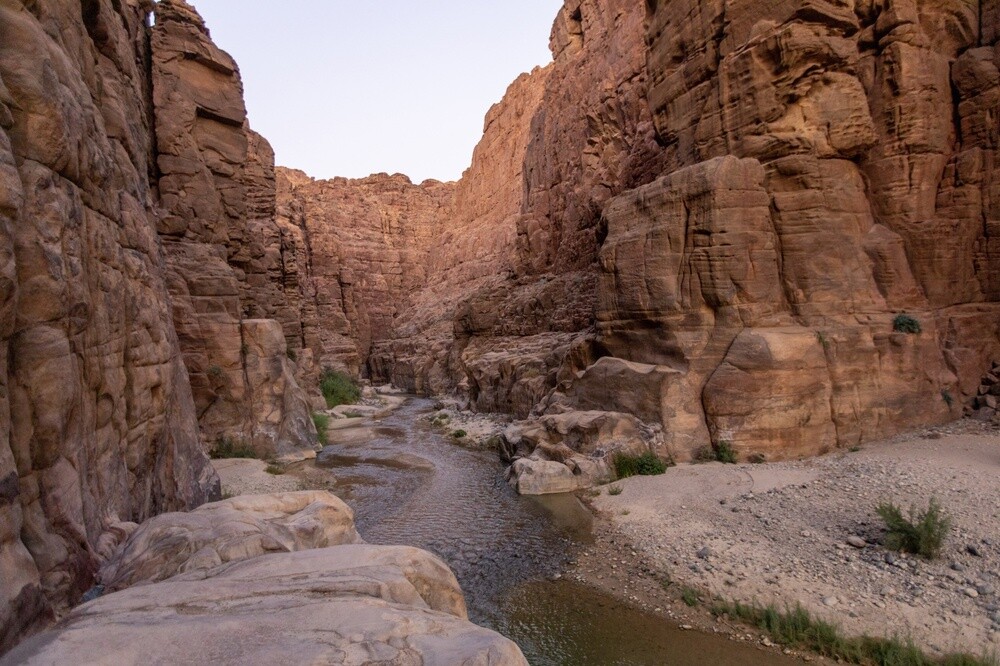
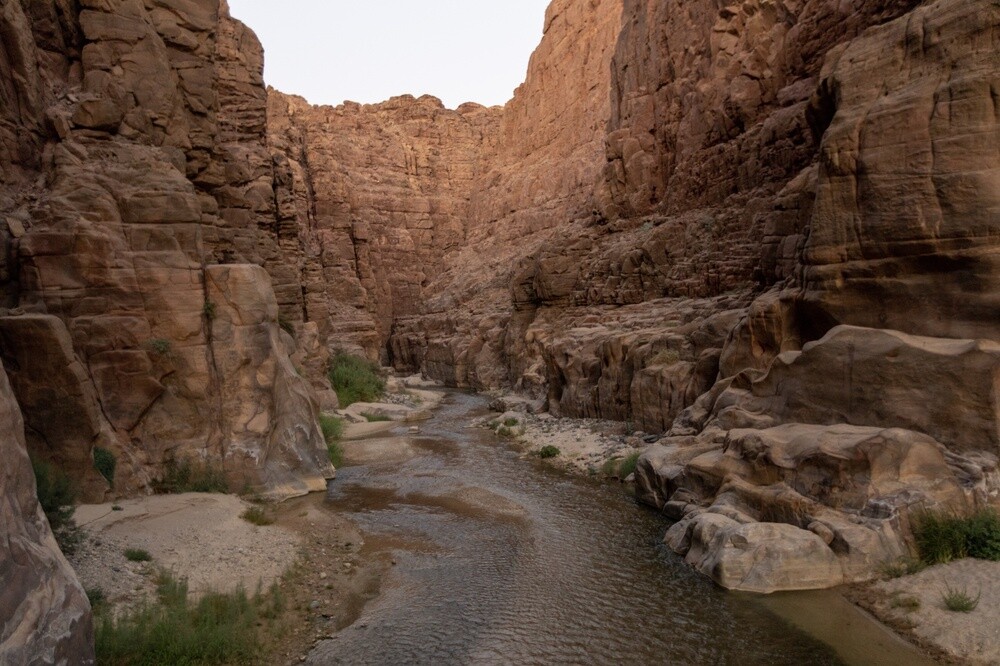
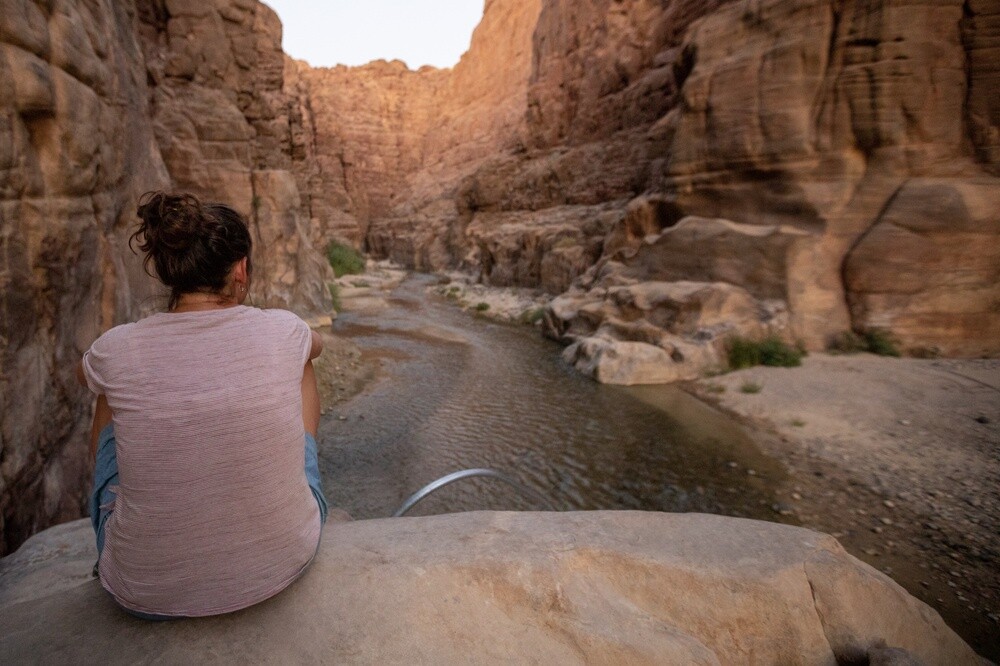
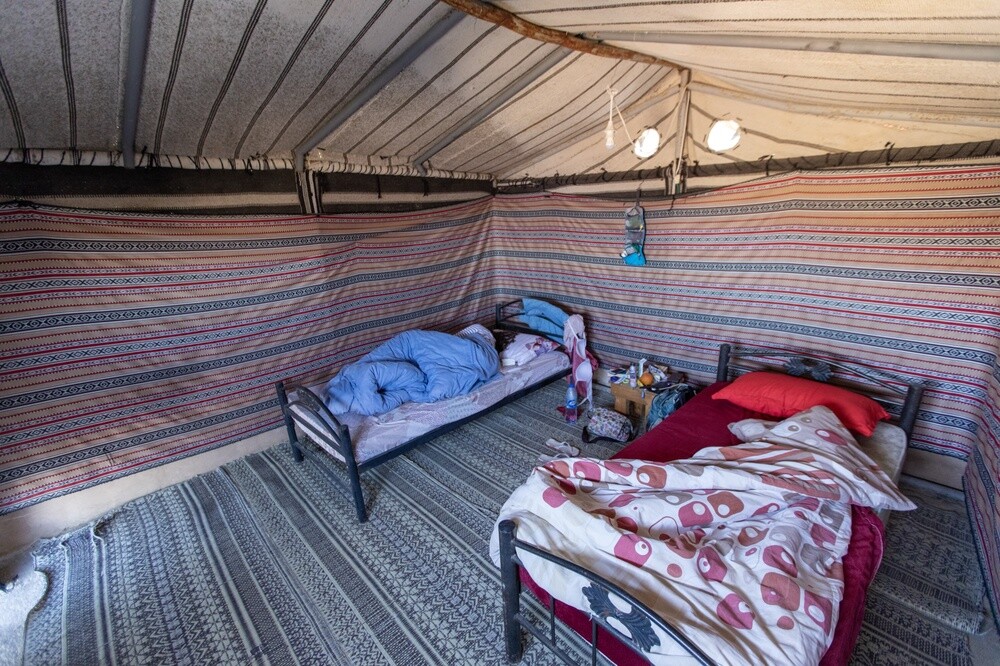
At the canyon the visitor centre was already closed. We got in around the side, up ladders and across the dam, to the spot where the route up the riverbed starts. But it was late, there was too much water and I was in the wrong shoes, so we put the canyon off for another time. Late in the evening we reached an eco-camp above the Dana valley and slept in a big tent with duvets.

Hana's diary: Jordan, day five. In the morning we were blown away right off the bat by the view of the Dead Sea from the balcony. In a lot of places by the shore there was this crust, from a distance it looked like some dirt or foam floating on the surface. When we got down to the sea, it turned out to be deposits of settled salt, nicely rippled, sort of lacy formations. Some bits had broken off, so I picked up a few to take home, maybe for Ondřej and his eczema, for the bath.

Visiting the Dead Sea was a big experience for me. Honza and I went through something similar 21 years ago in Libya. It's actually a lake in the middle of the desert with no outflow, so the water only evaporates from it. It's insanely salty, it has about five times more salt than a normal sea. When you get into it, it lifts you up like crazy and basically you can't submerge. The salt stings horribly, so under no circumstances must you dunk your head and let it get into your eyes and nose. I did that back then in Libya in a little lake in the middle of the desert and I thought I'd go mad. I had to swim back to the shore with my eyes closed, I was spitting into my palms to clean my eyes out, but it didn't help much. So this time I was careful.

But it was amazing. It lifts you up on your belly and on your back. When you stand in deep water, it looks like you're standing on the bottom, you're out of the water up to your chest say, and yet there's nothing but water underneath you. You can barely swim in it, you move forward very slowly. Above all it's not advisable to spread your legs, because it stings in every orifice.

Another attraction by the sea is the mud that has been settling there for thousands of years. It's full of minerals, healing and curative, it gets shipped all over the world for masks and wraps, and here it's lying around for free in enormous quantities. Everyone was smearing it all over their bodies, it was good fun. I filled one little bottle with mud and we're taking it home, our daughter can do face masks with it.

The Dead Sea is about 420 metres below the level of other seas, the lowest freely accessible place in the world. Not long ago we were in Death Valley, which is also below sea level and is the lowest point in America, and it was insanely hot there too. Here the heat was dreadful, but I think it was about the same back in Bohemia at the time, 35 or 38 degrees. The water in the Dead Sea is terribly warm, not unpleasantly so, but you definitely don't cool off. Interestingly, it was a bit cooler at the surface than lower down.

All around there's sand, stones, desert. In the hotel resort they water everything, so greenery grows there, but otherwise it really does feel dead. Desert, desert, and in the middle of it a motionless surface with almost no ripples. It feels mysterious. No boats, I suppose it would push them up too much, or it's just hard to sail in. No life.

The hotel had several pools, so we decided to spend most of the day resting by them. Unfortunately even the pools were so warm that you didn't really cool off, and when you swam you got even hotter. Sadly I spent a large part of the relaxing texting with Viktorie and Mrož on WhatsApp, trying to agree when we'd meet up, given we only get to see each other once a year. We got nowhere and ended up falling out again, so it mostly just annoyed me. With Tereza I was arranging what we'd do. She wrote that the boys are being good and don't miss us much. The youngest is apparently a gentleman, apologises and says thank you for everything, polite and well-mannered. That pleased us. He's counting down the days on his little fingers, we're away ten days altogether, and when the last finger disappears, we'll be back. He's even falling asleep on his own now. That's great, Tereza begged me not to ruin it when I get back. As for breastfeeding, my breasts came through unscathed. Only the psychological damage, of course.

Of the local food, the falafel is excellent, those fried chickpea balls, especially when they're fresh. I love hummus and even Honza has come round to it. And also the roast vegetables, peppers, courgettes, they do those brilliantly here. But the couscous we ate back then in Libya we still haven't come across here.

Towards evening Honza came up with the idea that we could head to the river where they do canyoning. That means you walk through the river on foot, sometimes you slide, sometimes you get carried along by the water, and it's nice. We packed up our bags and baggage, even though it was already pretty late. We're driving through the desert and suddenly there are weird noises, we had a flat. Honza got out the spare and it looked like it would be done in two ticks. Then he suddenly found out we were missing the wheel wrench and the bar for the jack. We replaced the bar with some junk from the ditch, but not the wrench. So I said, look, this'll be an adventure.

Except I waved down the first car and it stopped straight away. Three young Arabs jumped out of it, skinny, but impeccably dressed European-style. They were terribly nice, one of them knew about ten words of English, the others nothing. One of them chased Honza away from the wheel completely, they got out their tools and he changed it. Honza wanted to assist, but the lad wouldn't even let him. We thought they wanted to earn a bit on the side and we were already getting the money ready, but they absolutely refused to take it. We were delighted and surprised by how willing they were. Then they got out a phone and kept repeating something, for ages we didn't get it, until they showed us Facebook. One of them, Otman, took Honza's contact and now he keeps writing and calling him on Messenger.

We got to the river even later. It's a famous tourist attraction with a nice visitor centre, which had, however, been closed since about four o'clock. Honza didn't want to just let it go and went looking for a way to break in. Dusk was falling, it was about seven and still horribly hot, we were still by the Dead Sea, deep below sea level. I wasn't exactly keen on it, but we clambered over the rocks, up a ladder across the dam, scary stuff, and we got to the place where tourists who take the legal route start. Except we'd have got completely soaked, Honza had his things with him and the wrong shoes, and on top of that it was getting dark, so there was no point. We said we might give it a go the next day. There was a lot of water flowing, but it was a bit suspiciously green, so I don't know whether we wouldn't catch something, and with my scratched-up bites on my legs I'd pick up an infection too. It was an interesting experience anyway.

We went back to the car, and since we couldn't find any accommodation nearby, we said screw the canyoning and drove to Wadi Dana, which is supposed to be another famously lovely spot. It turned out that wadi means a valley or a riverbed, usually dried up here. The funny thing is that here we're heading for two recommended places, Dana and Petra, which are the names of Honza's ex-lovers.

On Booking, where he sorts out all our accommodation, Honza found an eco-camp about a kilometre from the little village of Dana. It's a tiny historic stone village high up in the mountains, where only three families still live. We arrived at about half past eleven in pitch darkness and it took quite some effort to find the owner. He was a young, likeable, European-looking Arab, about thirty, terribly nice and helpful, and he put us up in one of the tents. A big tent that would fit ten people, but with little beds and duvets. We'd been planning to sleep in the car again, because at that altitude there shouldn't be any mosquitoes and it shouldn't be so hot. There was also a common room under a canopy with carpets, mattresses and cushions, so we wanted to sleep there, but the lad said that's the living room and you don't sleep there. And he pushed the tent on us, which wouldn't have mattered, except it was more expensive.

A room in a luxury hotel on the shore of the Dead Sea with a view and a cracking breakfast cost 90 dollars. This tent in the middle of the mountains, also with a beautiful view, but that kind of charming, primitive accommodation, cost about 70 dollars. We liked it, it was just the price that stopped us short, I'd expected it to cost five times less. They have to make a living from something, I suppose. The camp had a few brick buildings with little rooms and about six tents, very charming, but almost empty. And a beautiful view over Wadi Dana.

I'd also like to add something about bathing in the Dead Sea. Female tourists mostly don't bother covering up, the most ignorant of all, in our opinion, are the Russian women. Especially in tourist spots, in hotels or later in Petra, women walk around in shorts and vest tops. I feel awkward about it, so I usually have at least my shoulders and knees covered. I have one long skirt from Tereza, very pretty, Honza likes it, but it's completely see-through, so against the sun you can see my whole legs. I don't know whether that isn't worse than if I had a knee-length skirt. Mainly though I wanted to say that European women were bathing in the Dead Sea in classic bikinis, some even in thongs, but the Arab women, poor things, were bathing in robes, sometimes in sportswear, in a T-shirt, trousers and a scarf on their heads.

The Dead Sea
Its surface lies roughly 430 m below sea level, making it the lowest point on land. The water contains around 34 % salt, which is why it makes you float.

Wadi Mujib
A canyon that opens into the Dead Sea. It belongs to the Mujib nature reserve, the lowest-lying reserve in the world.

Thursday 25 July 2019, Dana and Wadi Musa

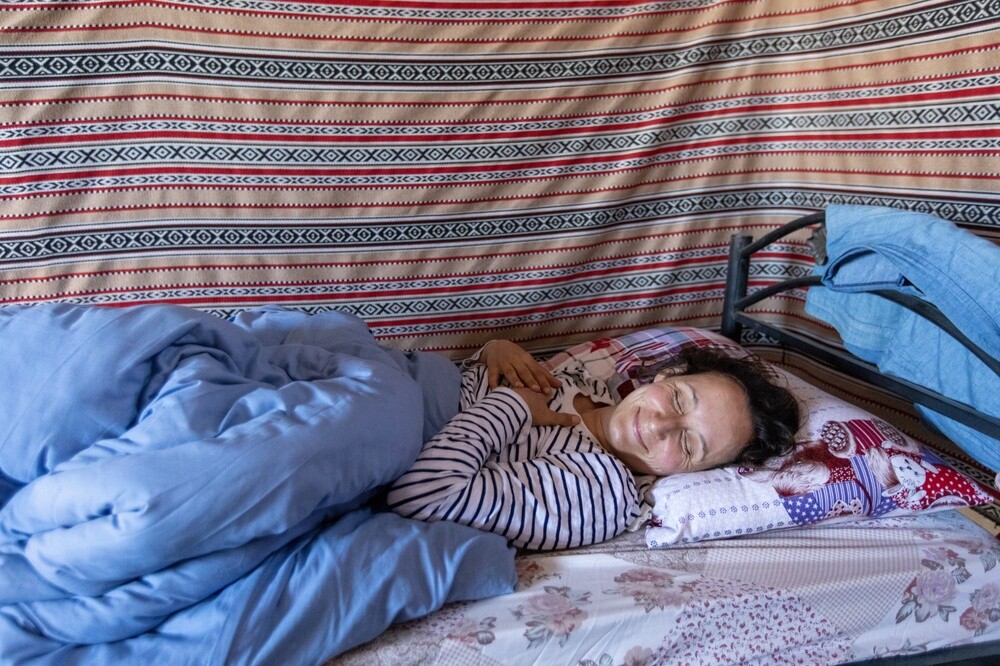
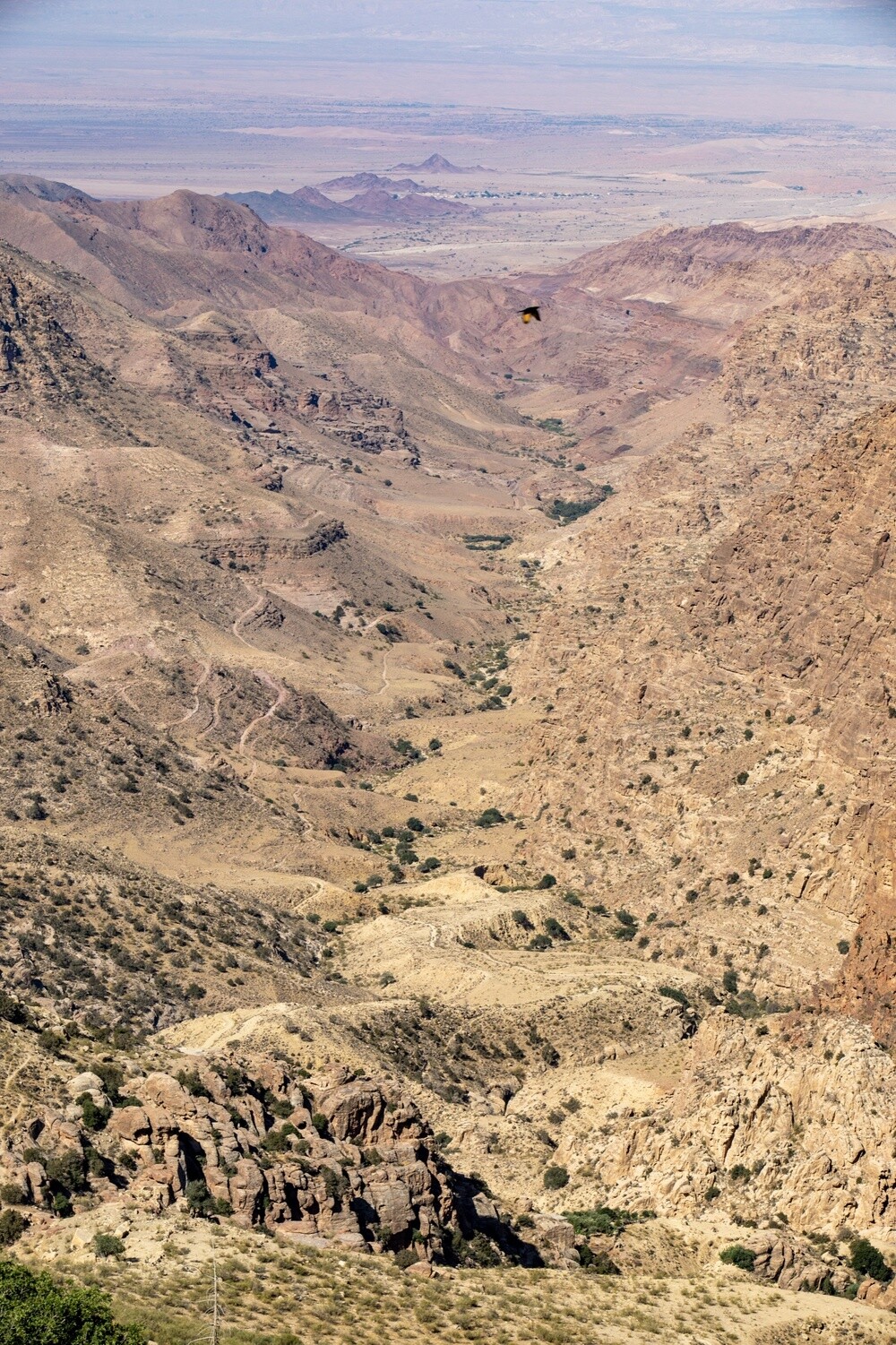
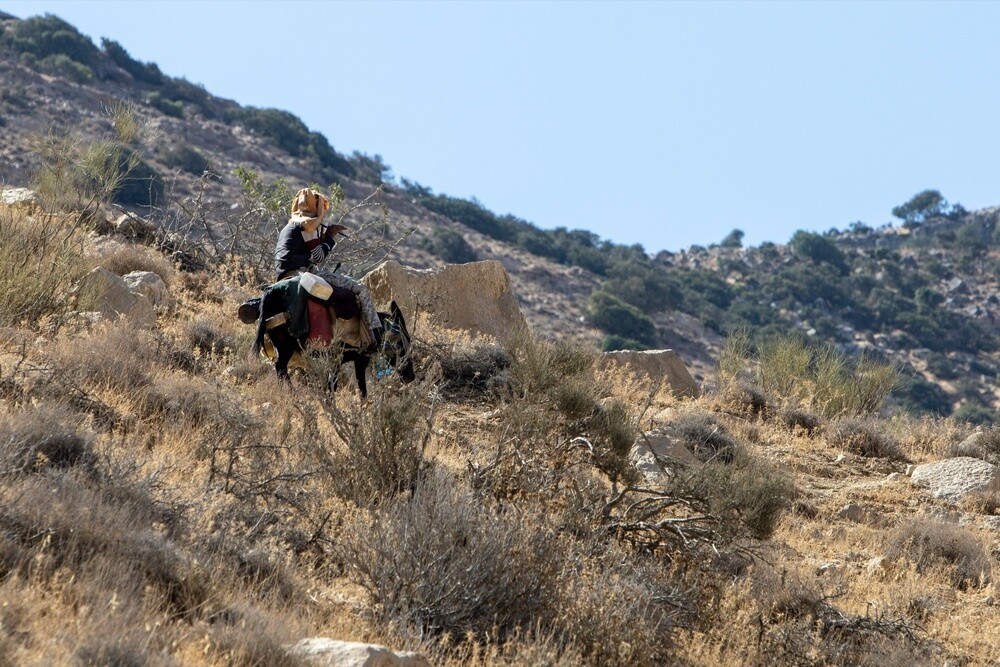
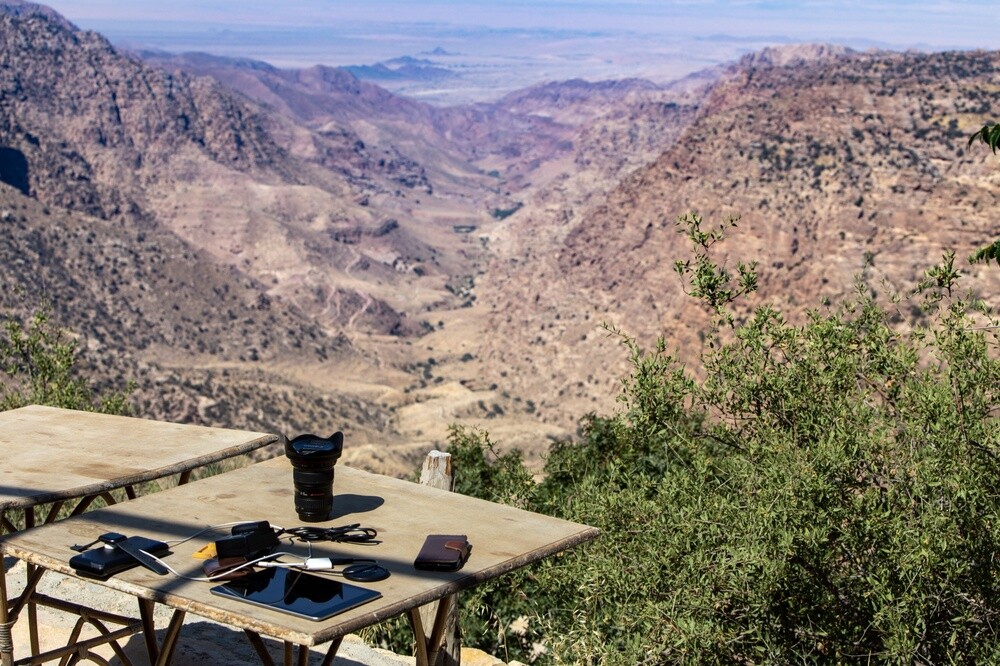
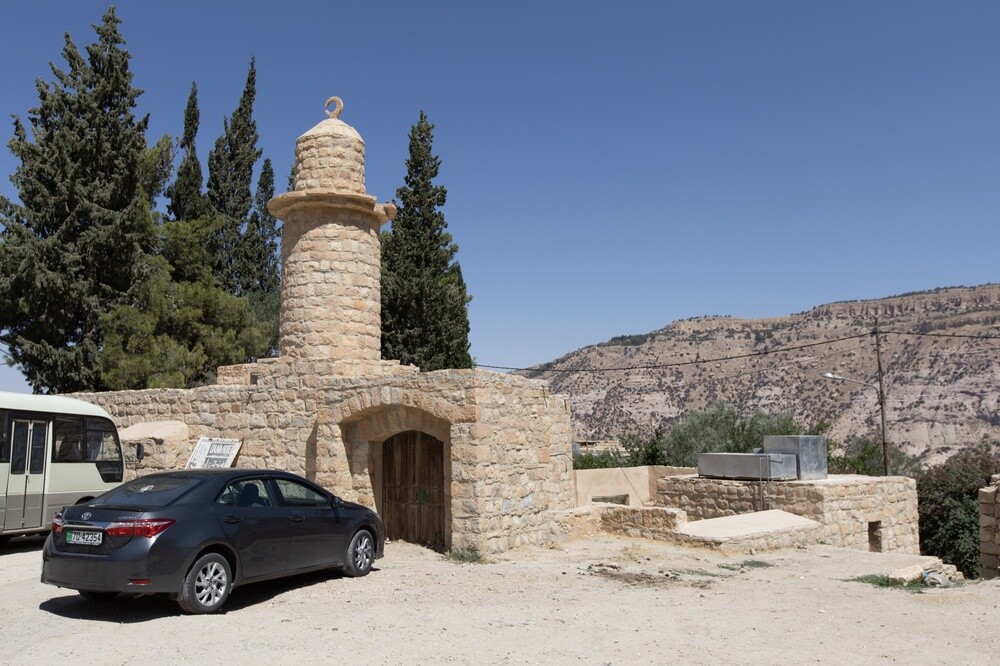
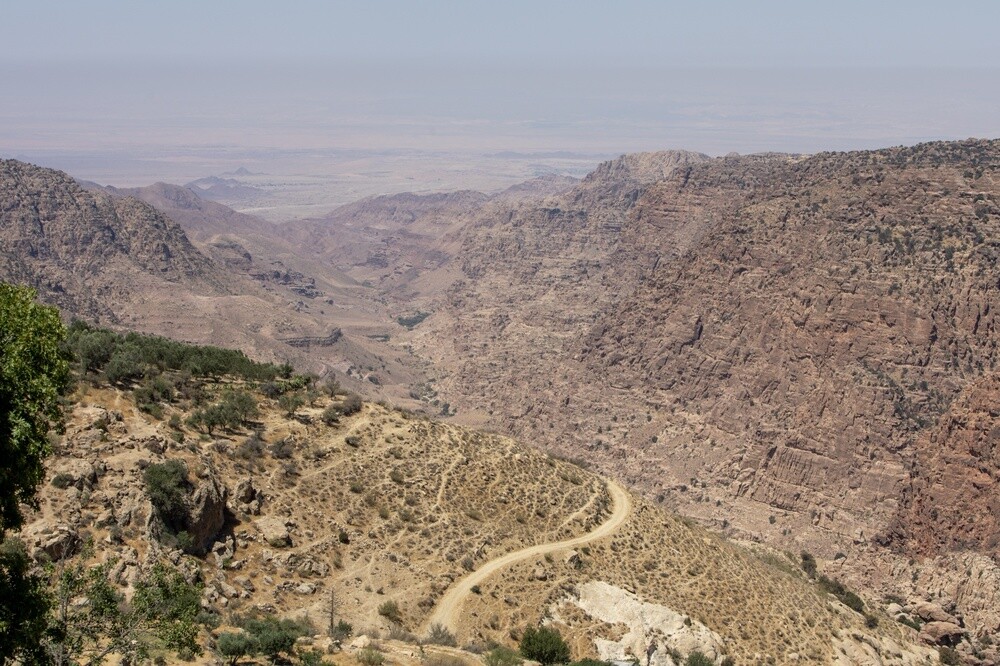
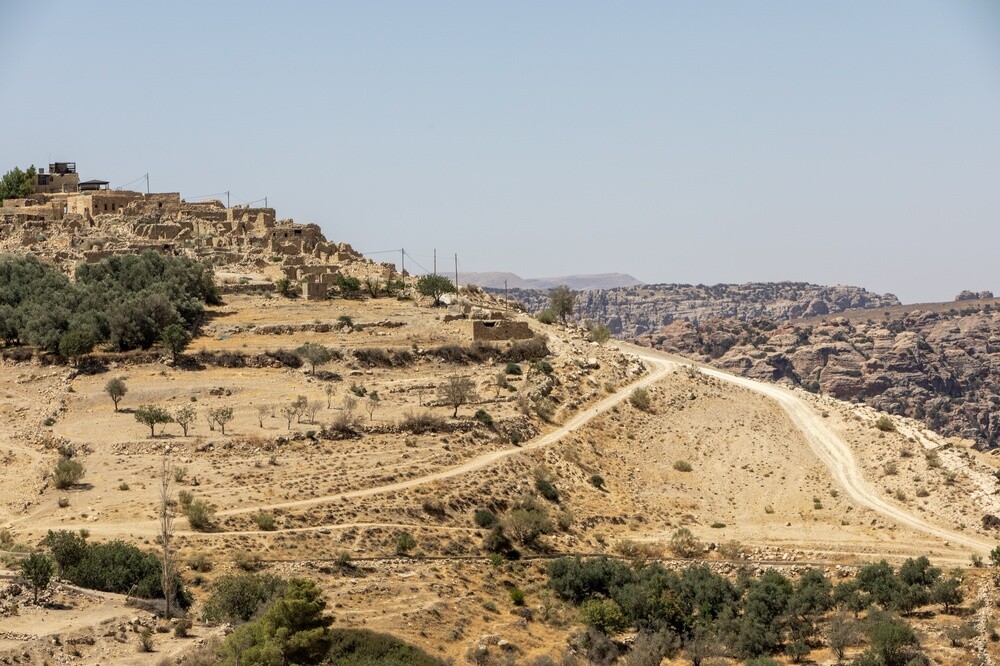
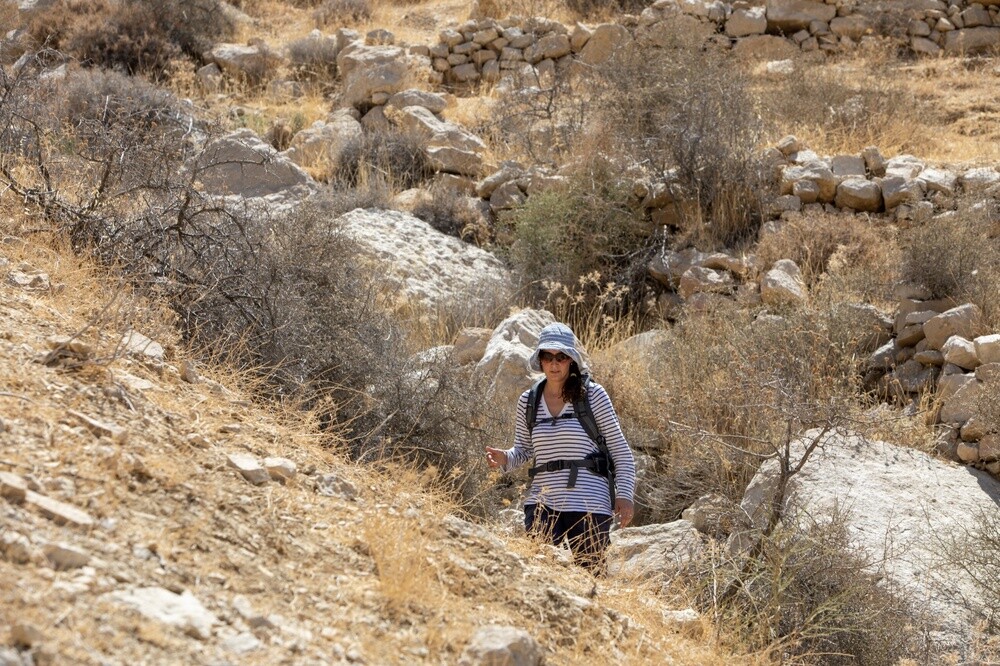
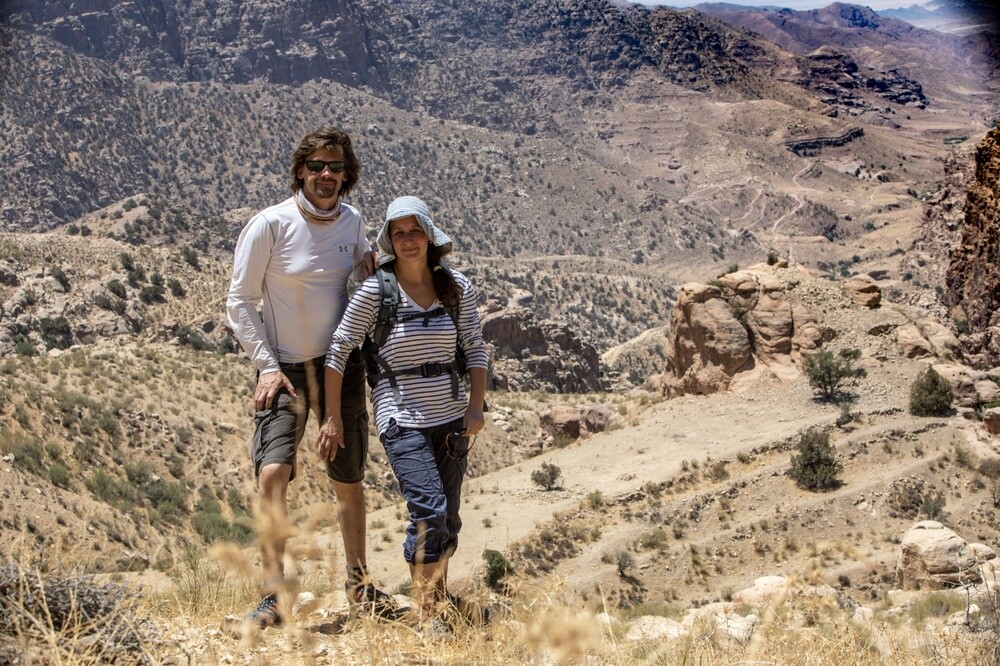
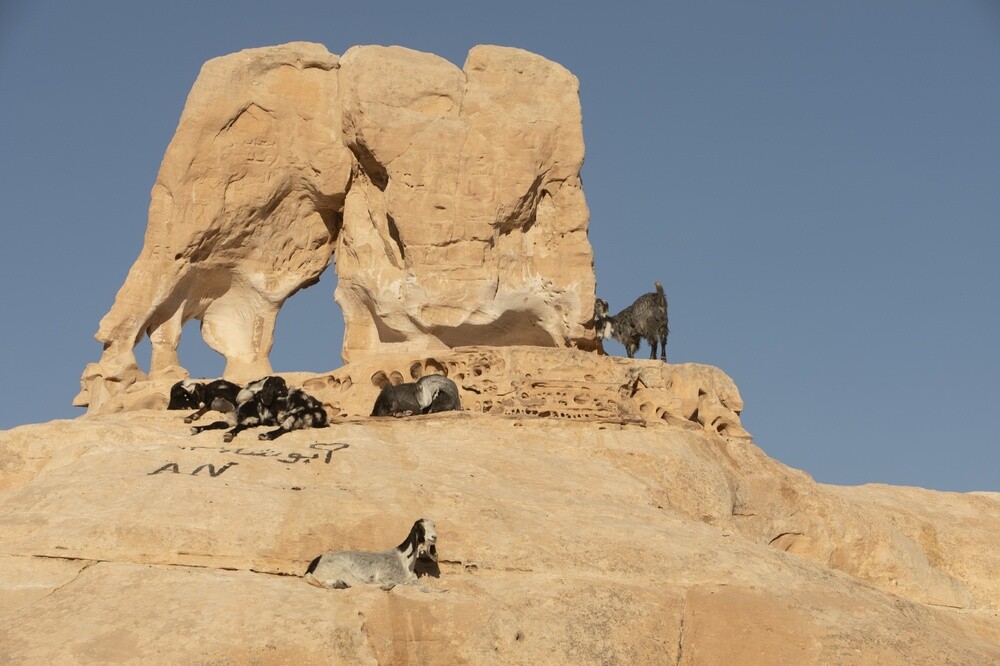
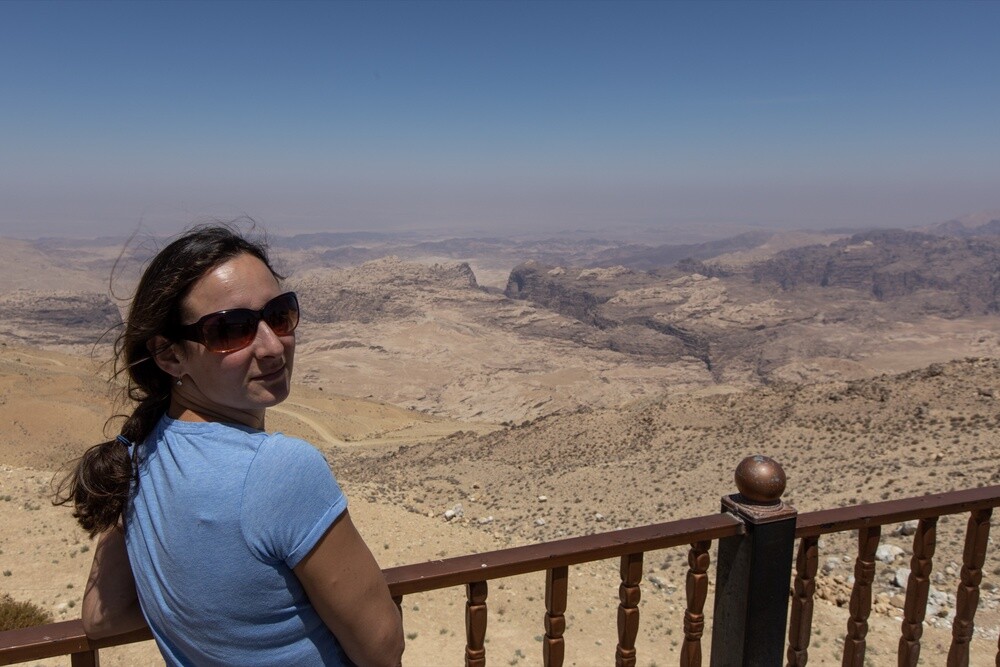
In the morning Hanka was still buried under the duvet, dogs outside and a view down into a deep valley. Locals rode past on little donkeys, there's a small stone mosque in the village. A lad from the camp, born in the village, suggested a short hike along the slopes to some caves: terraced fields, dry bushes, goats hopping over the rocks like chamois and a view all the way down to the desert at the bottom.

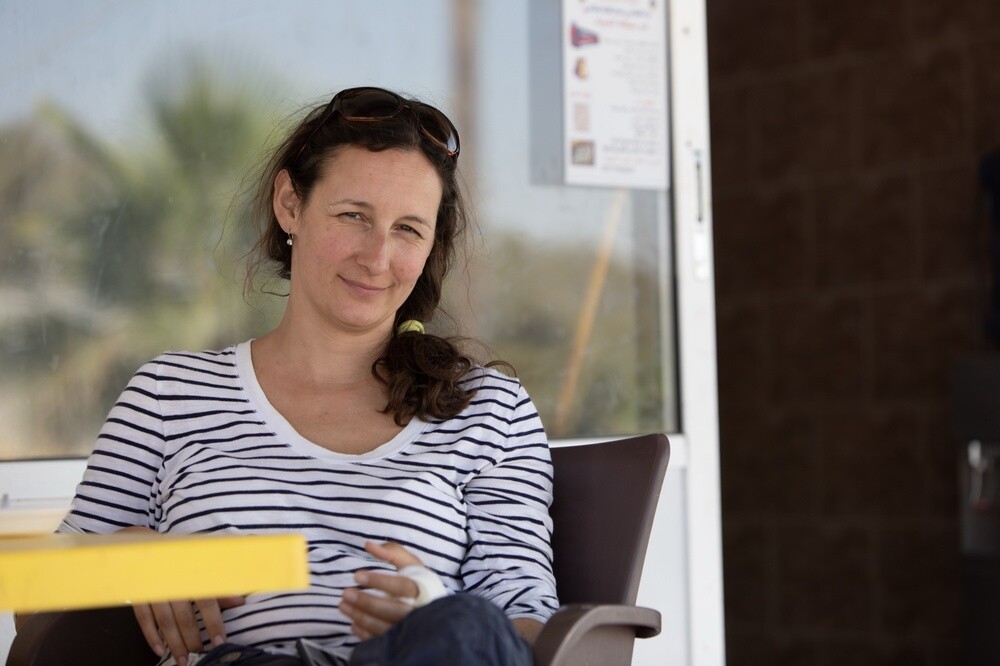
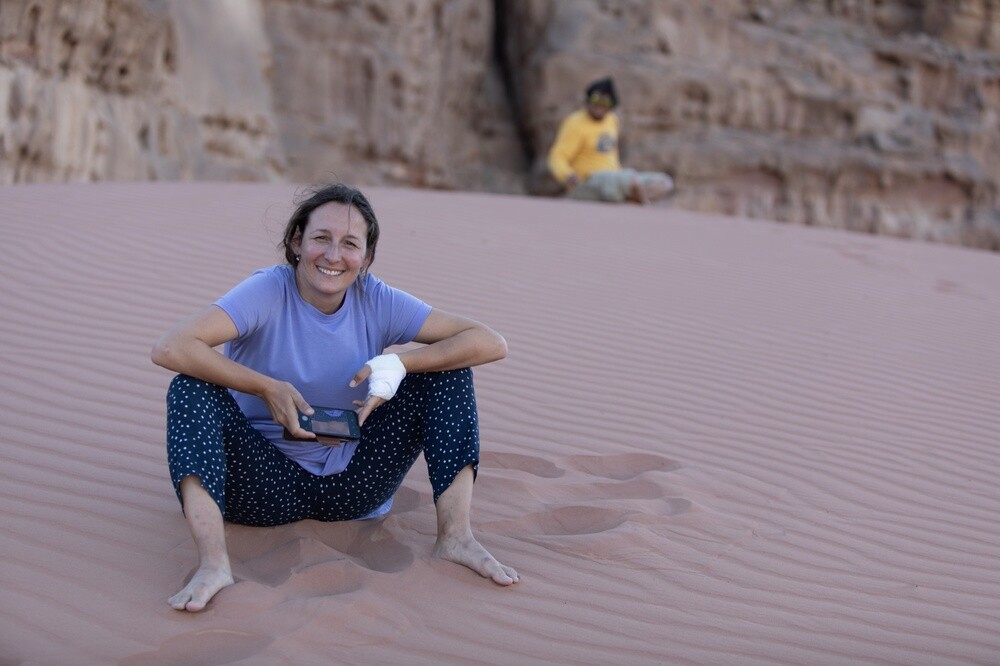
On the way back I was walking ahead when I heard a fairly calm "oh, shit" behind me. Hanka slipped in her sandals with smooth soles and landed with her hand right on the stump of a bush. Between her thumb and index finger she'd torn the skin and the tendon, a wound about five centimetres long. Nothing soft grows in the desert, everything is tough and prickly. Luckily she had a bandage with her, so we wrapped the hand up and walked the kilometre and a half to the village in the heat.

A local Bedouin sent us to the health centre in the next village. Hanka doesn't trust doctors even in Prague, let alone in a Jordanian village, so she was very suspicious. The doctor hardly spoke any English and kids from the street kept coming in to watch. But he knew what he was doing: he gave her a local anaesthetic, bravely fended off questions about whether the needle was really sterile, and stitched the hand up with seven stitches. And he didn't want a single dinar for it.

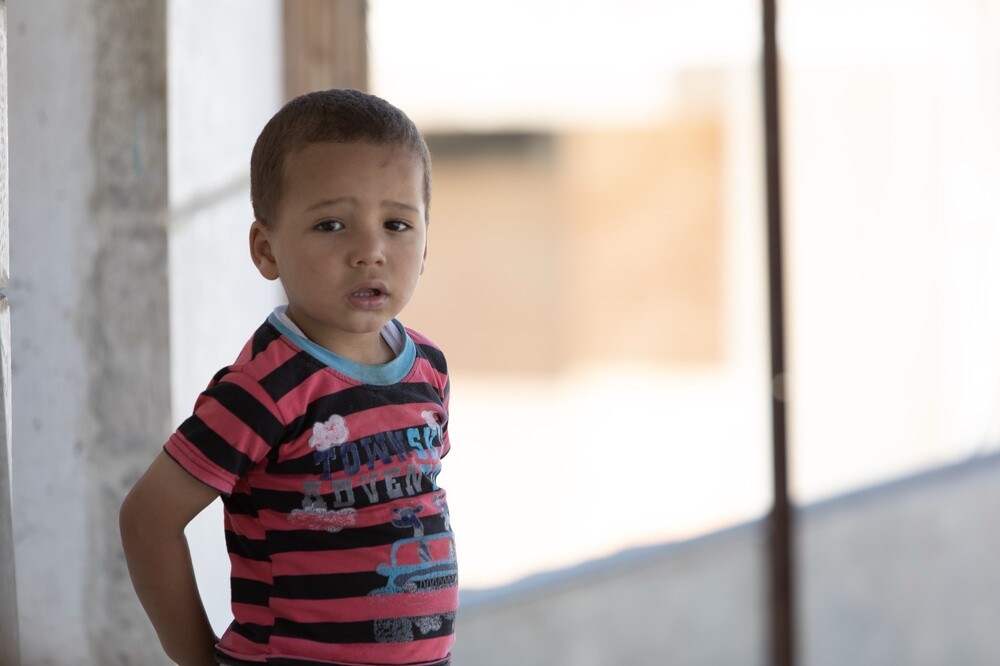
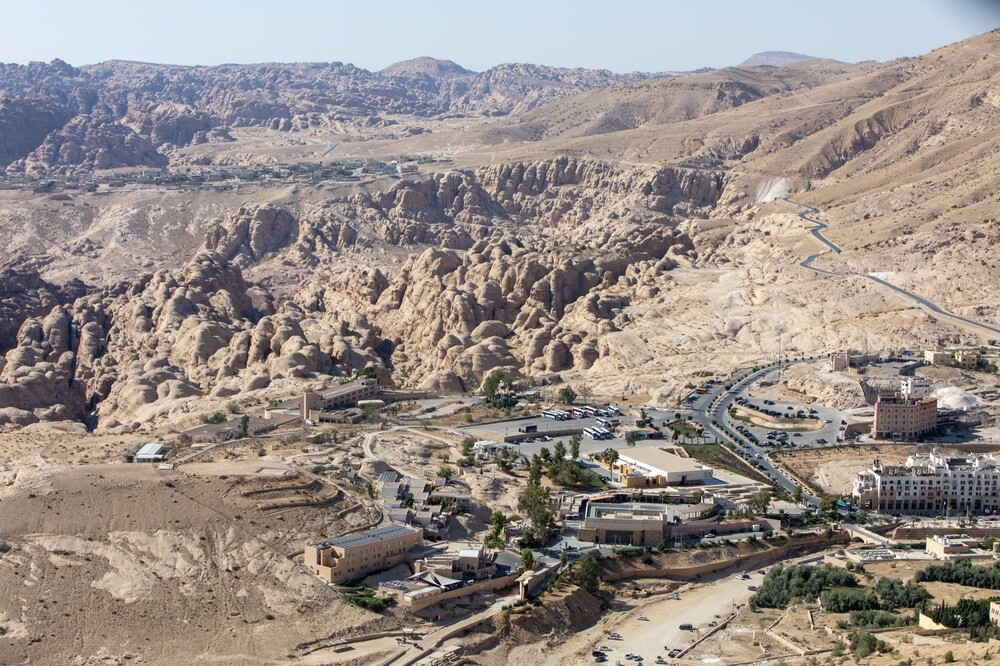
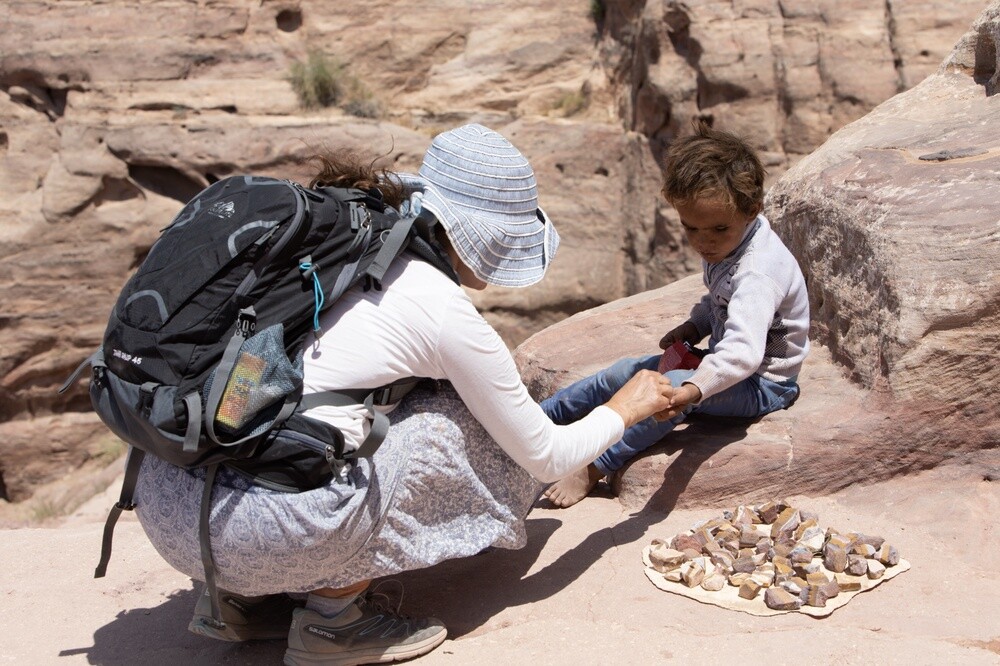
Later, in Wadi Musa near Petra, Hanka got antibiotics at the hospital and from then on she went for a dressing change every day. She took the whole thing very bravely, only bathing was complicated for the rest of the trip. The entrance to Petra was already closed, so at least we went through the new museum by the visitor centre. In the afternoon a little boy circled around us showing off.

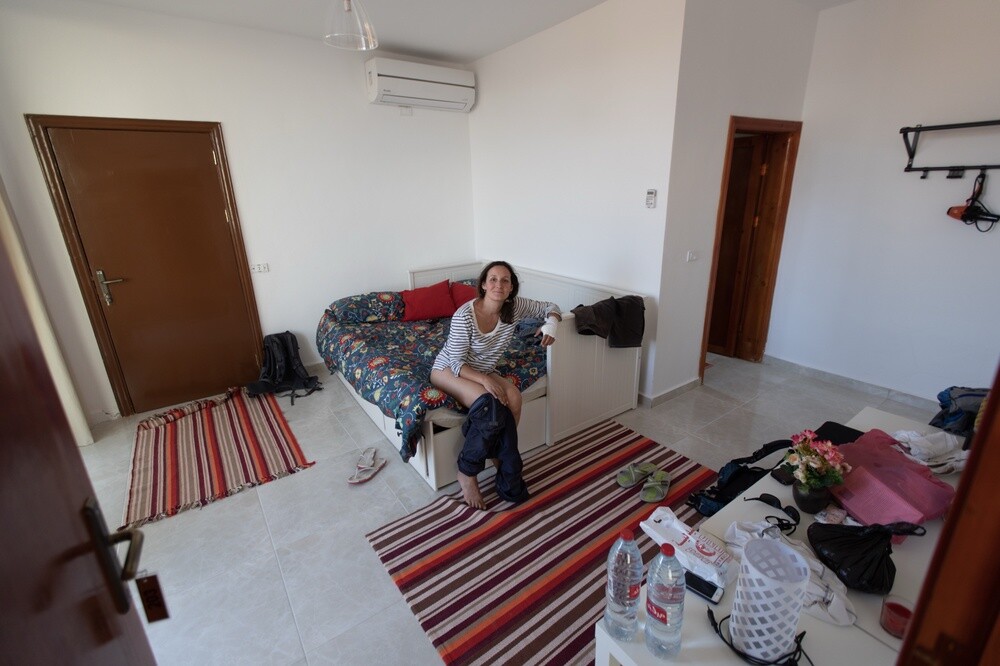
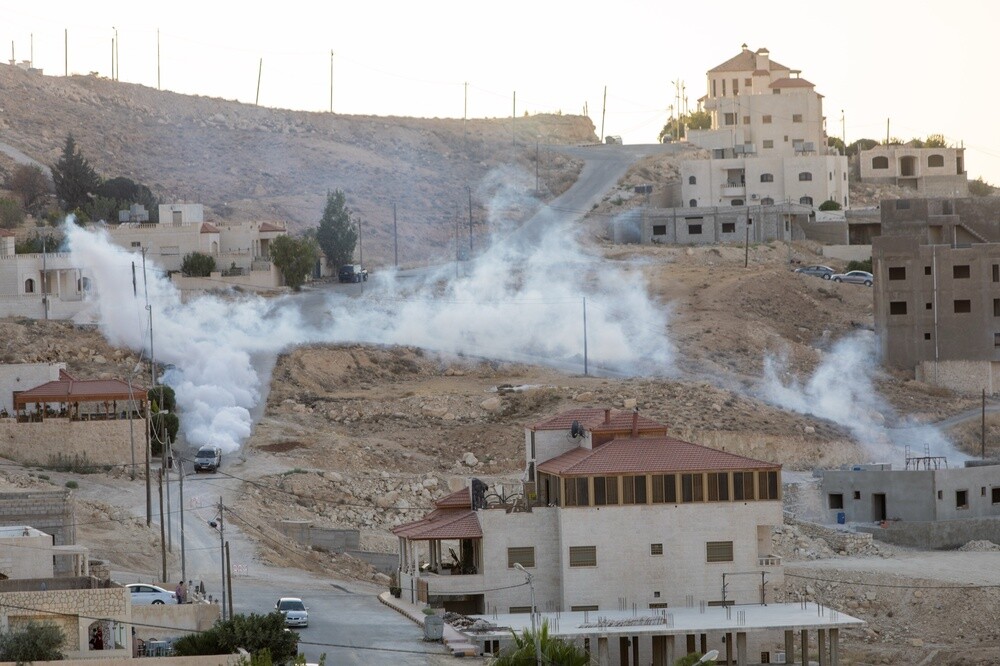
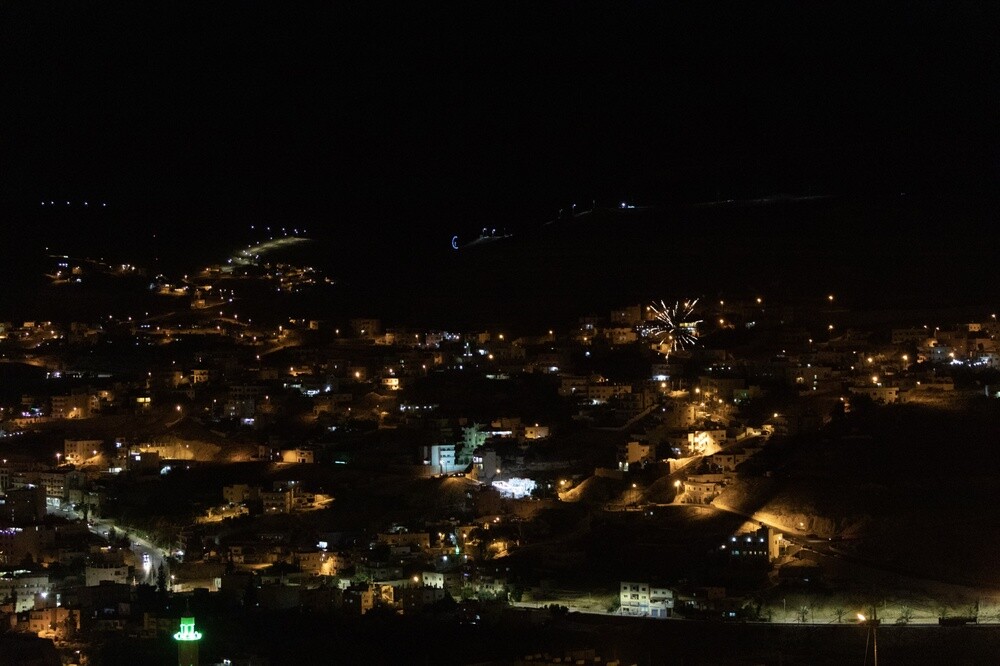
We stayed in a new apartment on the hill above Wadi Musa, run by the enterprising Shadi, with Ikea furniture and a view of the city at night. In the evening the town was full of smoke and there was shooting until midnight. Students were celebrating their exam results with fireworks and, as we only found out the next day, with submachine guns too.

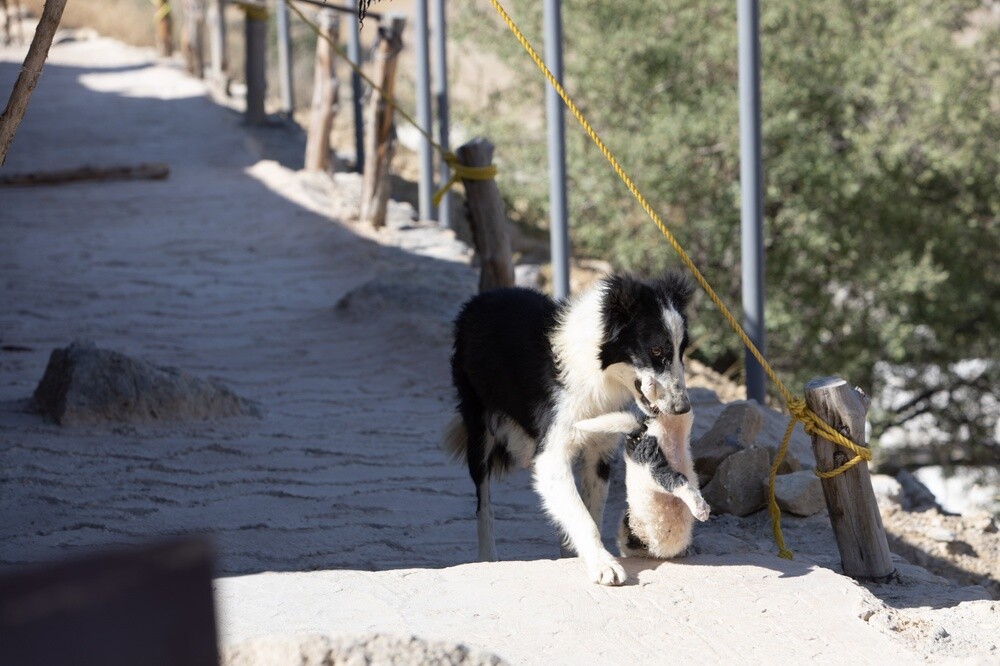
Hanka's diary: Jordan, day six. When we crawled out of the tent, the view into the valley blew us away, pure gorgeousness. I like lounging around when I don't have to get up, so Honza went to breakfast first. Breakfast was included and the lad made it for us. During breakfast a skinny, dusty bitch walked past Honza — all the animals here are dusty and neglected — carrying what he thought was a dead cat in her mouth. But it was her puppy, probably dead, she was carrying it by a little leg to bury it somewhere.

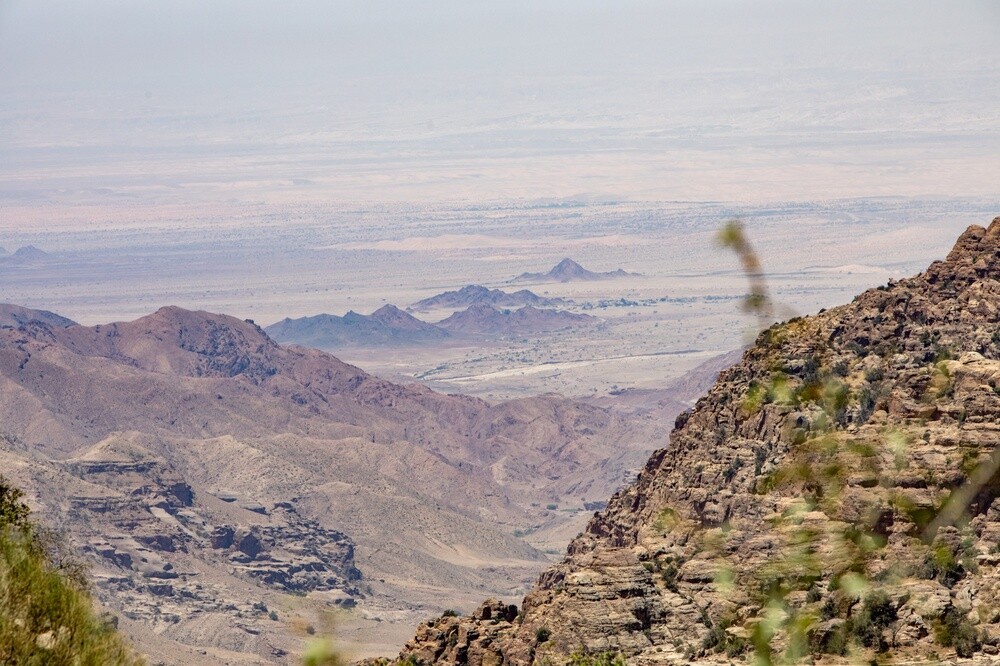
The lad chatted with us for quite a while. He was born in that village and told us how they built the camp. Years ago it was the idea of his uncle or someone, who couldn't finish it, and in the end about 90 families apparently chipped in to complete it. They even had a shower and a flush toilet. And he recommended a trip to us. There were two options. One really long one that goes through the whole valley, about 16 kilometres downhill, but you'd have to drive over a hundred kilometres around to get back and go to a lot of trouble finding someone to take us. We wanted to drive on further, so we chose the shorter version, over the hills below the camp to some cave. It was really easy to follow, always the same valley, always a similar view, but gorgeous.

You meet hardly any tourists here. All sorts of shepherds live here. We saw loads of goats, which behave more like chamois and leap over the rocks at unbelievable heights with total ease. The little shepherd we met was playing a whistle, he was absolutely adorable and authentic. But unfortunately even here, in the most remote places we got to, there was rubbish lying around. Less than elsewhere, but still. It's really depressing.

The path was easy to walk at first, but then it turned into goat tracks. And unfortunately I'd taken my daughter's Keen sandals, which seemed fine for a hike, but they have very smooth soles and it was pretty slippery. I was being terribly careful, I kept holding on to things and staying behind so nothing would happen to me. It was hot, Honza's shoulder, knee and back hurt, so he was a bit grumpy. It turned out there were several caves there. We got to one, had a snack and headed back in a loop.

So we're plodding along and out of nowhere my foot slipped a bit. I tried to grab a broken little bush, just a reflex, and tore my hand open. I couldn't believe it at all. Between the index finger and thumb of my left hand I had a hole about a centimetre deep and five centimetres long, gaping at me. It was quite a shock, but it didn't hurt. So I tell Honza we'll probably have to get it stitched up. At first he didn't want to believe it either, but when he saw it he agreed. By total coincidence I had a first aid kit with two bandages with me, so we wrapped it up and walked to the village. It was still a kilometre and a half, all off-road, uphill and in terrible heat. Luckily it didn't hurt much, but the psychological shock made me faint and I was a bit afraid I'd collapse somewhere. I tried to drink a lot.

In the village a local Bedouin told us that in the neighbouring village, bigger and more modern, about two kilometres away, there's a health centre. I thought we should rather drive to some more decent hospital, but we stopped at the centre anyway. Honza went to scout it out and came back saying there's an intelligent-looking doctor there who speaks English. So I said fine. The doctor really did look intelligent and likeable, but he barely spoke English, maybe he understood a bit. He was nice, but we didn't communicate much because we had no way to.

The hygiene conditions in the surgery obviously looked considerably different from ours, everything a bit grubby. Above all, about three kids and some other guy from the street ran into the surgery and cheerfully watched what was going on. He treated it professionally, I guess, probably perfectly fine. I'm suspicious of course, so to this day I wonder whether he might have used an already used needle with the anaesthetic. Let's hope not. I cheekily asked him afterwards and he acted like he doesn't use needles twice. And yet he had two syringes just lying around there. Well, never mind, I pray to Allah it was clean.

He stitched it up beautifully, with the help of an assistant, I've got seven stitches there. For the dressing he first wanted to use one of my own bandages, the one I came with, but he found it was bloodstained and they went to the storeroom to look for another. In the end he wrapped it up nicely. We thanked him profusely and asked what we owed, expecting some awful sum. And he said it's free, they have state healthcare here. So let's hope they reimburse him somehow and he didn't lose out on it. It confirmed our experience with the locals, that they're terribly kind and selfless. First they helped us enormously with changing the wheel, now they've stitched up my hand. He spent at least three quarters of an hour on me and didn't want anything for it. I don't have any medical report, but it probably doesn't matter. Anyway, he said I should get a tetanus shot. We thanked him ten times, bowed, jumped in the car and sped off towards Petra, probably the biggest attraction in Jordan, unfortunately full of tourists.

In Petra we found a fairly civilised hospital, probably because of the tourists. The nurses wore Arab robes, but pale blue, nurse-like, and an Arab headscarf, but white and lacy. They just looked like lovely Arab nurses. Here it was tougher already, they wanted money, they had a reception and everything was written down. At that first centre they didn't want our passports, names, nothing. We were wondering what it would cost in America. When I was there with my son to have a doctor check him after a concussion, they didn't X-ray him, she just took his blood pressure and temperature, tapped his head, shone a light in his eyes and looked in his ear. We were with her for ten minutes and they wanted 80 dollars. And this good soul patched up my hand for free.

At the hospital they prescribed me antibiotics, which was probably a good thing so no infection would get in there. I had my tetanus shot in 2016, on the day we conceived our youngest, I remember that well. A tetanus shot is valid for ten years, so they didn't give me one. We paid 8 Jordanian dinars, one dinar is a bit more than a dollar, about 33 crowns. At the pharmacy they gave me pretty strong antibiotics, but I'd rather not resist.

The entrance to Petra was already closed, it was evening, so there was no point going there. But next to the visitor centre there's a huge museum, beautiful, modern, marble, spotless, exactly like a professional European museum with flat screens and loads of artefacts. There was so much there that we didn't manage to read anywhere near all of it, but we learned a few things. Obviously in an English museum I don't understand every fifth word, which frustrates me, but Honza told me about it afterwards.

On the way to Petra, when we had lunch at a little shop, hummus again, vegetables and falafel, two begging children came up to us with their mother. The mother looked fairly normal and clean, but the children were so terribly neglected that it made us feel awful. The little girl about nine or ten years old, the boy younger, both desperately dirty, their hair in dreads. If the mother can't give them proper food, she could at least wash their faces. Honza gave the girl one dinar, and immediately the grubby boy and the mother came running too and kept begging, but we didn't give them anything else. Otherwise, as I said, all the children here are spotless and dolled up, this was an exception, which is why it struck us so much.

Honza found the accommodation in Wadi Musa near Petra on Booking again by chance and then we congratulated ourselves a lot. Firstly it was a great price, 35 dollars, half of what the tent cost, and secondly it was in a gorgeous spot right up on the hill. Our car nearly didn't make it up that hill, I thought we'd tip over backwards. But a gorgeous view of the town and the surrounding mountains. The house was built for tourists, four or five little rooms with a shared living room and a tiny kitchen. It was only six months old, everything new and undamaged. The funny thing is they used Ikea furniture, the same white sofa bed we have in our guest room. Plus Arab rugs and one whole wall of the room glazed, so the view into the valley really is worth it. The first night we were there alone, so Honza happily sprawled on the sofa in the living room and took photos.

The owner, an Arab of about 38, Shadi, is very friendly and European-looking. He wears civilian clothes, shorts, a T-shirt and sunglasses with built-in hands-free, and he said people mistake him for a tourist and that he does it on purpose because it's more advantageous at work. A sort of modern Don Juan. Self-confident, enterprising and go-getting, but at the same time likeable and nice. Very talkative. He lives in the house right next door and the little hotel is run for him by a chap we called the little cook, his complete opposite, quiet but terribly kind and nice, and he cooked for us.

It turned out Shadi earns on the side with other things. He immediately suggested that it's better to do Petra from the far end. It's a big rock city with a valley running through it, about 13 kilometres long. Usually you start from the visitor centre and only the strongest characters make it all the way to the end and back. From the far end, which is up on a hill, you walk more downhill than uphill and only go one way. For 35 dinars he'd drive us up there in the morning. And he immediately offered us dinner too, which cost more than the accommodation, but since we hadn't eaten anything but falafel and hummus for several days, we went for it. It was excellent, Honza went wild with delight: rice with nuts, roast chicken and vegetable bits and pieces on the side. I'm still a bit afraid to eat vegetables, but so far touch wood, neither of us has had the runs yet. And Honza even drank tap water twice by mistake and he's holding up so far.

We said we'd watch a film in the evening, but Honza was busy with photos and I read for a while and then dealt with correspondence, I sent photos of my ripped-open hand and wrote to Mum and Tereza. So we didn't put a film on, not even the second night, which we also spent here.

One more note on the museum visit. We met an Arab family there, the dad dressed European-style, two little boys and the mum veiled, but she looked pretty intelligent and likeable. We got talking by one of the exhibits. I said it must be terribly hard to read Arabic, and she said it is fairly hard, that each letter has something like four forms depending on where it stands in the word. She has a nine-year-old son and he still has a bit of trouble with reading, it's not as simple as the Latin alphabet. She was so sweet that I felt sorry we'll probably never see each other again.

Dana
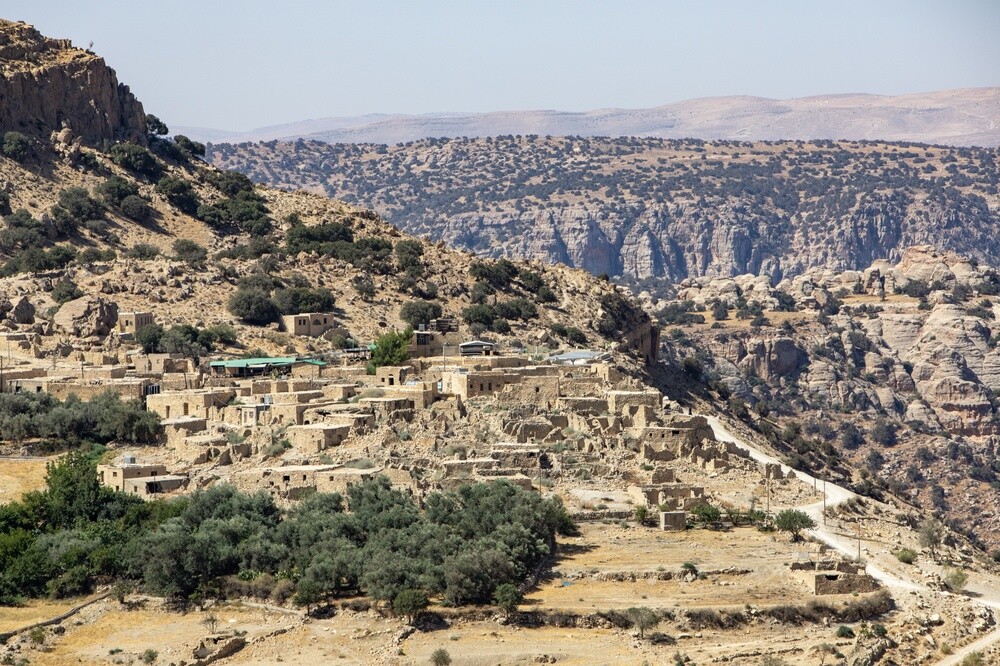
A nature reserve on the edge of the Wadi Araba desert rift, the largest in Jordan. The stone village of Dana sits right above the valley.

Wadi Musa
The town at the entrance to Petra, it lives mainly off tourists.
Friday 26 July 2019, Petra

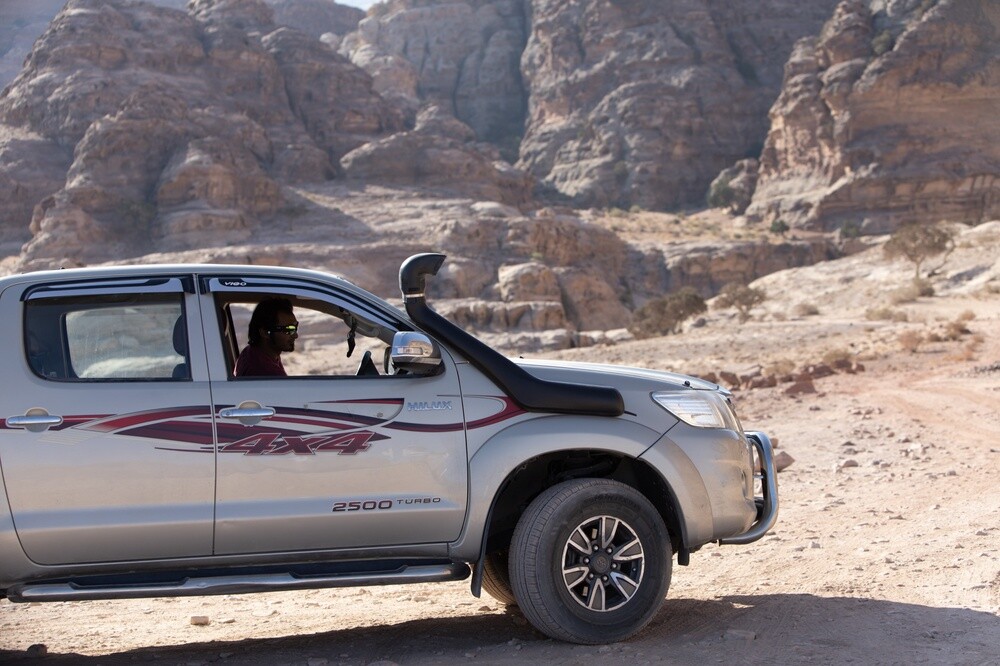
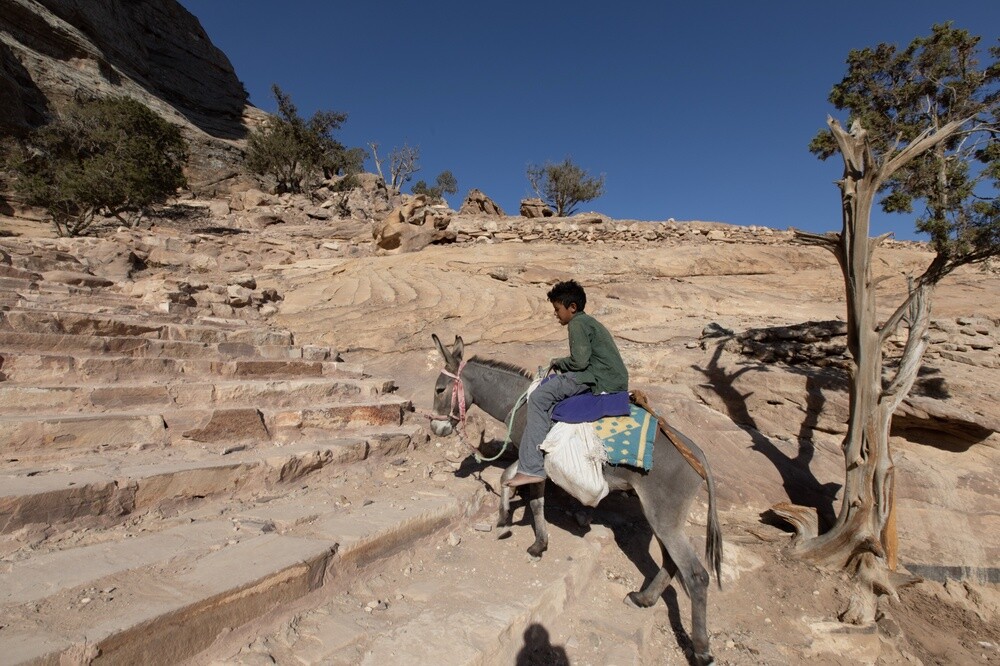
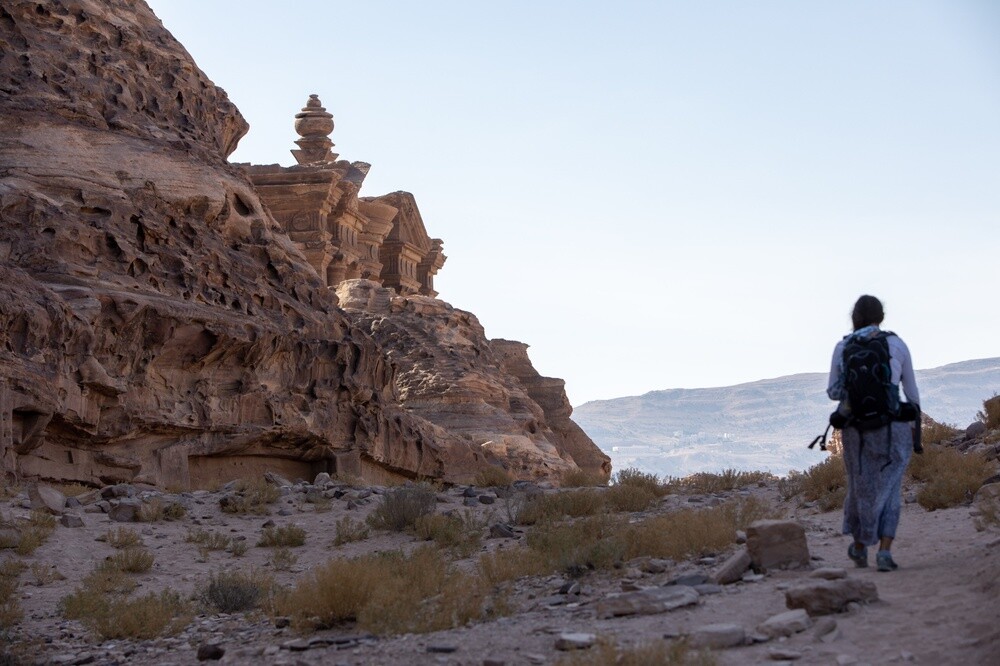
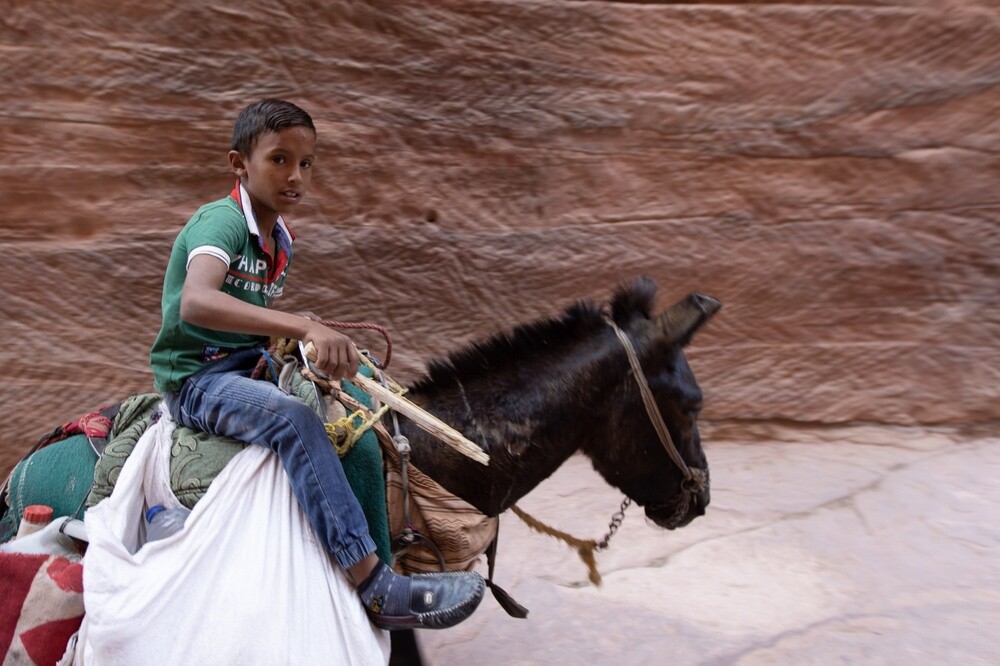
In the morning Shadi drove us in his Toyota up into the rocks above Petra, from where you can take the back route and walk more downhill than uphill. I stood on the truck bed filming, Hanka, with her stitched-up hand, preferred to sit inside. On the way a boy on a little donkey, a drinks stall in the middle of nowhere and trails between the rocks.

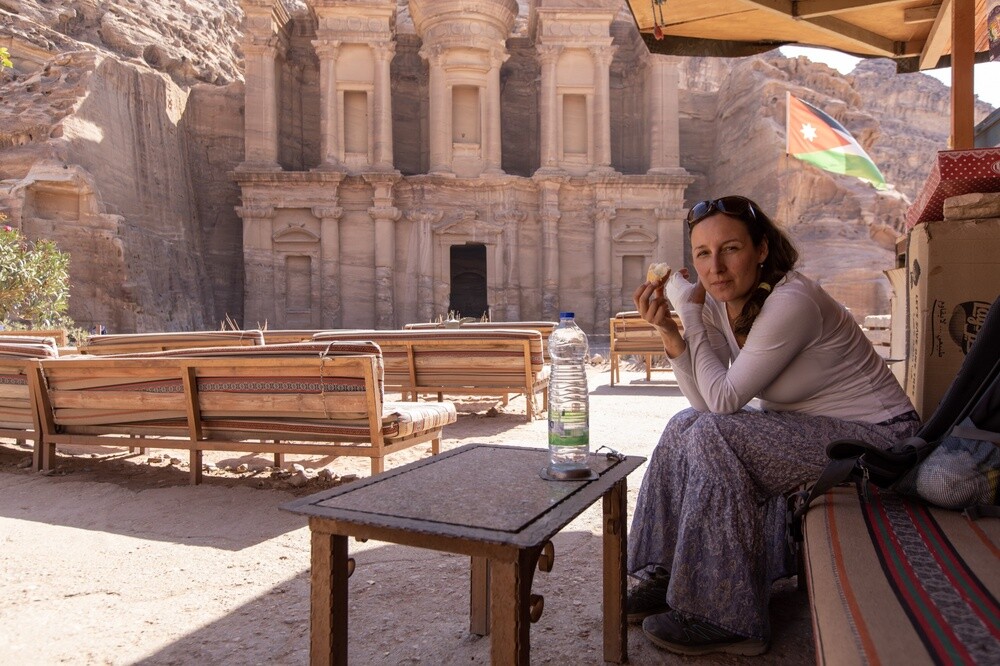
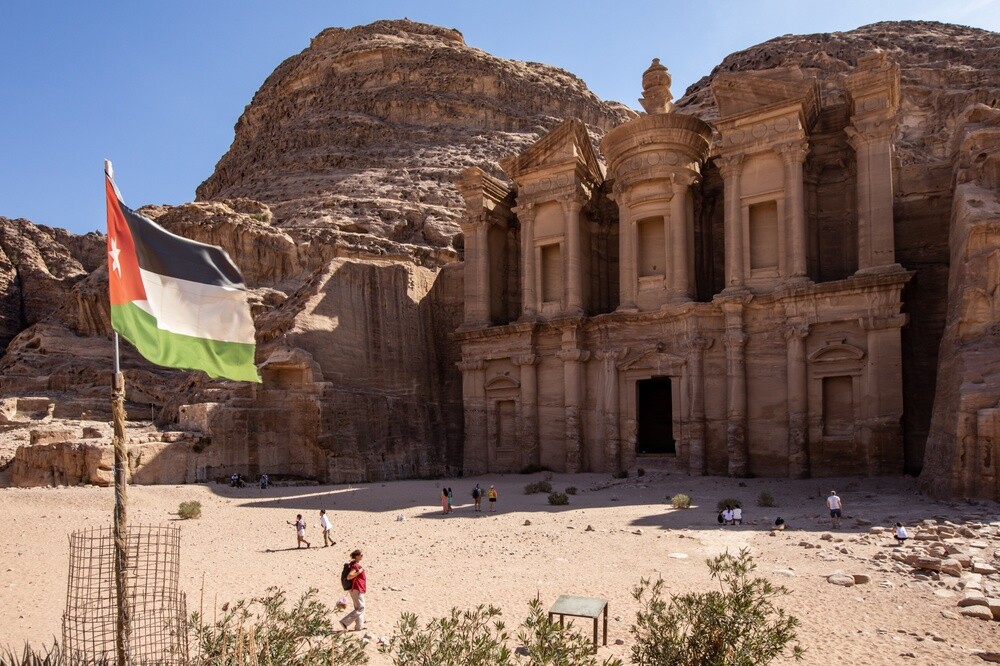
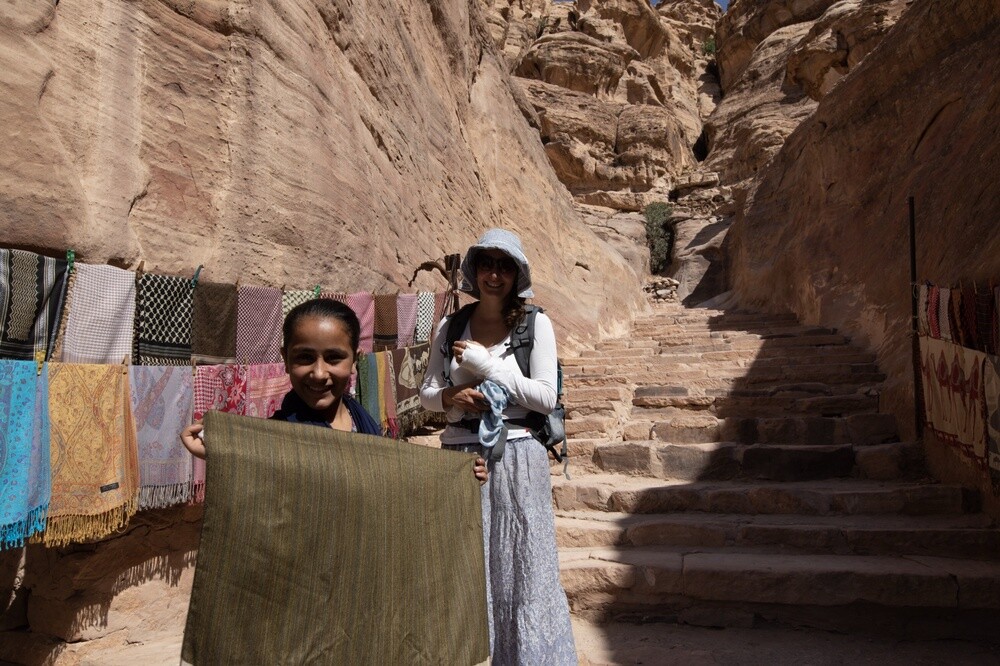
At nine we were at the Monastery, almost without people. Coffee in the shade opposite and a Jordanian flag. Then down hundreds of steps between the stalls. The saleswomen in robes spoke excellent English, for one dinar they offered a scarf “for luck”, and Hanka ended up walking away with a scarf with camels on it and a little cat figurine for grandma Madla.

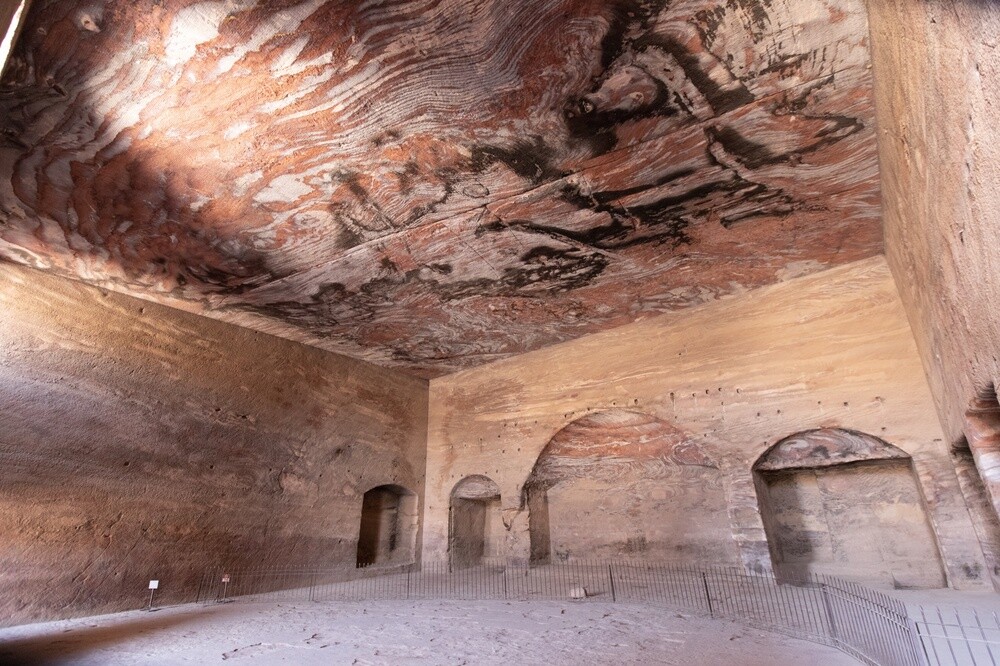
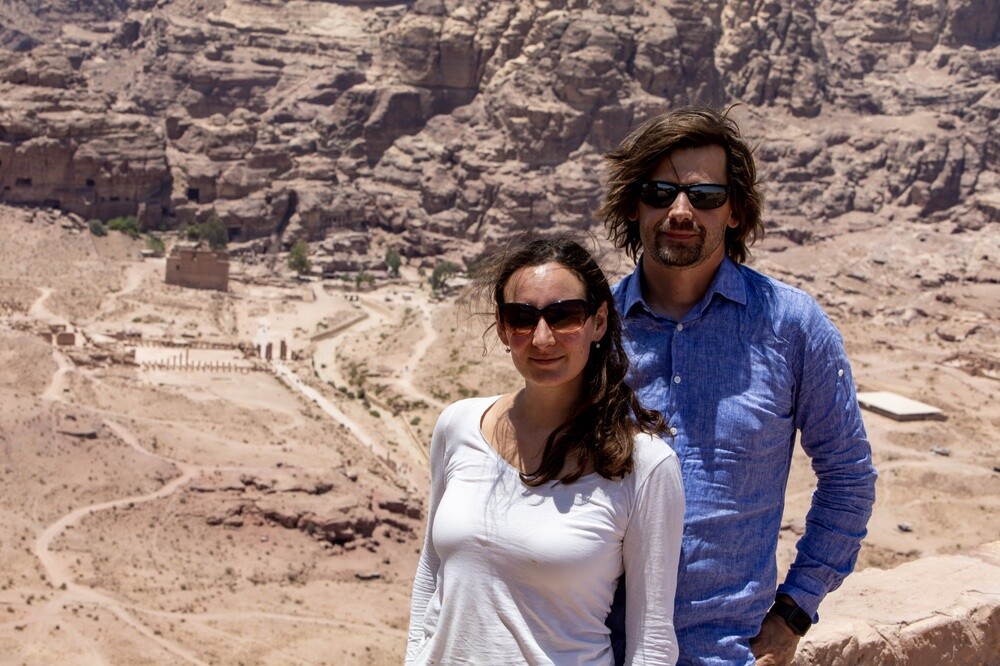
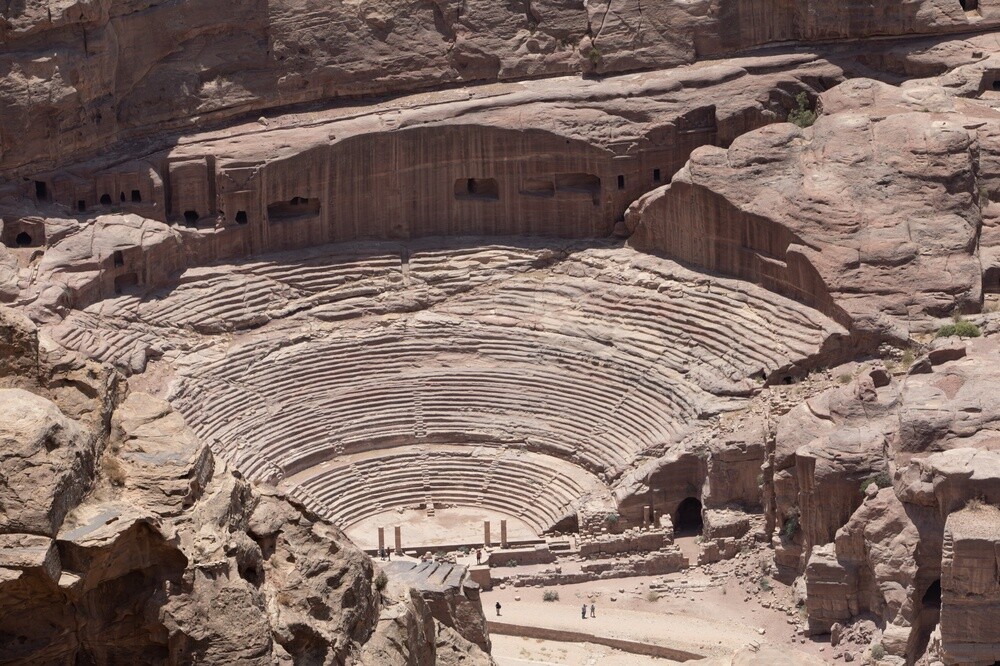
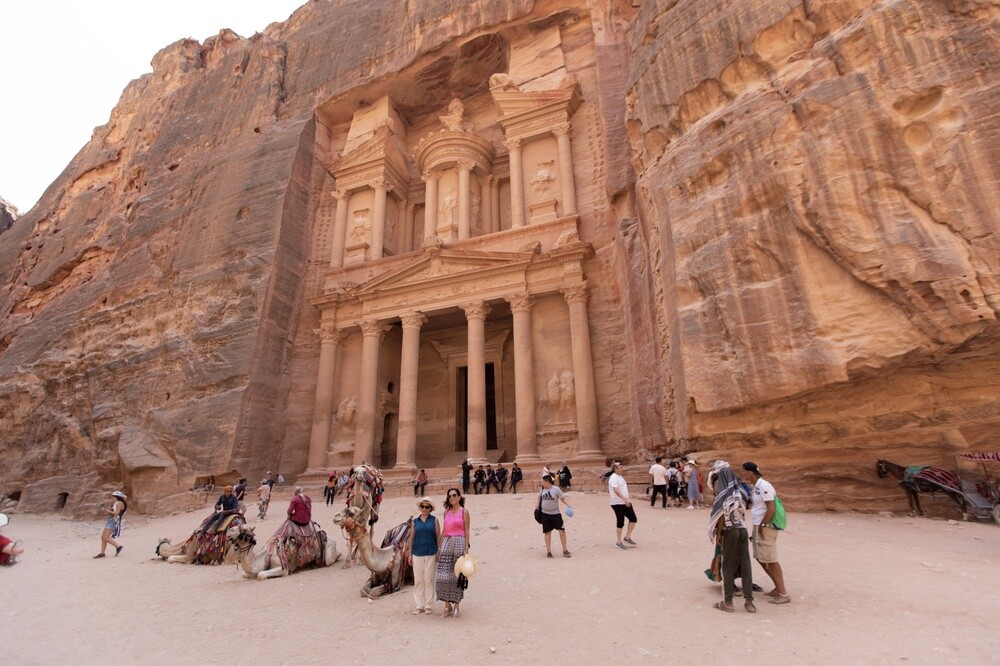
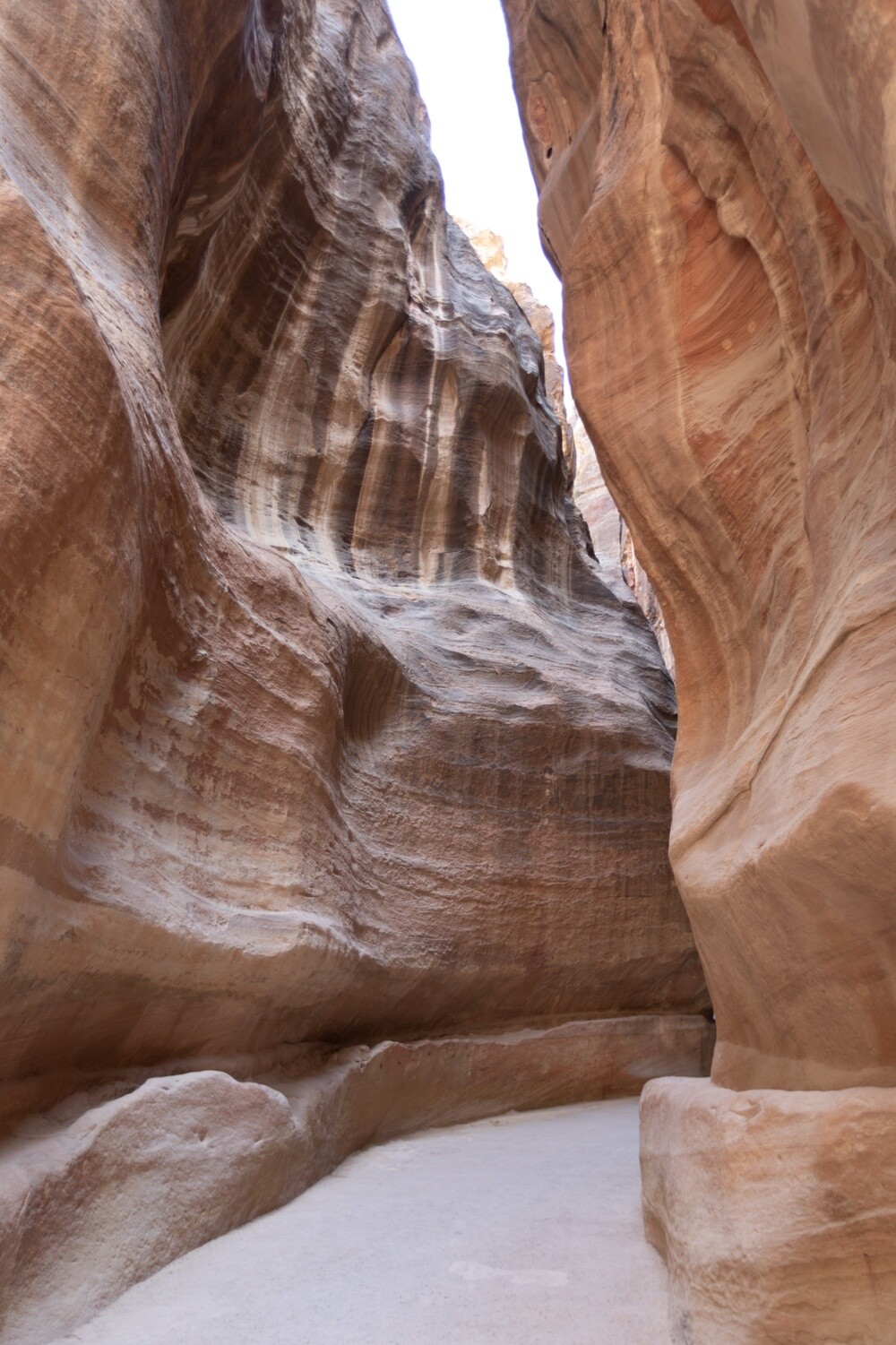
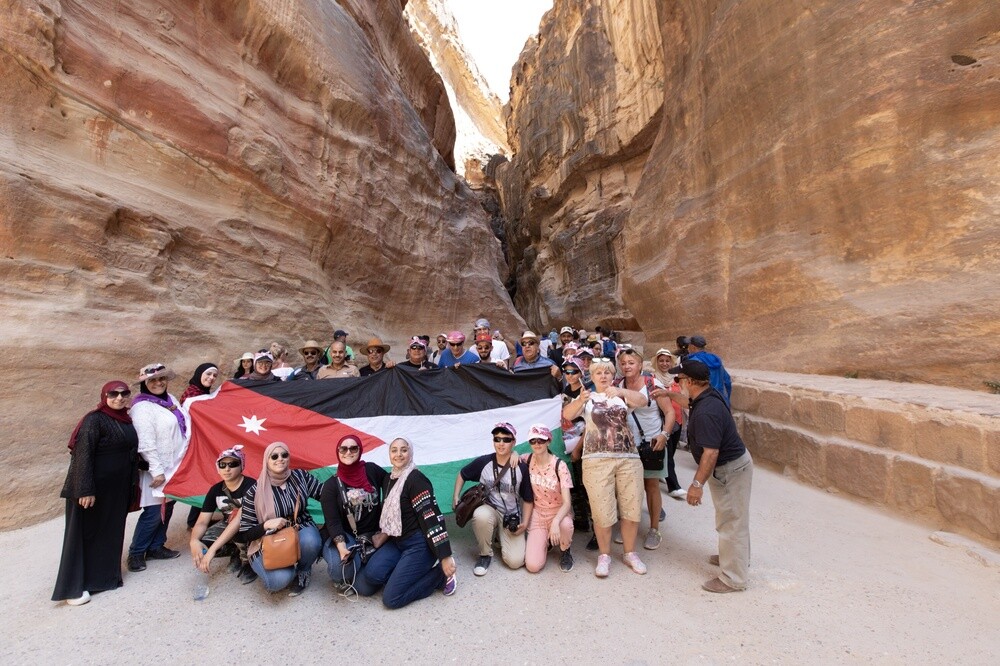
The tombs carved into the rock have coloured stripes of sandstone on the ceilings inside. Above the theatre we took a photo together. Camels and donkeys everywhere, often tied up in the sun without water, and a hungry one-eyed kitten that we gave water and a bread roll to. In the afternoon the Treasury full of tourists and then out through the narrow Siq gorge.

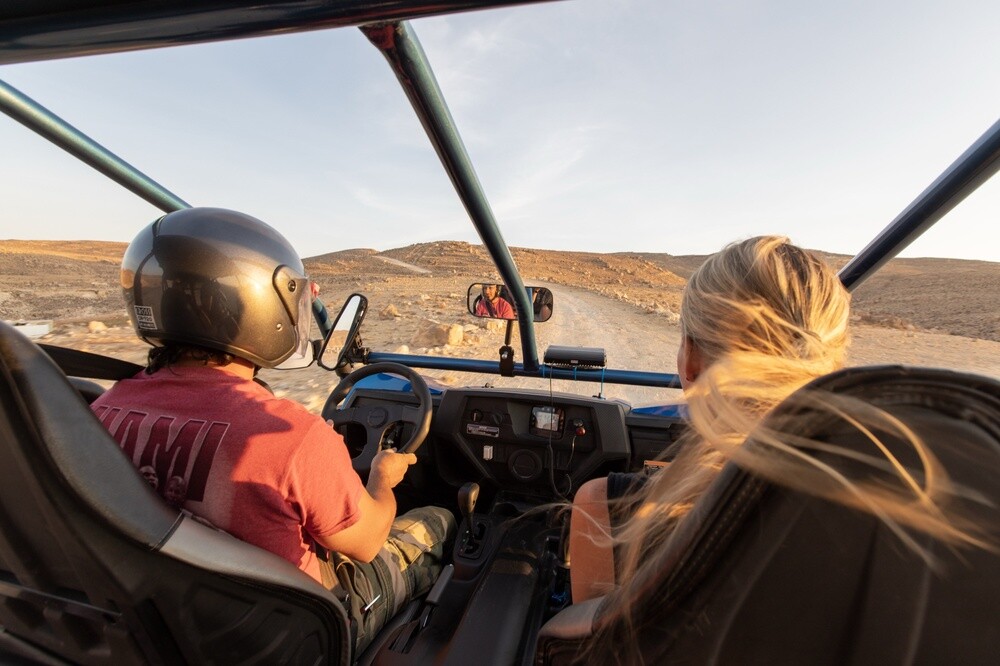
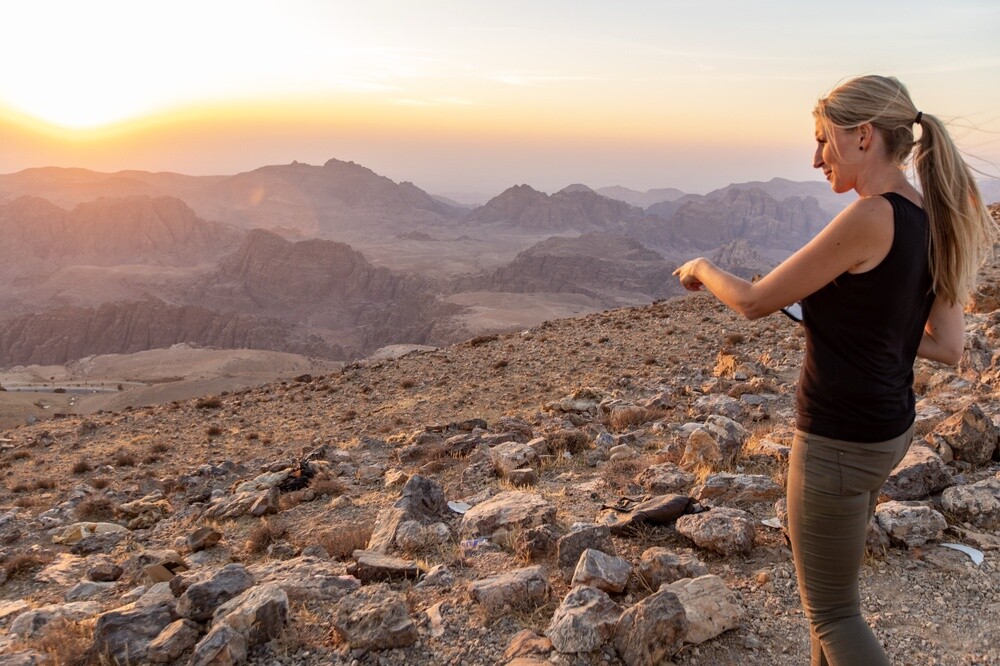
Hanka went for a dressing change and in the evening Shadi took us, along with the German neighbours from the room next door, up the highest hill around in a buggy. He was the only one with a helmet, apparently he's an important person. Up top a sunset over the mountains and then dinner with a view of Wadi Musa all lit up and Shadi's stories.

Hana's diary: Jordan, day seven. We'd arranged with Shadi, our host, that he'd drive us at seven to the far end of Petra. He claimed that the earlier in the morning, the fewer tourists there are and it's not so hot, and that from the far end you can manage it easily, even with a detour it was about 15 km. He drove us in his off-road Toyota, which Honza claimed is unbreakable, that he knows it from the Dakar, and Shadi really did bounce it along the dirt tracks like a madman. He wanted us to stand on the truck bed and enjoy the view, except with one hand I found it really hard to hold on, so I sat inside. Honza stuck it out, though he was trying to film again, so he nearly fell off.

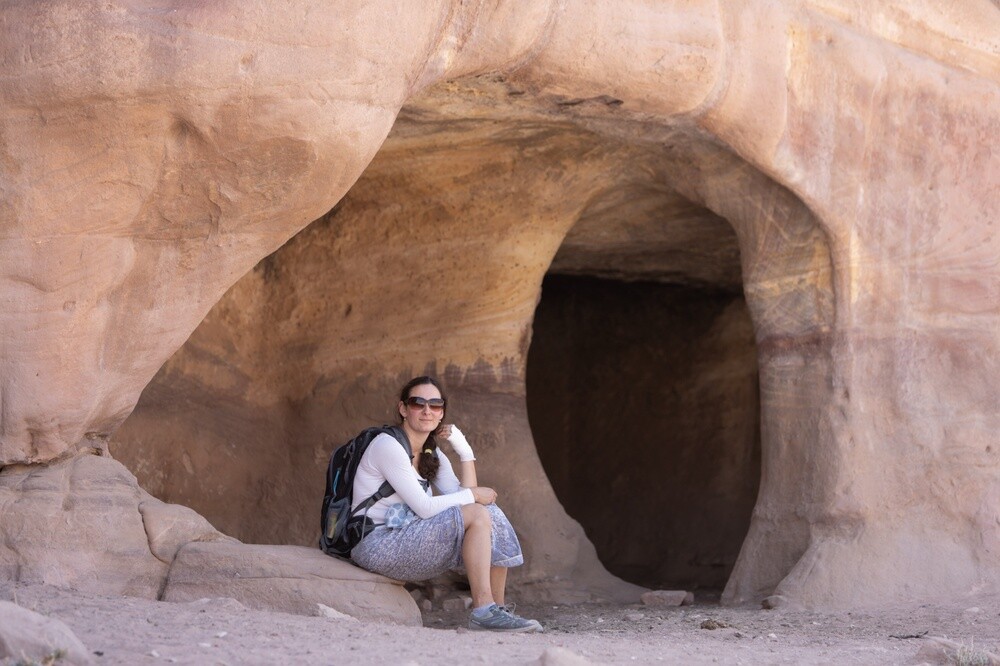
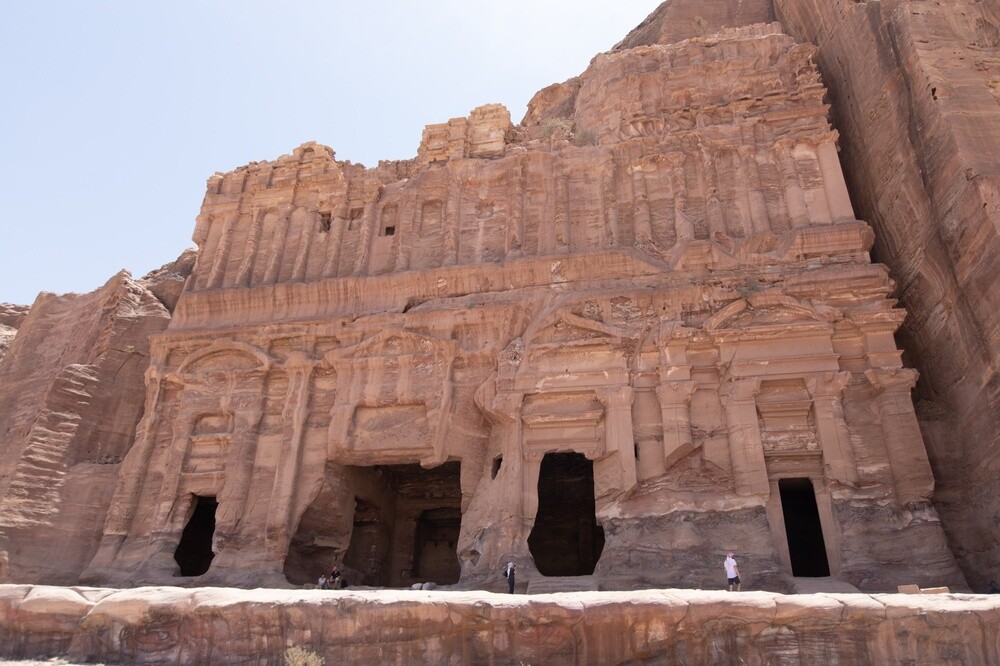
Of course other people had the same idea, so we weren't completely alone there, but there definitely weren't many of them. Mountains, rocks, desert, it was nice. We went plod plod and came to the first of the temples, which were originally carved into the rock as tombs. There are maybe seven or eight big ones, spanning the whole cliff, with an entrance. The structures were built in several phases, the beginnings were about two hundred years before our era. Apparently it was hidden for a long time, at least until the middle of the nineteenth century the public knew nothing about the rock city, until some European discovered it, travelling there disguised as an Arab. Besides the temples there are loads of little dwellings and caves carved into the rocks. It's sandstone, I think, so it was doable, but even so it must have taken a huge amount of work.

Gradually more and more tourists turned up and in places there were quite a lot of them, especially in front of the biggest temple there were crowds of people from all over the world. We met four Czech women our age travelling together. A big part of the route was lined with stalls, run mostly by veiled women and their children. The funny thing was that most of the saleswomen spoke English brilliantly and had their lines down pat: come to us, if you're our first customer you'll bring us luck, I'll give you a discount, just one dinar. If you let yourself get drawn in, it turned out that for one dinar you get the simplest Arab scarf, which is mostly worn by tourists here and is apparently made in China. The other scarves were more expensive, but the prices were good, so in the end I bought a scarf with camels and a tiny cat figurine for grandma Madla's collection. We were totally cracked up by a girl of about thirteen, the daughter of one of the saleswomen, so talkative and with such brilliant English. In a robe, in a dusty wasteland like this, and her English was absolutely top-notch. Honza thinks they have quite a good education system here, because with a few exceptions everyone here speaks English, better or worse.

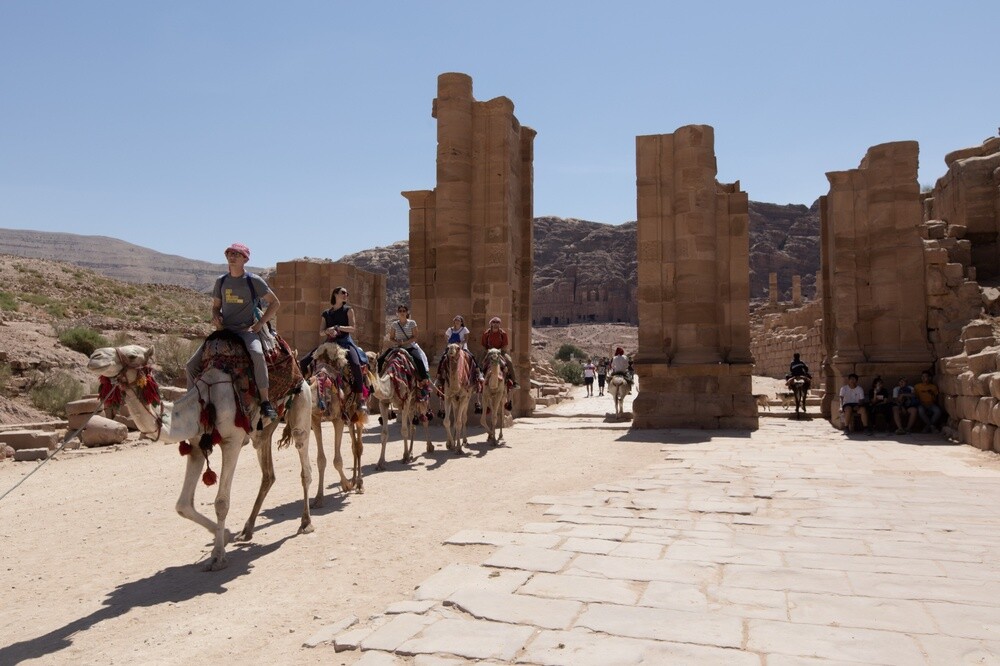
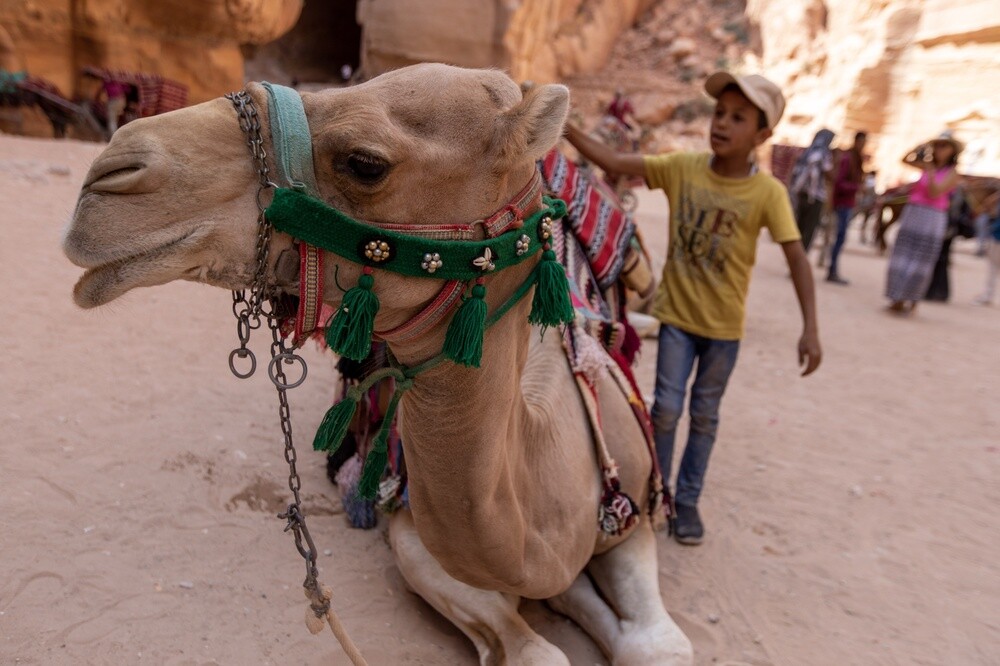
The whole valley of Petra is riddled with animals. Rides on donkeys, mules and camels are offered everywhere. Donkeys apparently climb those steps well, the locals ride them and carry all their stuff and water on them. It looks funny, because when someone sits on a donkey their feet are practically on the ground. But I felt terribly sorry for the donkeys. They look sad by their very nature, they have a sad expression and bray so pitifully, and the poor things were often left tied up in the sun without water. All those animals looked pretty wretched and plenty of tourists were happy to take a ride on them, which I found awful.

We made one detour where it said there's the most beautiful view of Petra. We had to scramble up a horrible hill, but it was worth it. There were quite a few stray dusty dogs and cats, which also looked miserable. We saw a kitten, it could have been seven weeks old, and it was climbing the steps so thin, scrawny, dusty, flea-ridden and one-eyed that I've never seen anything so wretched. It was meowing like crazy, so we gave it a bit of water and a piece of a bread roll, and the poor thing ate it out of desperation. Other people were giving it something too. I don't know if it even has a chance of surviving. As soon as its awful mother saw it had got something, she ran over and wanted to eat it herself. Bitch.

After the trip we were insanely dusty, sweaty and filthy and were glad to shower and change. Then we went to the local hospital for a dressing change, which went fine and cost 10 dinars. Since I don't have a medical report about the first treatment and the stitches, I decided I'd probably just say to hell with the insurance company. I don't know if I won't regret it, because they told me I have to come for a dressing change every day so it doesn't get infected in this heat and sweat. I've kept the receipts, but they're in Arabic and to a Czech insurance company they look utterly untrustworthy.

More guests moved into our little house, nice Germans, Alex and Madeleine, or something like that. Terribly cultivated and intelligent, like all the Germans I know, as if they were trying to disprove my theory from the day before yesterday. He's dark-haired, she's a slim pretty blonde about our age, he's younger. He works at the German embassy in Amman, they've been there since March for about two years and they've absolutely fallen in love with the place. They invited us to spend our last night at their place in Amman and gave us their contact details. But in the end it looks like we won't be sleeping in Amman at all.

Madeleine complained about the Syrian refugees, which Germany is now full of. In 2015 Germany took in about a million of them and now they're gradually bringing over their wives, children and family members, alleged or real. The authorities have a terribly hard time telling the difference, because people say all their documents and wedding photos burned. They ask control questions first to the man in Germany and then to the woman in Syria, and she felt sorry for those who really do have a wife there. She's worried the German economy won't be able to carry it in a few years. In Hamburg alone they apparently had to open 30 new schools. German courses are offered to refugees for free, but they don't go, so they added a free breakfast, and they come, eat the breakfast and run off. Honza doesn't see it that darkly and thinks the German economy will handle it.

Towards evening Shadi came over saying he had a surprise for us, a sunset. He turned up around half past seven with a buggy, a tiny noisy little off-road car with no roof, just frames, with four seats. He was the only one with a helmet, and when Honza asked him how come he has a helmet and we don't, he said he's an important person and cackled about it. There were five of us, so Alex stood in the back holding onto the frame. Shadi drove us up what's probably the highest hill in the area. We drove uphill for ages, and wherever he could he drove like a lunatic, showing off, of course. Up top there really was a beautiful sunset. I'm not especially into deserts, but this was genuinely lovely.

For dinner we again got food more expensive than the accommodation, which is paradoxical. It was good, but actually the same as yesterday, chicken with rice, plus a good soup, desserts and melon. We ate outside with a view of the lit-up town, that was really nice. Shadi entertained us with stories. Once he took his father to Egypt, and because his father only knows the squat toilet and couldn't find one in the apartment, he peed in the shower cubicle. He also told us what a terrible despot his father is. Shadi has seven or eight full siblings and a whole pile of half-siblings. And he said he's been to about 78 countries, which seems pretty suspicious to us, but most of his stories were fairly believable.

I'd hoped we'd finally watch a film in the evening or party with the neighbours, but we all collapsed into our rooms and passed out. Honza still did some photos, I somehow just keeled over. Once again nothing came of the evening.

The previous night there was a huge firework display in Petra until midnight. After a month the students had finally found out their school-leaving exam results and were celebrating with fireworks and, as we found out only afterwards, by firing off a submachine gun.

Petra
The rock city of the Nabataeans, in ancient times a trading crossroads for caravans. It's been on the UNESCO list since 1985.

The Monastery (Ad-Deir)
One of the largest structures in Petra, the facade carved into the rock is almost 50 m high. About 800 steps lead up to it.

The Treasury (Al-Khazneh)
Petra's most famous facade, right at the end of the Siq gorge, most likely the tomb of a Nabataean king from the 1st century.

Saturday 27/7/2019, to Aqaba

Hanka had wanted a Bedouin rug ever since Petra. Shadi of course sells rugs too, so at his house we walked away with a long dark red kilim, supposedly from the fifties, for 70 dinars. In the morning one last view of the mountains around Petra and then off to the south.

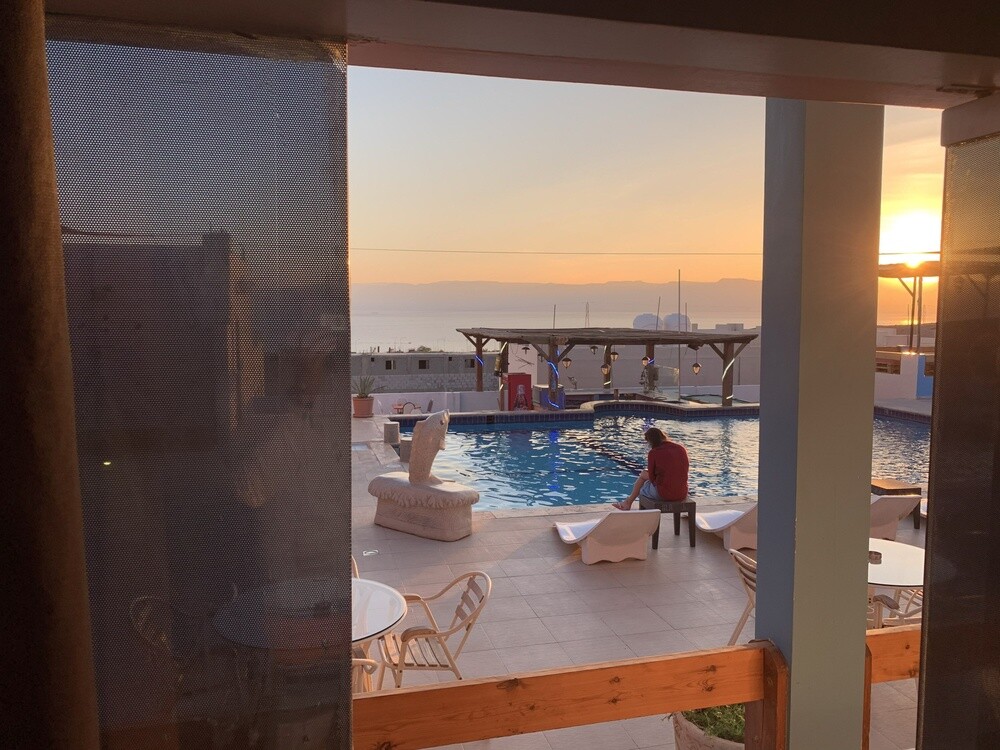
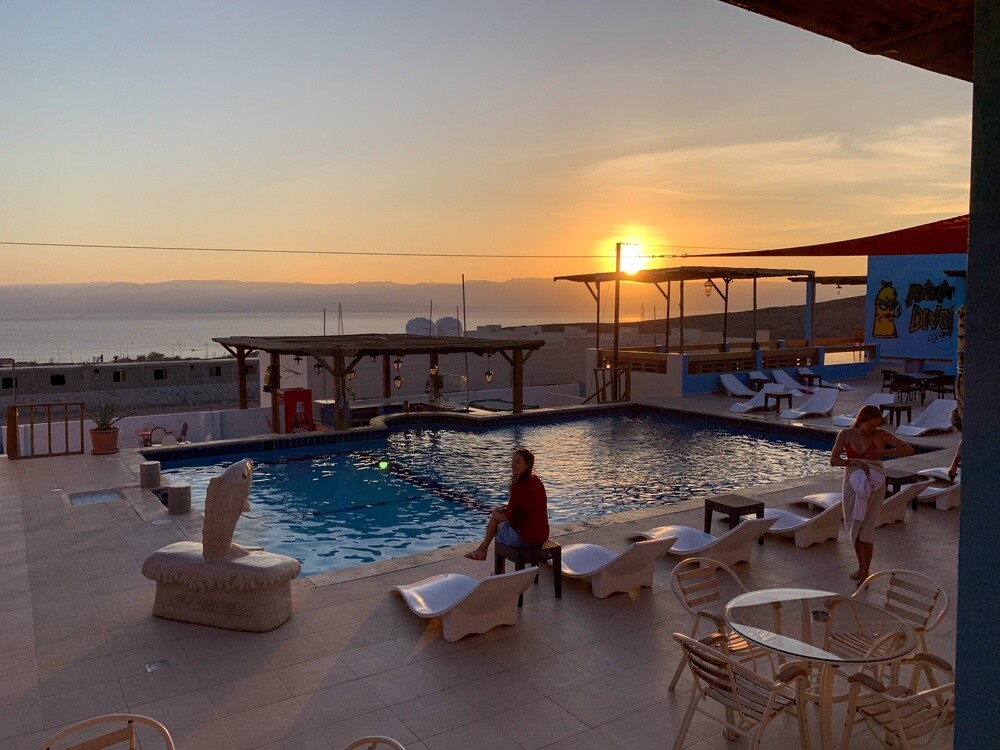
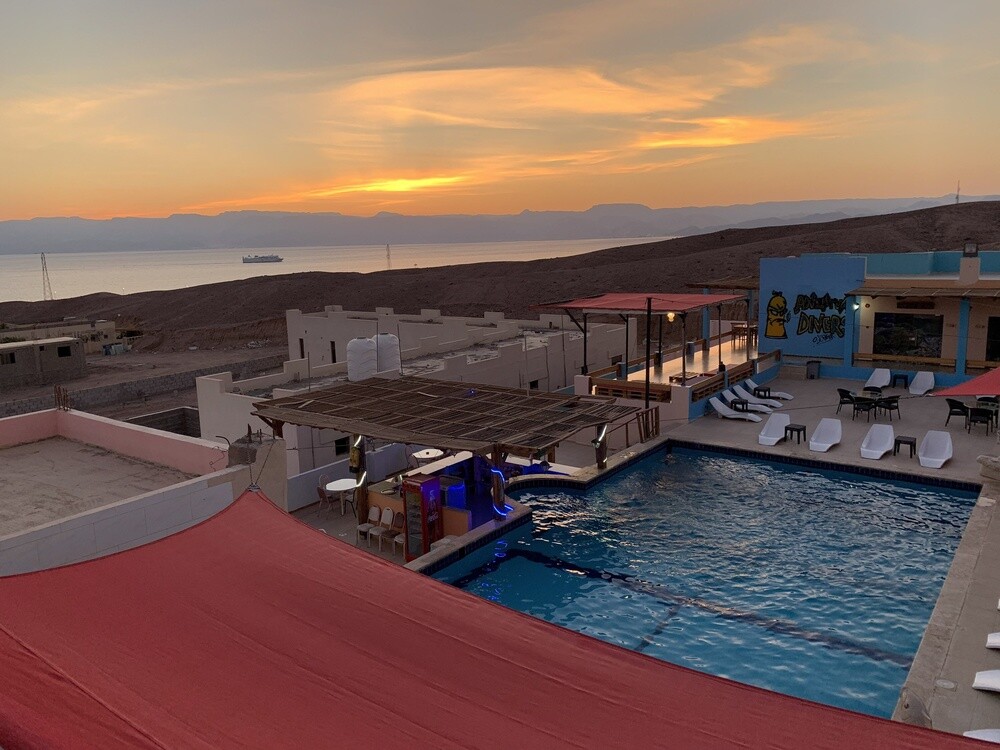
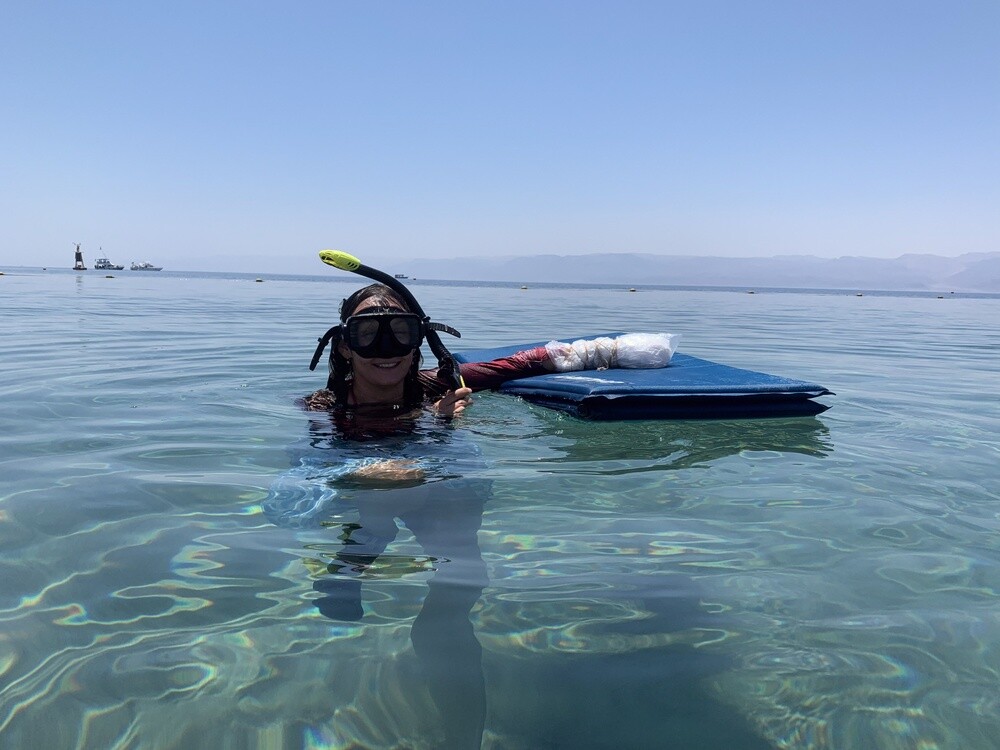
The night in Wadi Rum that Shadi was arranging for us got pushed back by two days, so we drove straight to the Red Sea. We stayed at a diving centre south of Aqaba, in a little hotel with a pool, our room was called Kingfish. They whisked me underwater right away. Hanka wrapped her hand in plastic bags, grabbed a folded sleeping mat and swam with it, and when I lent her a mask she found out that the stones underneath her were corals full of fish.

In the evening another dressing change at the hospital in Aqaba, where they swapped Hanka's antibiotics for stronger ones because of the swelling. At eight in the evening it was still 38 degrees. At the liquor store I bought a stash of Petra beer, sunset over the Red Sea and dinner outside on the street.

Hanka's diary: Jordan, day eight. In Petra they were selling beautiful little rugs at the stalls, those Arab wool kilims. I love them and I've wanted one for ages. Honza of course forbade me from buying anything like that in the middle of a hike in Petra. But I asked Shadi whether he might know of something. He's a clever one, he knows everything, he's heard of everything and above all he can arrange everything. So naturally he said he sells rugs too, and took us to his house, the building next door in a similar style to ours. He lives there, probably with his sister and her two small kids, adorable, about four and two years old.

Shadi rolled out several rugs, they had ten or fifteen of them there, and I hesitated terribly. He offered us a Bedouin one, according to him from around 1950, really long, very pretty, dark red. In places it was already slightly torn, but he said not to worry about it, that it should stay that way. There were smaller and newer ones too, but I liked the Bedouin one best, so in the end we took it. It cost 70 dinars, a bit over two thousand crowns, and Shadi of course assured us it was a good price. I suppose I believe him. I'm delighted with it, I just don't know where we'll put it. Shadi said we could cut it in half and make little tassels at the ends, but that would probably be a shame. We'll see when we get back from America. We don't have much stuff, so hopefully we'll cram it into a backpack.

Then we set off further south. Jordan is pretty small, so it wasn't far to the Red Sea, which was where we were headed. It's the southernmost part of Jordan and Jordan has only a tiny bit of Red Sea coast. Israel to the west of it has even less, but it's probably enough for them, they're glad to have access to the sea and shipping to the east. I admit I knew almost nothing about Jordan, not even exactly where it lies. The map is interesting to look at: the Red Sea is a sort of cone and at the top it has two little antennas, two narrow inlets, and at the tip of the right-hand antenna is Jordan.

We'd agreed with Shadi that we'd meet in the evening in the Wadi Rum desert and he'd take us away from the other tourists for a night under the stars. We experienced that once in Libya 21 years ago and it was lovely, so we'd like to do it again. We'd already paid him, but during the day he got in touch asking whether we could postpone it, because the husband of another of his sisters crashed his car, he's in hospital and he might have to help out. It turned out our flight isn't until Tuesday at six in the evening, so we agreed to push it back by two days. We'll stay two nights by the Red Sea and on the last night we won't sleep in Amman at the Germans' place, but in the desert with Shadi. Wadi Rum is in the south, but Jordan is so small that you can easily drive across it in one day and we'll make the plane.

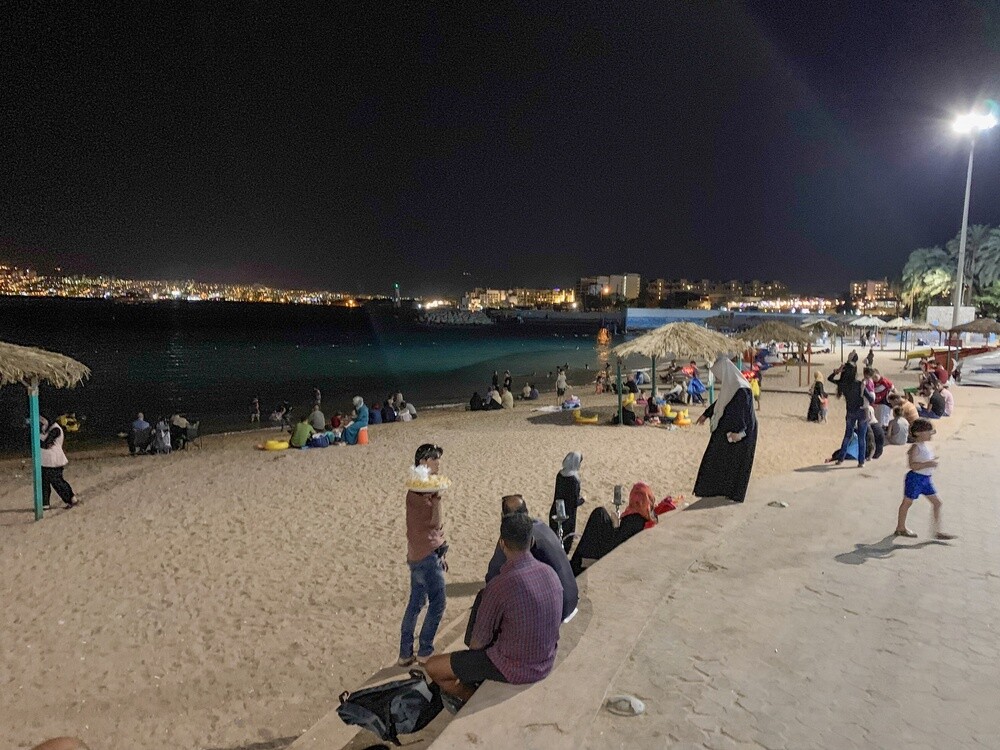
We drove through the town of Aqaba, which is right at the tip of that antenna, and continued a bit further along the eastern shore. I was surprised at how there's nothing here. I thought that on such a short stretch of coast there'd be loads of hotels and tourists, but not at all, it's half empty everywhere. Locals clearly predominate, they gather on the beach only in the evening, from about six or seven, and stay here into the night. We meet maybe ten tourists a day. Which is nice.

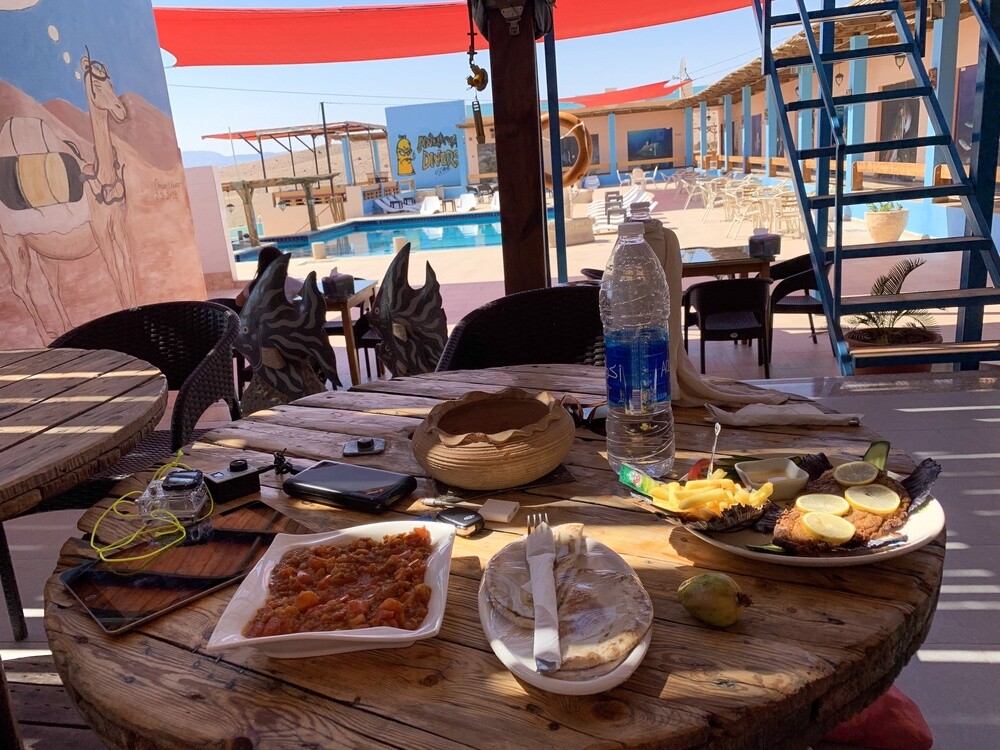
Honza found a diving centre on Booking, there are several of them here, and we immediately understood why. The centre is also a nice little hotel, traditionally a bit scruffy. As the crow flies it's 400 metres from the sea, but you have to go along a scorching road, so we drive a bit along the coast where the centre has its base. They grabbed Honza straight away to go diving, so he put on a wetsuit, tank, fins and all the other junk and off they went into the sea.

I went to the beach. The beach isn't much, sort of scruffy sand. Luckily they collect the big rubbish, but there are a million small bits, so you wouldn't want to walk here barefoot. The odd palm, a bush here and there, and the sea looks gorgeous. The beaches in Croatia are definitely prettier and nicer, but even so it's lovely.

Honza was underwater, so I thought I'd test whether I could get into the water somehow with my injured hand. Arab women predominate on the beach, of course covered from head to toe. They either have normal robes or terribly funny swimsuits made of the same material as ours, but it's actually a hoodie with long sleeves, long enough to cover your bum, with a hood instead of a headscarf, plus long trousers made of swimsuit fabric. So I feel silly being here in a bikini, I wouldn't feel entirely comfortable even in a one-piece, although tourist women mostly wear ordinary swimsuits. I bathe in Tereza's little blouse with a scarf around my hips, so at least I'm somewhat covered. It's practical, I don't have to put on sunscreen, and when I get out of the water the wet rag keeps cooling me, so I'm not hot within five minutes.

I wrapped my hand in several plastic bags, took a sleeping mat folded in half and threw myself into the sea. And to my surprise it worked perfectly. For a long time I swam with my legs, both hands on the mat, and I was thrilled that I could be in the water. Mask and hat on my head, I swam about 300 metres there and back. On the way back I met Honza, who'd just got back from the dive, and he says: Please, put on a mask, it's fantastic here. So I put it on and found out I can dip under quite well if I leave just that one hand on the mat and have the rest of my body in the water.

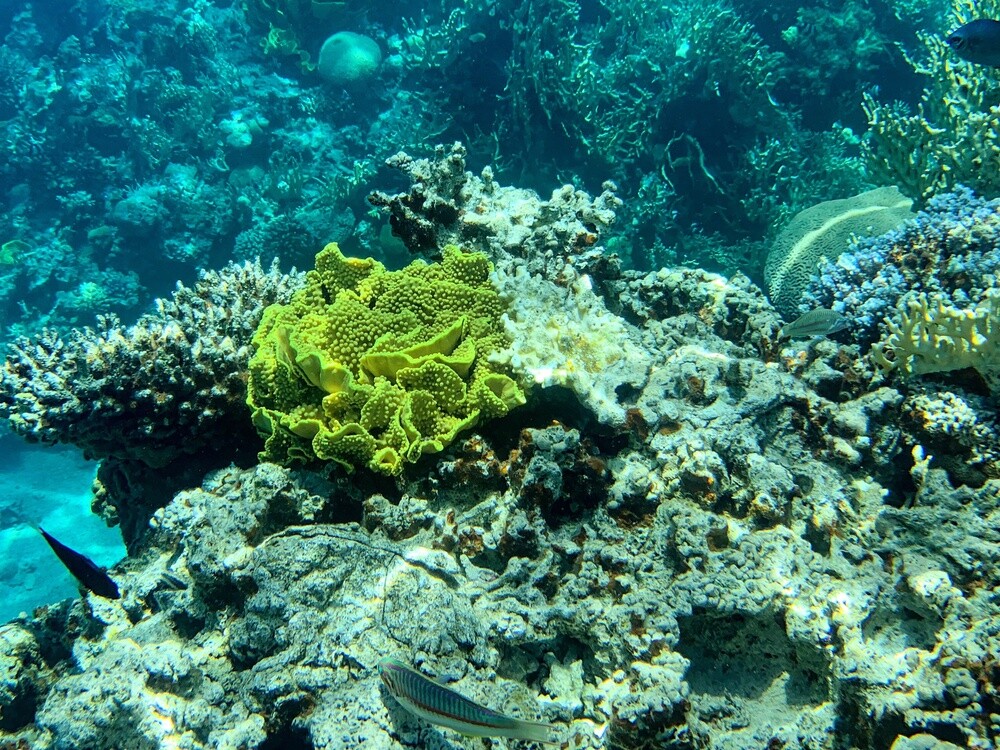
I looked underwater with the mask and snorkel and was absolutely stunned. I had no idea what I'd been kicking into and treading on down there, luckily I had sandals. I thought they were rocks and stones, and it never occurred to me in my wildest dreams that they were coral reefs, beautiful ones, and that thousands of fish swim among them. Until you take a look underwater you have no clue. It's a terrible contrast to the deadness up above the water, where it's dry, desert, the odd palm or shrub, and underwater there's life like mad. What shocked me most was how close to the shore it is. There are corals even in places where you can comfortably stand, so you don't even have to worry about a shark eating you.

We decided to stay at the diving centre as well and got a little room called Kingfish. The hotel is single-storey, a row of little rooms in an L shape around a small courtyard with a pool and a bar where there's never anybody. On one side there's a partly roofed dining area, a few tables made of cable spools, not out of necessity but because it's cool. The little rooms have glass doors with big pictures stuck on them, see-through from one side, with photos of the fish and sea monsters that live here. Quite nice.

The hotel is run by a huge fat Arab who really does look like a boss. All the divers and the staff, all men, are small and among them he's the boss. But he's terribly kind. Everybody here is kind. At first you were suspicious that if somebody speaks to you they want something, usually money. But it turns out people here are kind of their own accord and don't want anything from you. They just ask in a friendly way what's wrong with your hand, and above all where you're from, and when you tell them, it's welcome, welcome. Both men and women speak to us, even to me on my own. I was worried they might want to harass me somehow or rob me, but they just say hello out of interest, ask something and walk on. Madeleine said they told her here that the greatest danger threatening you here is a car crash on the road. Nobody stole anything from us, nobody mugged us. I left a bag on the beach unattended for an hour, for instance, and nothing happened to it, even though plenty of locals were milling around.

In the evening we drove into Aqaba again, about 20 minutes, to the hospital for a dressing change. It turned out my hand was horribly swollen, part of the scar was healing nicely and part of it was nastily weeping. They called in two doctors for me and they first said surgery might be necessary. They speak beautiful English, but the pronunciation is really funny, they don't even try to imitate original English. Fortunately surgery wasn't necessary, they just swapped the antibiotics for stronger ones and gave me pills to bring the swelling down. It threw me and I was afraid how it would turn out. Luckily it then started going well.

We hung around town for a while. It was insanely hot, at eight in the evening still about 38 degrees and at eleven still about 34. It radiated out of the concrete and asphalt. Where we're staying it isn't that insanely hot. We also found out that if you soak thoroughly in the sea before leaving for that concrete hell, you cool down inside too and it lasts you a long time. We did that the next day.

We went to buy water, which reminds me of my guilty conscience about how much plastic waste we're leaving behind here. You can't drink tap water, so you drink bottled, and in that heat you get through two bottles a day. The hotel does have a bin for plastic and paper, but 90 percent of the time they don't recycle here, Shadi didn't even really know what I meant. They probably burn it. Then we stopped by a liquor store, because Honza suffers terribly here without alcohol. There's no prohibition, but you can hardly buy alcohol anywhere, only perhaps in five-star hotels or in specialised shops, of which there are very few. Honza enthusiastically bought a pile of Petra beers. In the evening we collapsed from the heat, completely wrecked like corpses. So again no film. Honza said that with the local wifi you can't even download a film, so I gave up on that hope.

Sunday 28/7/2019, Aqaba

In the morning I went diving again. Around the centre there are sunken vehicles accessible from the beach, a tank, a plane and a ship, all overgrown with anemones and corals. Hanka rested in the morning and in the afternoon went snorkelling again with her arm propped on a foam mat. Brain-shaped corals, a pink "cauliflower", clownfish in anemones and a fish that according to Hanka looks like a torn-up rag.

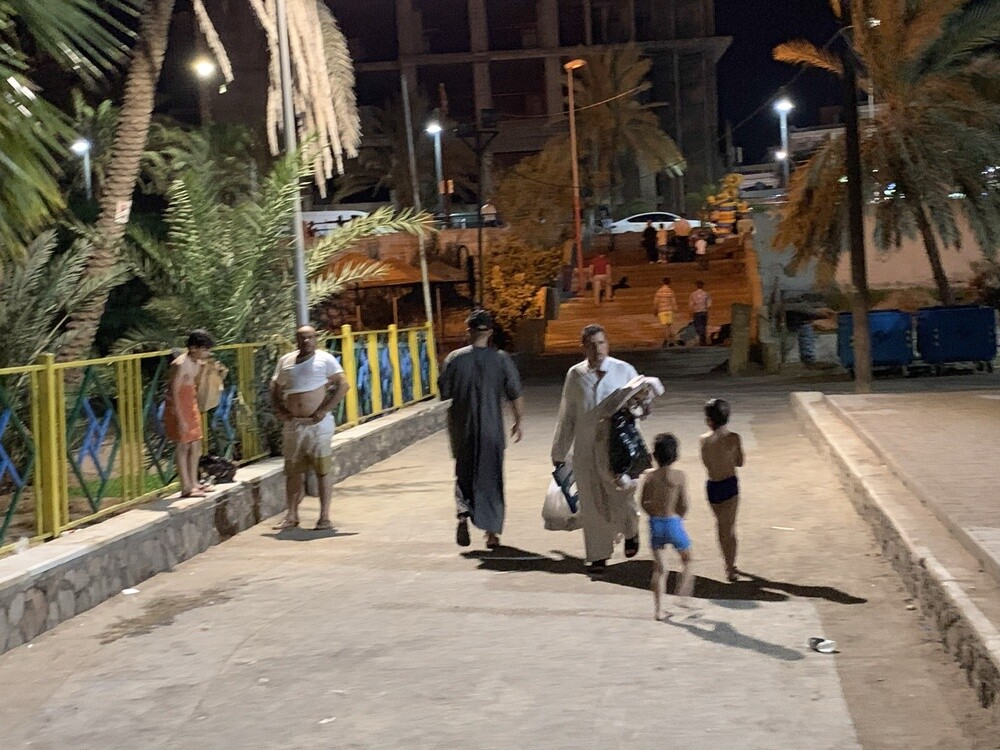
Food on the hotel terrace, shopping for tea and cardamom coffee in town and the evening on the town beach. Local families swim and picnic even after dark under the lamps and within twenty minutes ten people asked us where we're from and how we're doing.

Hanka's diary: Jordan, day nine. While at Shadi's place in Petra, high up on a hill, the wind kept blowing and at night it was beautifully cool, here by the Red Sea the night was horribly hot. We had to keep the air conditioning on, which wasn't very pleasant, Honza grumbled that it gave him a bit of a runny nose.

One more digression. I've long wanted to add that the ecocamp in Wadi Dana, where I later tore my arm open, lies about 1500 metres above sea level, and we drove up there from minus 400 metres at the Dead Sea. Quite a huge difference in altitude, but luckily we didn't get altitude sickness.

I didn't sleep very well, plus I was still rattled by my arm, that it's swollen and not healing, and I didn't feel like doing anything. So Honza set off to the sea to dive and I lounged around the room until lunchtime. Why not for once, when you're on holiday. I was dealing with correspondence with Tereza and we were trying to work out where we'll go on our joint trip, which I'm also really looking forward to. Our youngest is perfectly happy at Tereza's, which makes me terribly glad and I'm grateful for it. Tereza treats him like her own and he treats her almost like a mum. He does count on his little fingers how many days we're still away, but otherwise he's completely cheerful and he even falls asleep on his own now.

We spent almost the whole rest of the day by the sea, we only drove to the hotel to eat. More and more I was trying to dive, well, with my arm on a floating foam mat. It's unbelievable what's under that sea. They take divers to various spots and you don't even have to go out by boat, they enter the sea straight from the beach and swim there. In one place there's a sunken tank, in another a sunken plane and in another a sunken ship. We don't know which of them got there naturally and which were planted there for the tourists. In any case it's all overgrown with anemones and corals and fish swim around in it. Honza filmed it all and was absolutely thrilled.
Honza has told me many times how fantastic diving is, but it never really grabbed me, because underwater there was never as much to see as here. And the amazing thing is that these beauties are just a few metres from the shore, five, ten, fifteen metres. I have to say I'm genuinely in awe. There are brain-shaped corals of various sizes, pink corals that look like a pink cauliflower, all sorts of anemones and all kinds of leafy creatures waving in the sea currents. And an incredible number of all sorts of fish. Afterwards we tried to find them on the internet.
Yellow, orange, striped, white with black dots, yellow and white with black stripes running forwards, backwards and diagonally, flat ones, orange ones. Clownfish, there are loads of them here and they love hiding in the waving anemones. Then I saw a green fish about 30 centimetres long with a blue head and yellow tail. One brown one that looked like a little pig, it had a pretty unfriendly face and side fins like ears and it twirled them like propellers. And one brown and white one, ugly, was on the sign listing the dangerous creatures. It looks like a torn-up rag, it waves about in the water and stays in one place, all lace and fringes. Interesting, but pretty ugly. Black fish with orange or yellow fins, blue and yellow fish. Just unbelievable. I don't think they'd be any good to eat. Tereza would definitely be happy here, I think she should come here or somewhere else on the Red Sea.
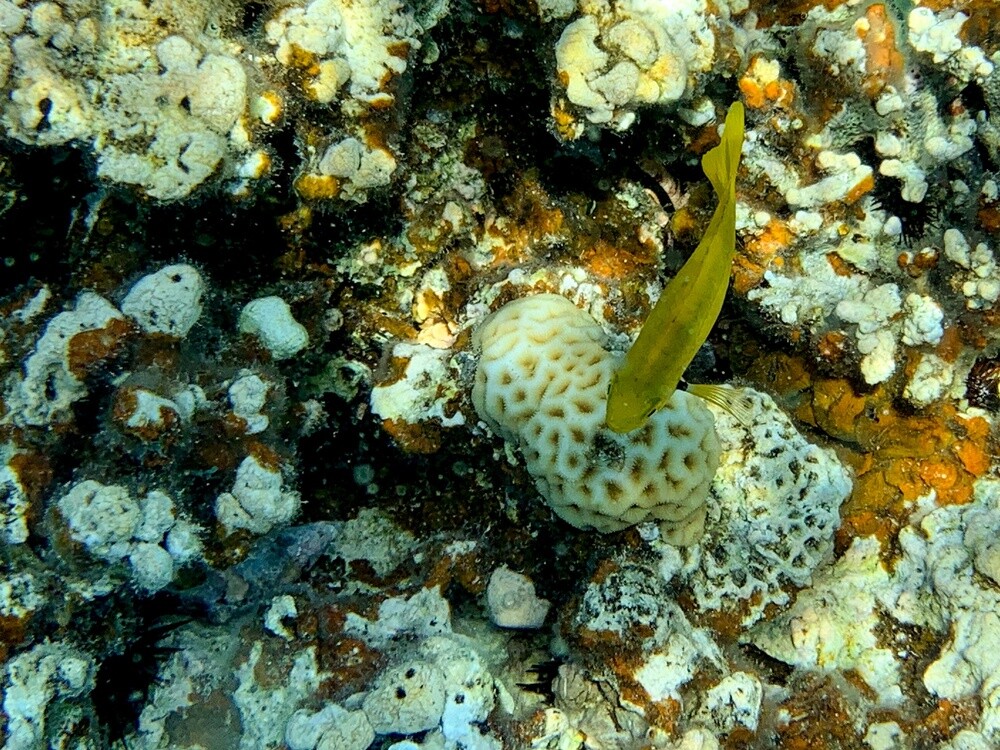
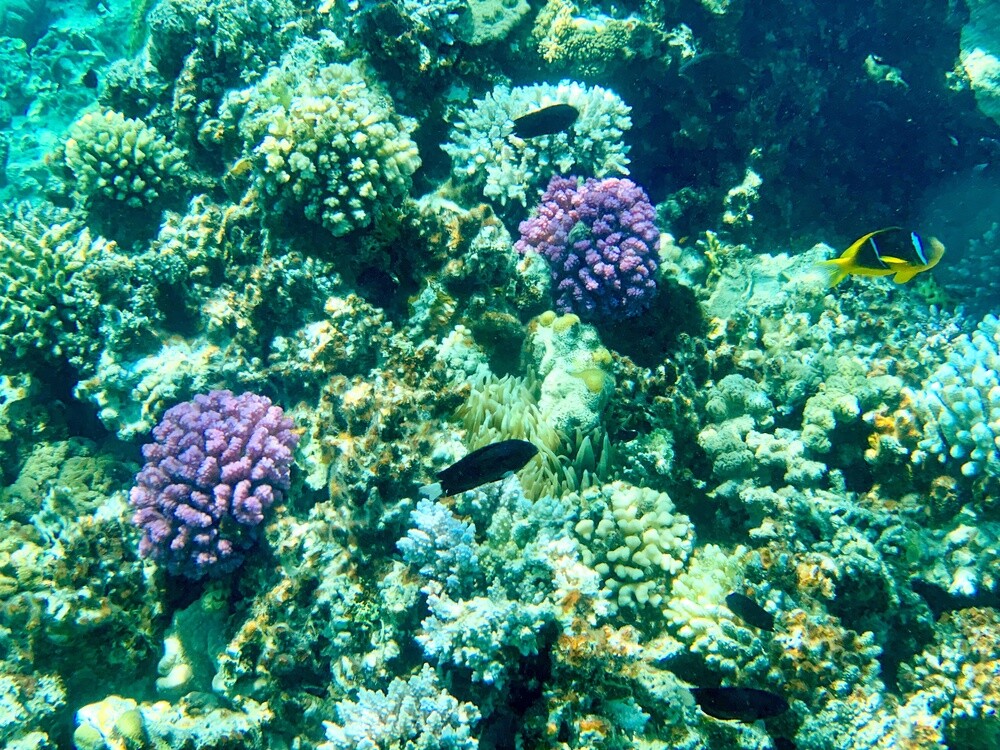
From the beach we look at the other side of the sea and that's already Egypt. But there you risk the pharaoh's revenge, apparently everyone gets the runs there. And we haven't messed ourselves even once here. I read quite a lot, that was nice. In the evening we went again for a dressing change and luckily the arm started to go down a bit, so that's good. Messages came from our daughter, she's on her way through Poland to Lithuania, they're going to cycle there and they're taking our Sharan. I'm quite envious.

In town we bought loose-leaf tea, black tea which Honza bought, and Bedouin tea, a mix of loads of herbs, smells nice. And loose local coffee mixed with cardamom, it has a peculiar flavour. They sweeten everything insanely, tea and coffee alike. Wherever you go they offer you a shot glass of tea, it's funny. In Petra I rashly had one shot when the shopkeeper we bought something from poured it for us. Then I thought I'd probably get hepatitis, because I'm probably not vaccinated anymore and god knows who's been licking it and whether they even wash it. Yuck. So let's hope not.

Then we bought some disgusting fast food, it was supposed to be a kebab, but it was mainly chips, in a plastic box too. We took it to the town beach, it was at least ten in the evening and it was packed, kids were bathing in the dark under the lamps. That was fun, they were splashing around, shrieking and hollering. There were only locals, not a single tourist, but in the 20 minutes we sat there at least ten people came up to greet us and ask how we're doing, or the kids to ask what our names are. They're really lovely.

We were wondering under what conditions these kind, welcoming and good people, who help you selflessly, turn into terrorists or fanatics capable of a suicide bombing. All in the name of holy war and Allah. I don't know, everyone here worships Allah. I'll try asking Shadi.

On the beach there were only locals, but otherwise there were quite a few tourists in Aqaba. Most of the European and American women were at least more or less covered up, shoulders and knees. But then there were the types I was ashamed of, one lot were Slovak and then Russian women. Russian women completely ignore the local standards of decency. Yesterday we met one who we were sure was Russian, well past her prime, squeezed into a horrible little tank top and shorts with her backside hanging out of them, and she was wiggling around there. It made us want to disappear, let alone in this environment.

Aqaba
Jordan's only port, at the end of the Gulf of Aqaba on the Red Sea. On the other side of the gulf you can see Israeli Eilat.

Monday 29/7/2019, snorkelling and Wadi Rum

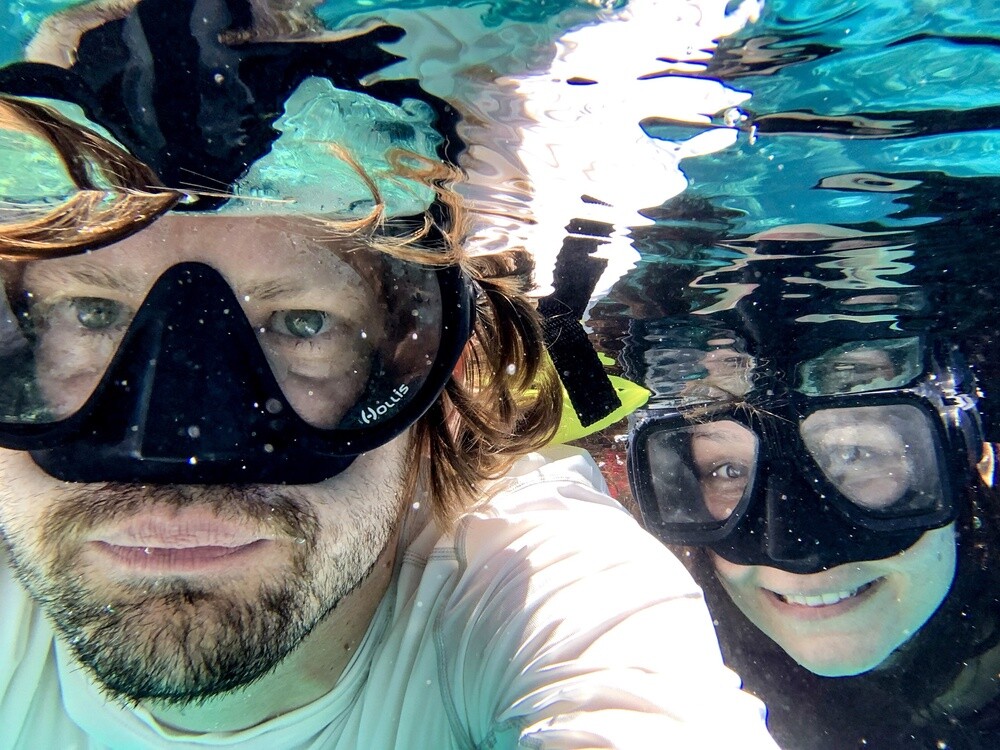
Snorkelling by the corals on Aqaba's southern beach in the morning. Hanka snorkelled too, with her stitched-up arm on the foam mat, and we took a selfie together underwater.

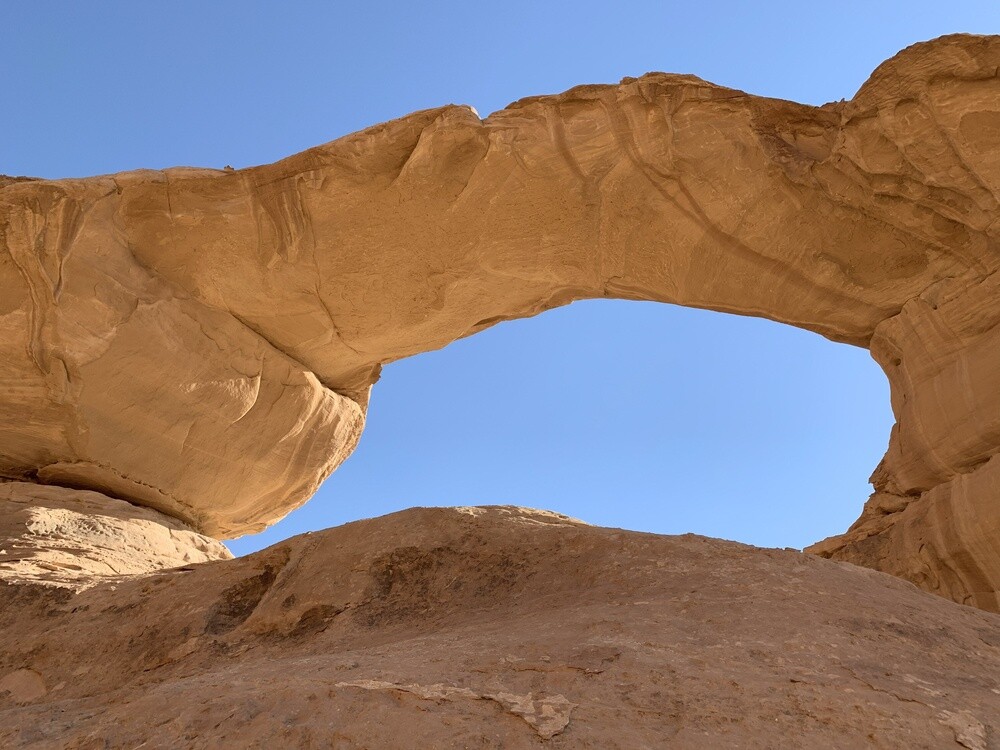
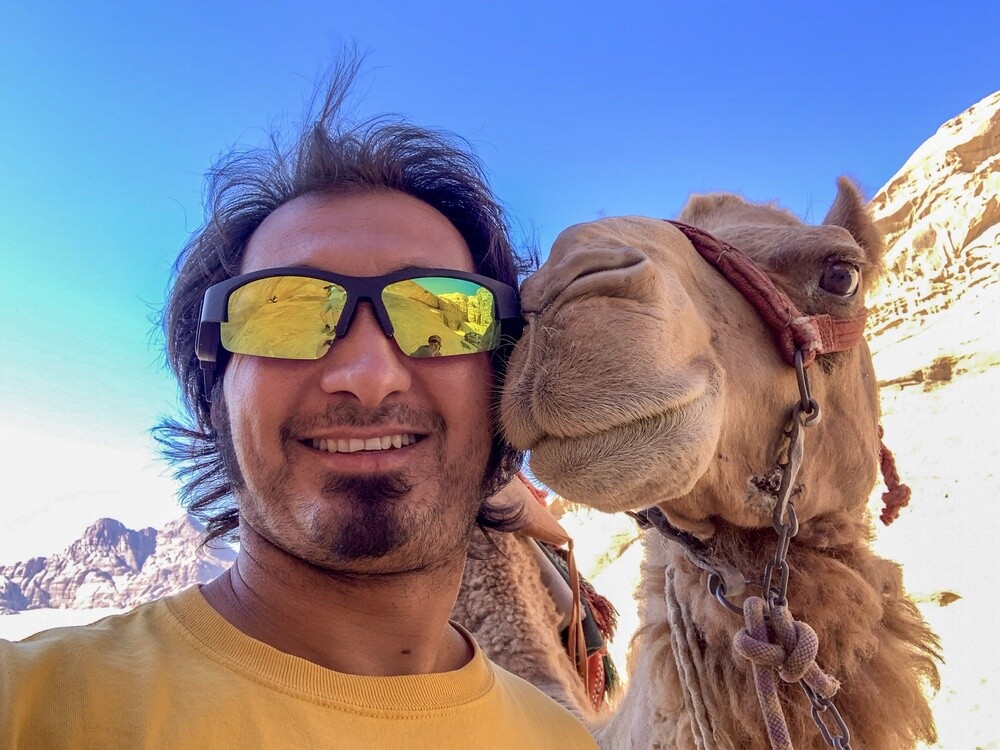
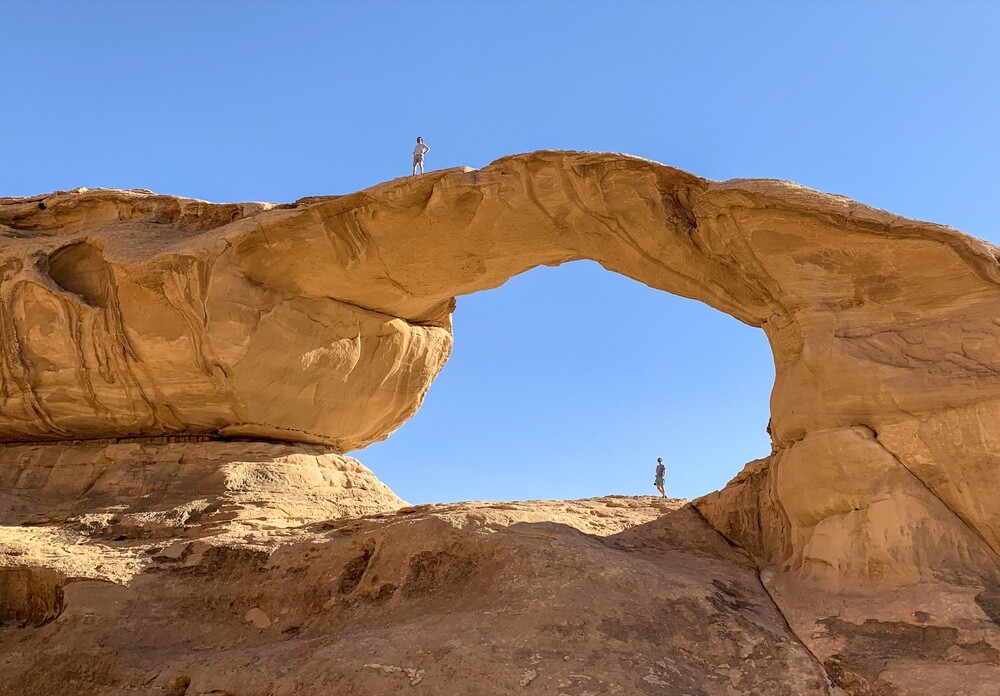
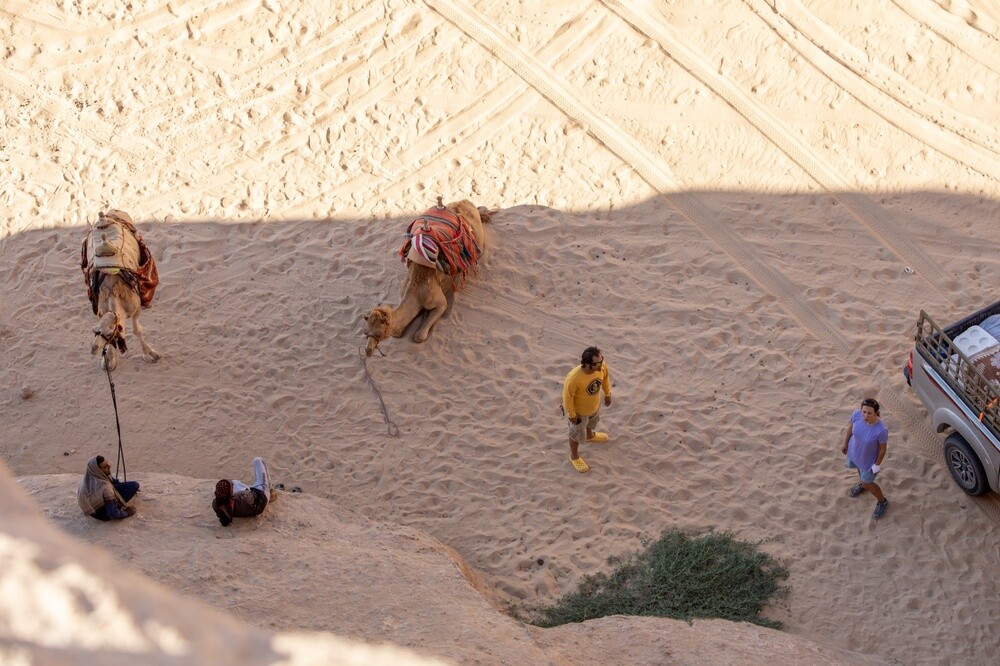
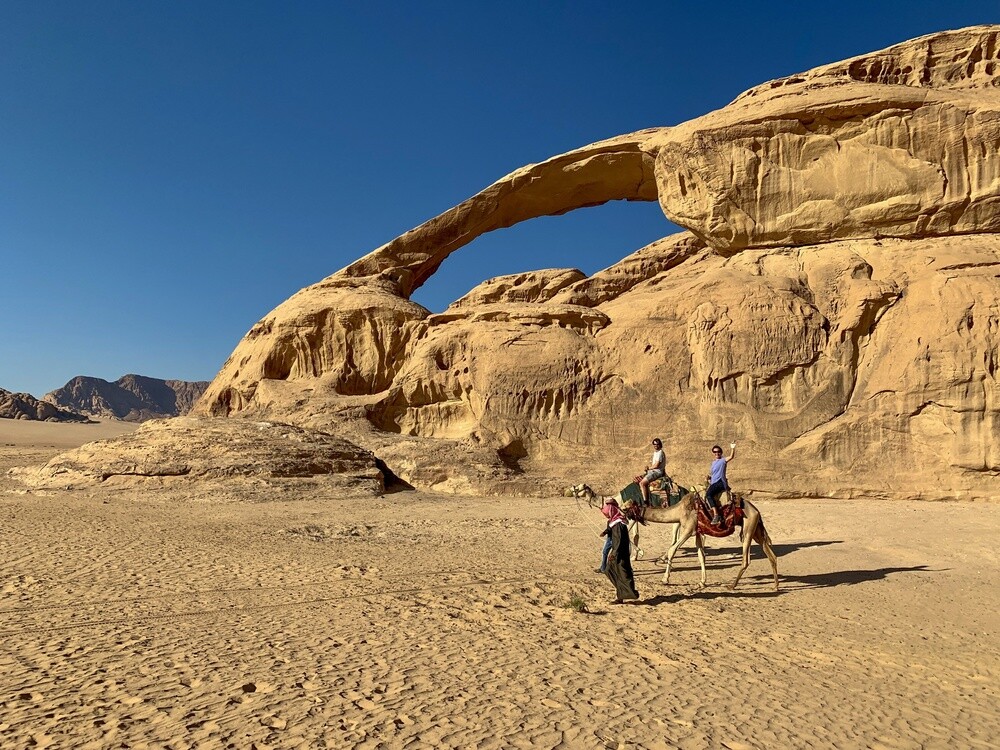
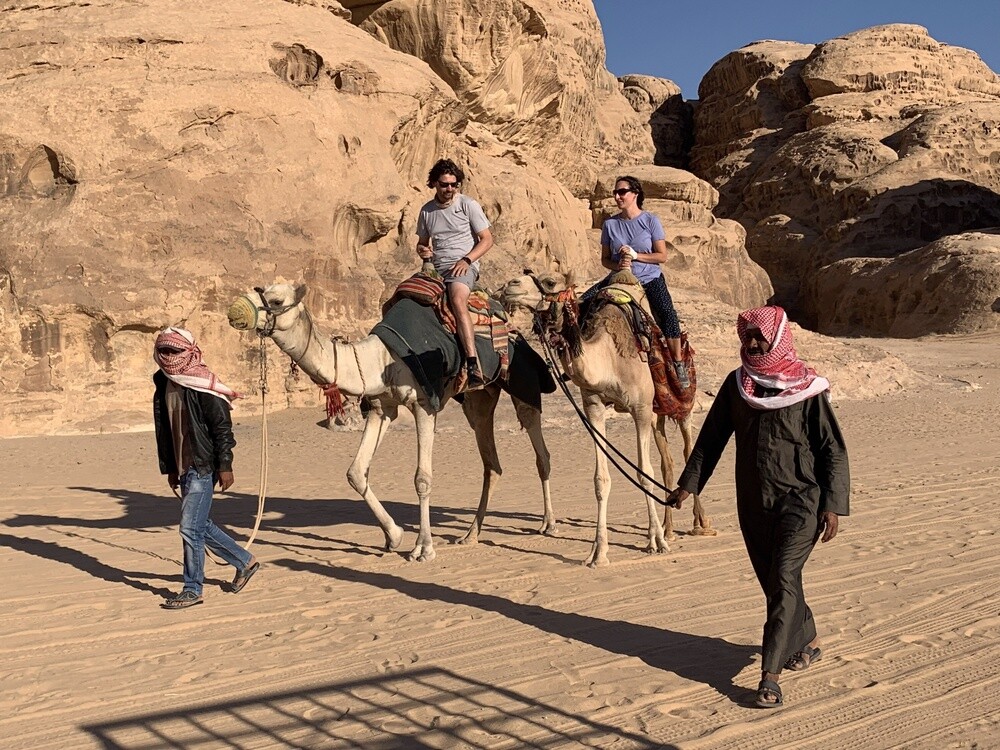
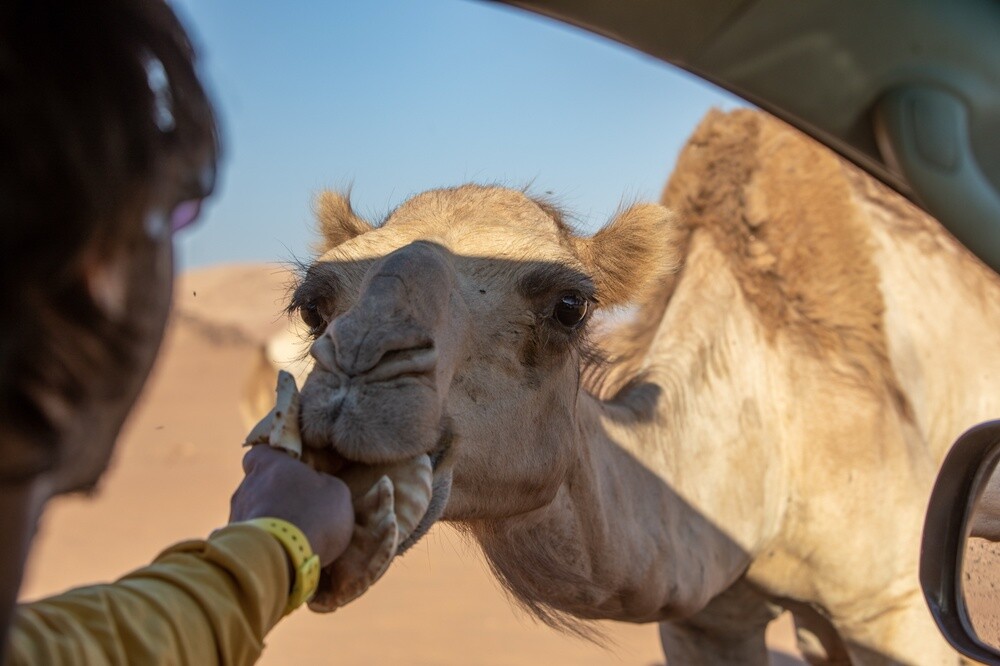
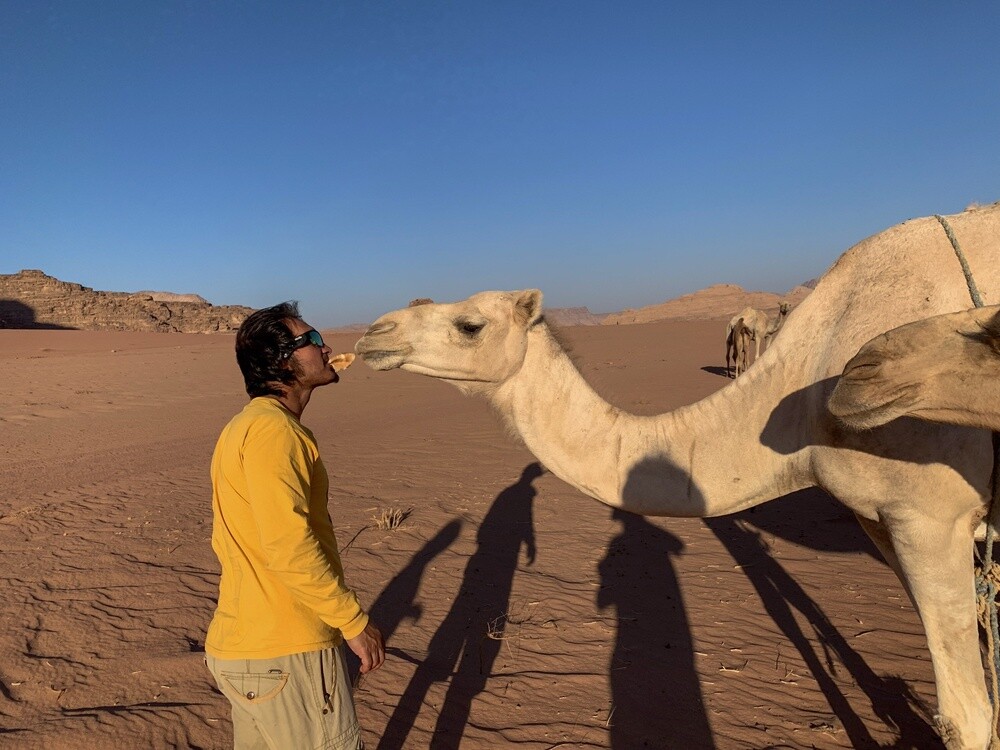
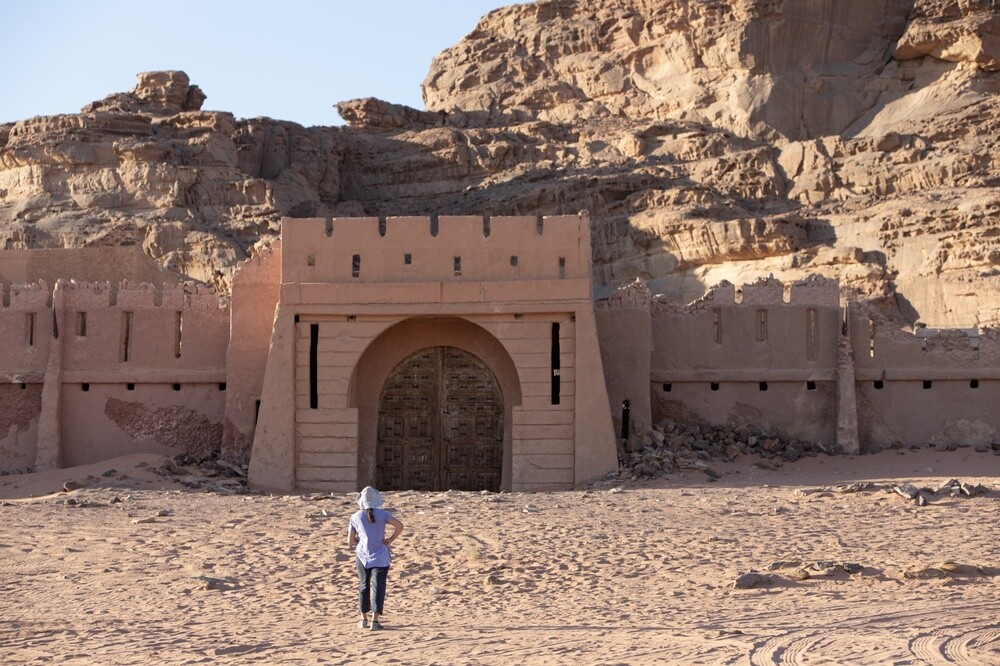
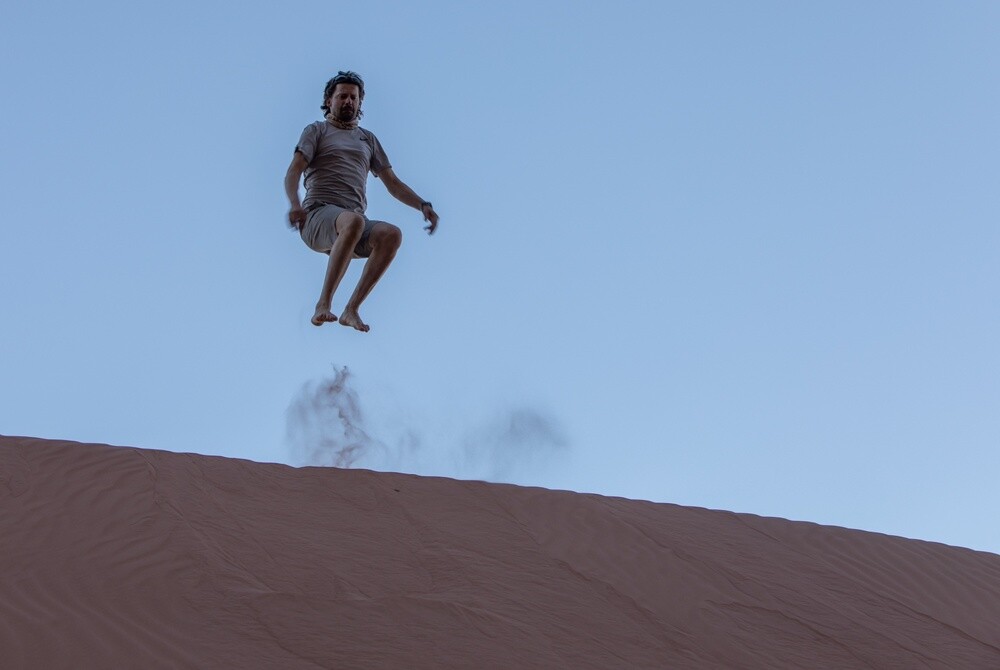
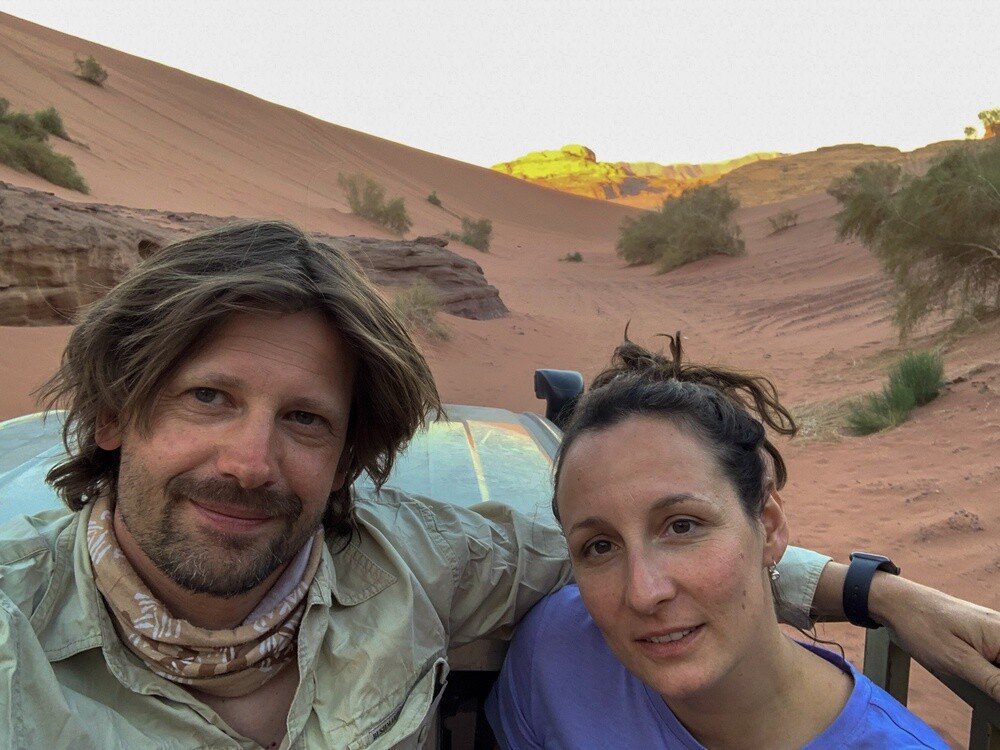
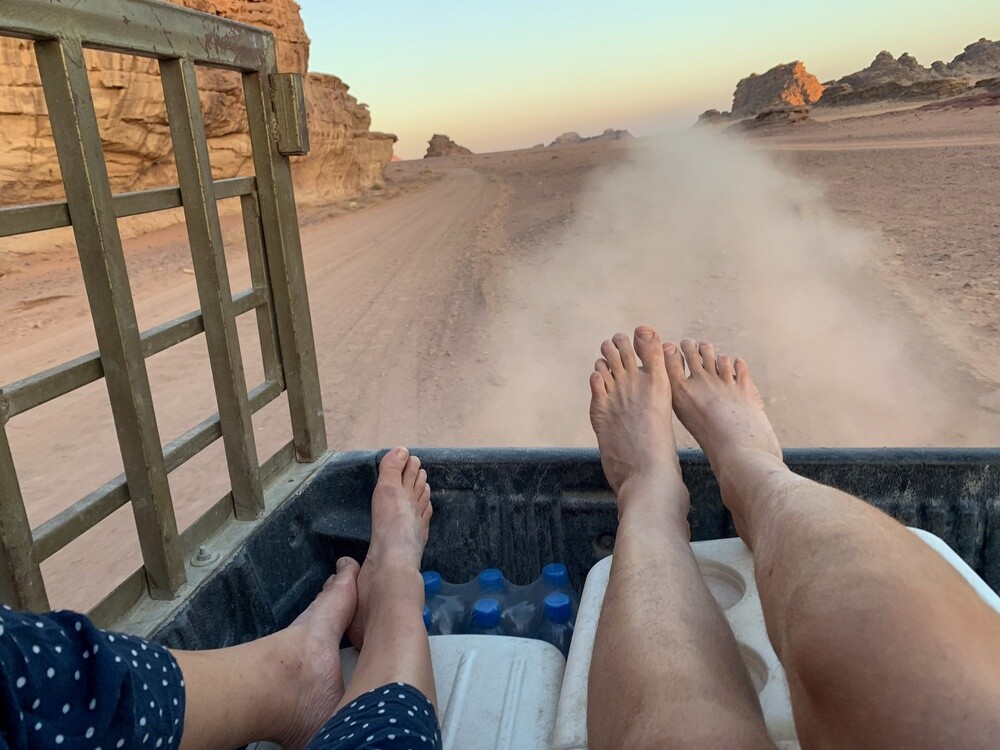
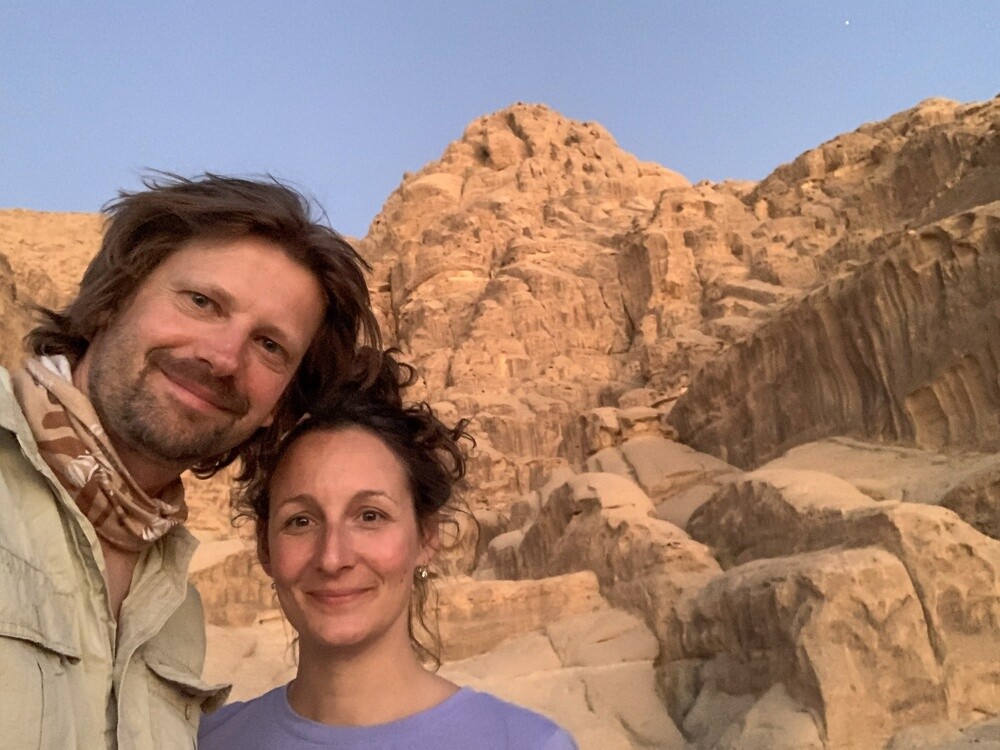
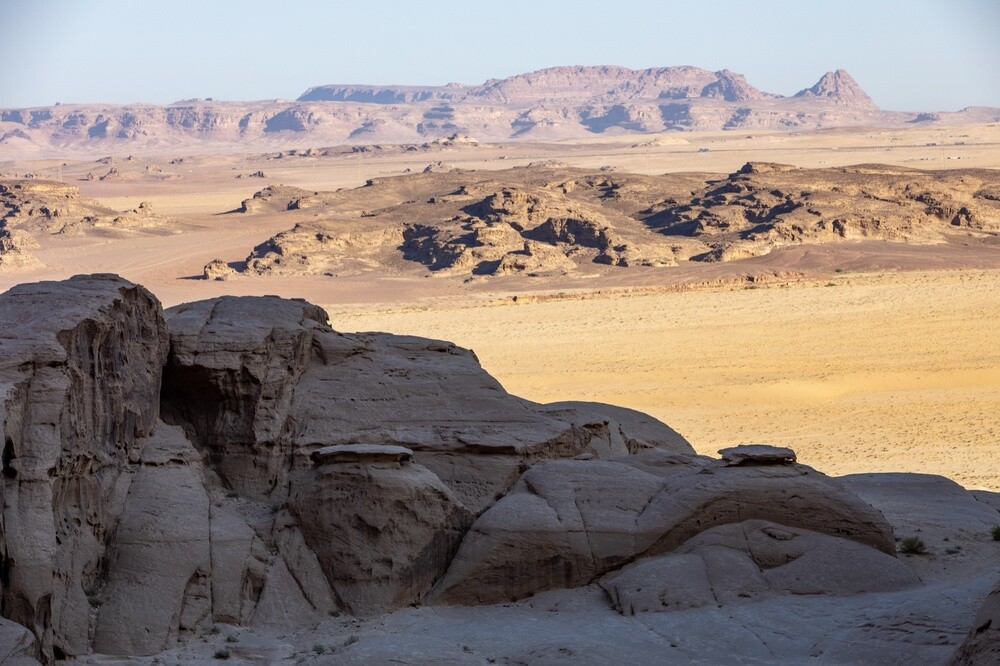
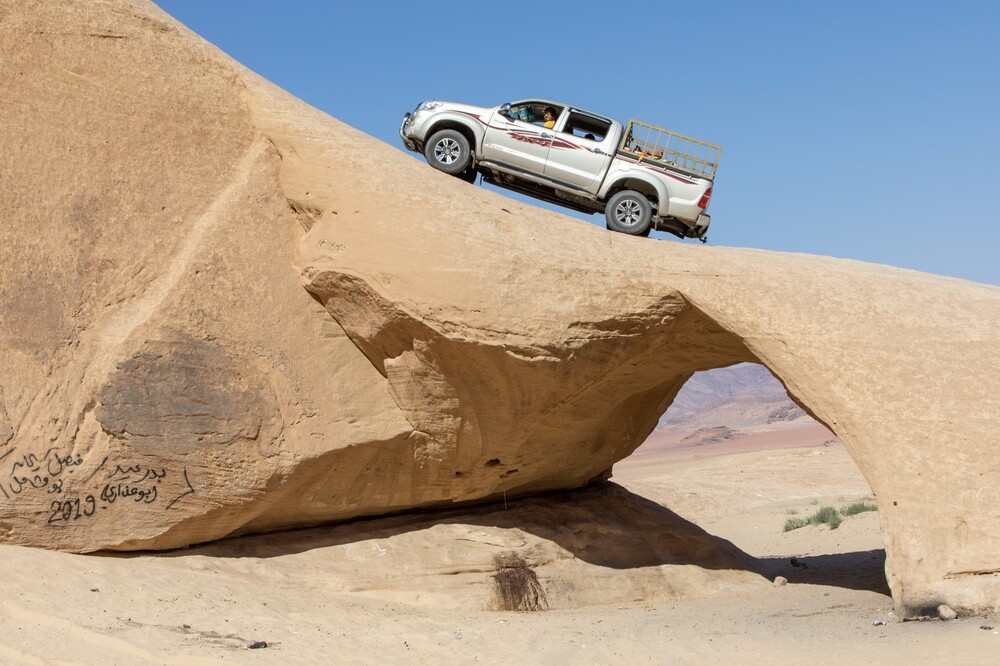
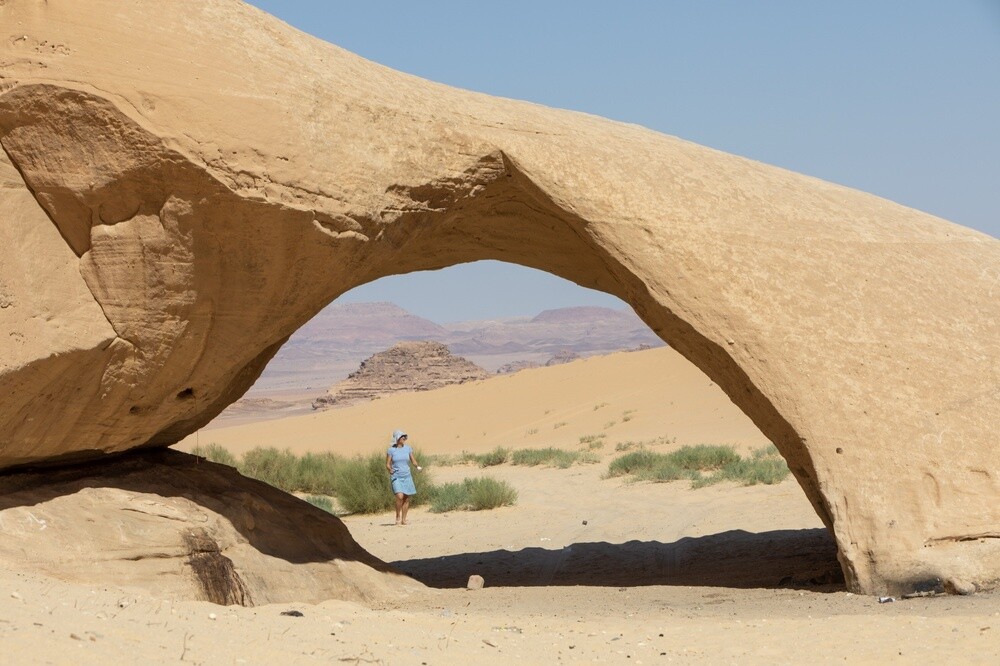
Wadi Rum in the afternoon. Across the desert in a pickup with a Bedouin guide, rock bridges, camels and a guide who posed for a photo with a camel and gave it a kiss. The pickup in the red dunes, jumping off a dune and the ride on the truck bed with our feet up 😄

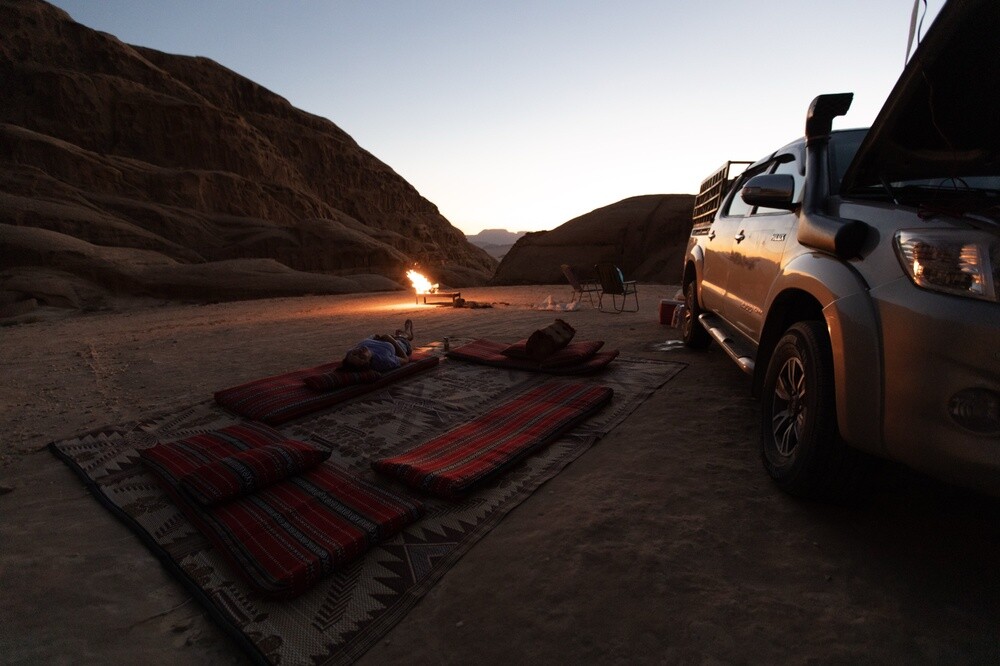
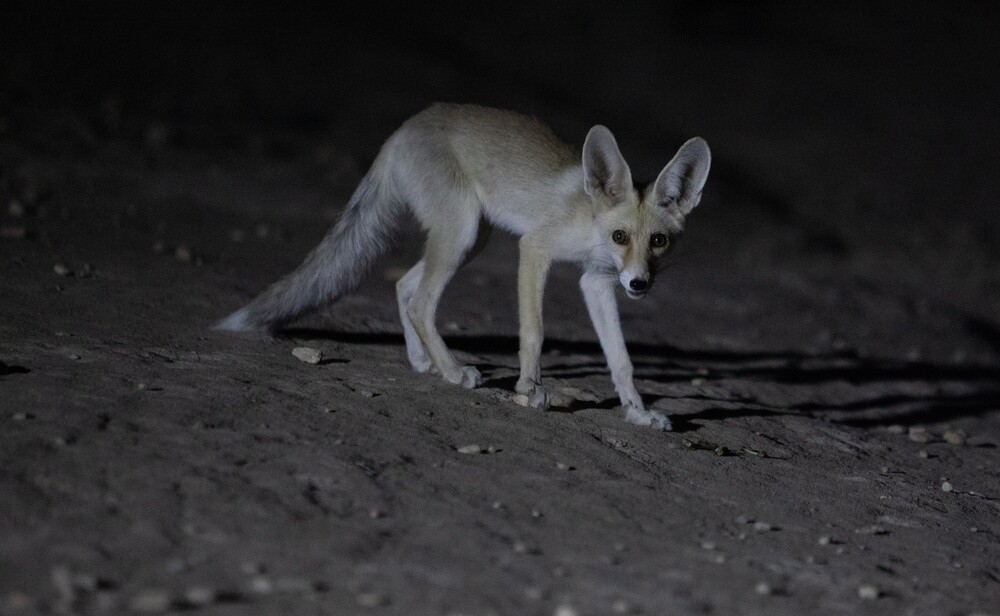
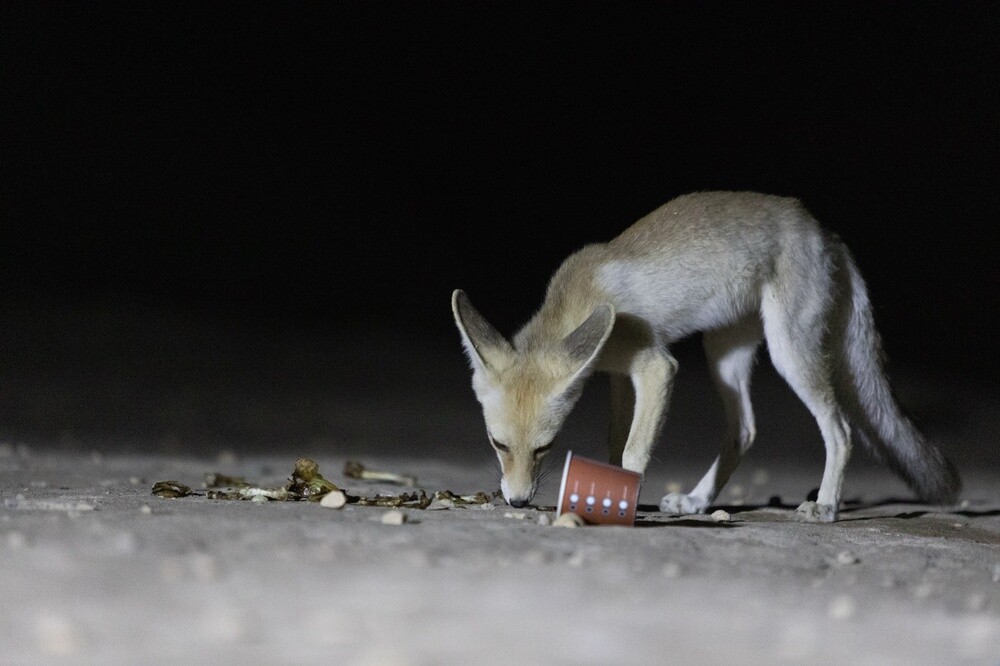
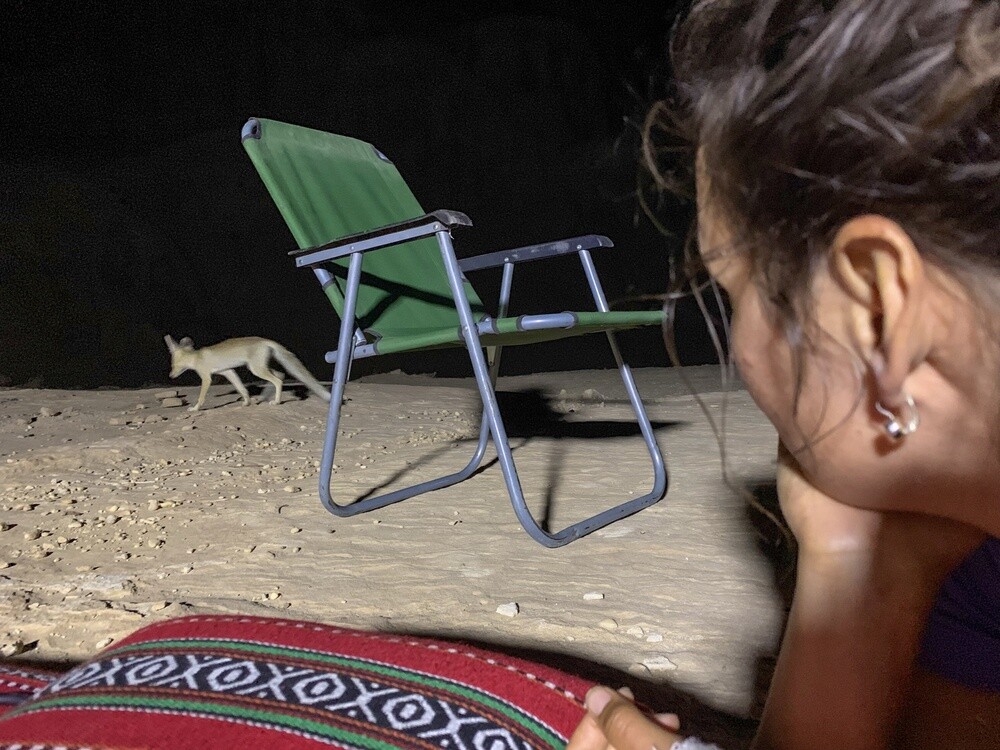
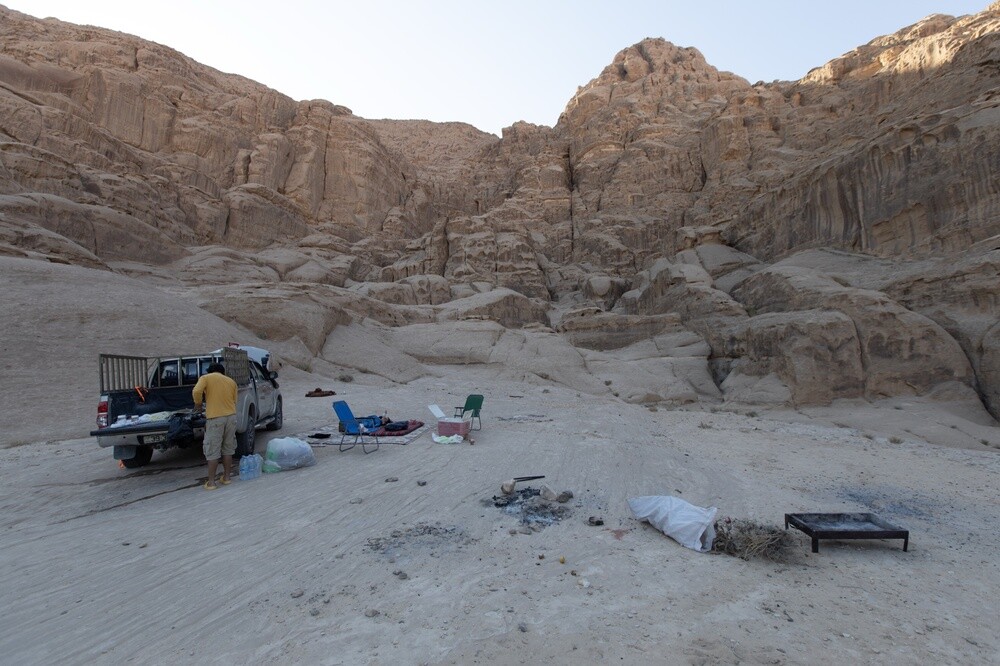
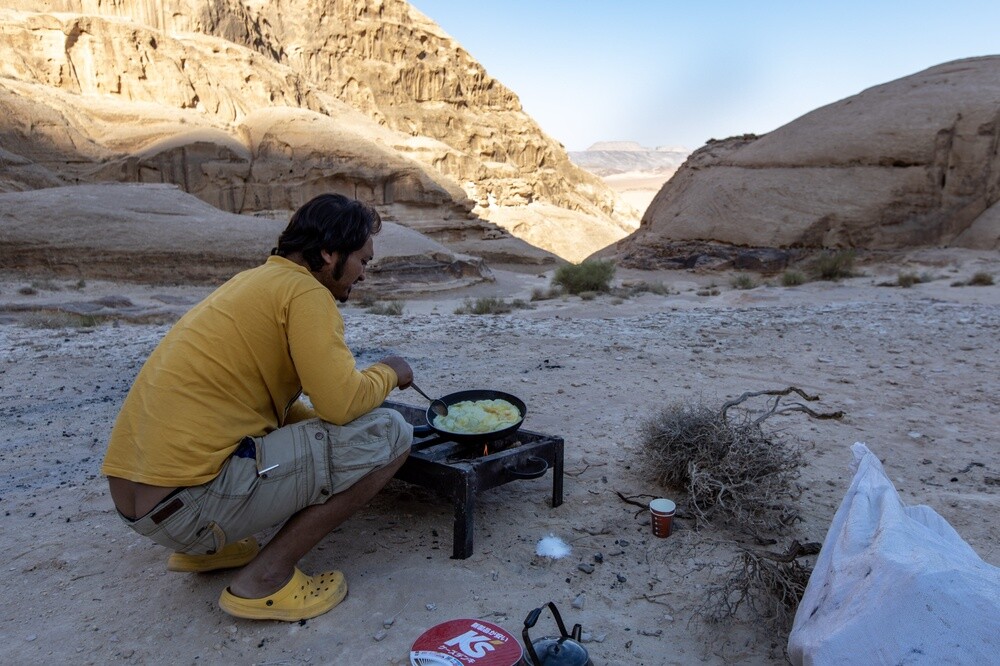
In the evening a camp under a rock: a fire, food cooked in the embers and carpets on the sand. We wanted to repeat a night under the stars like the one in Libya, where we slept this way 21 years ago. During the night desert foxes came to the camp and took the leftovers.

Wadi Rum
A desert of sandstone and granite rocks in southern Jordan, on the UNESCO list since 2011. Lawrence of Arabia was filmed here, as well as the Mars scenes for the film The Martian.

Tuesday 30/7/2019, Wadi Rum and back to Amman

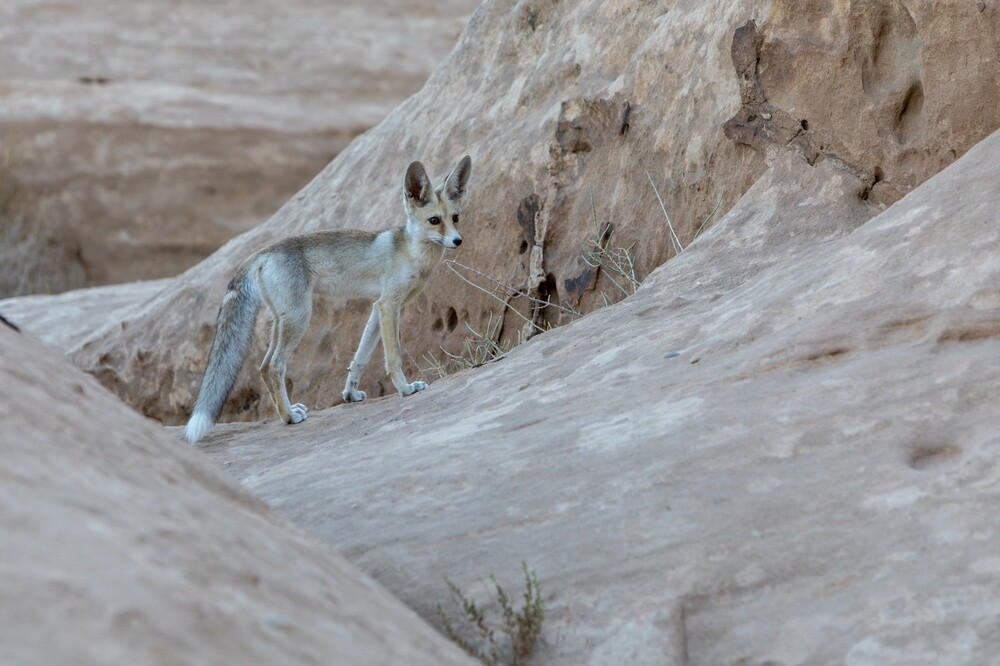
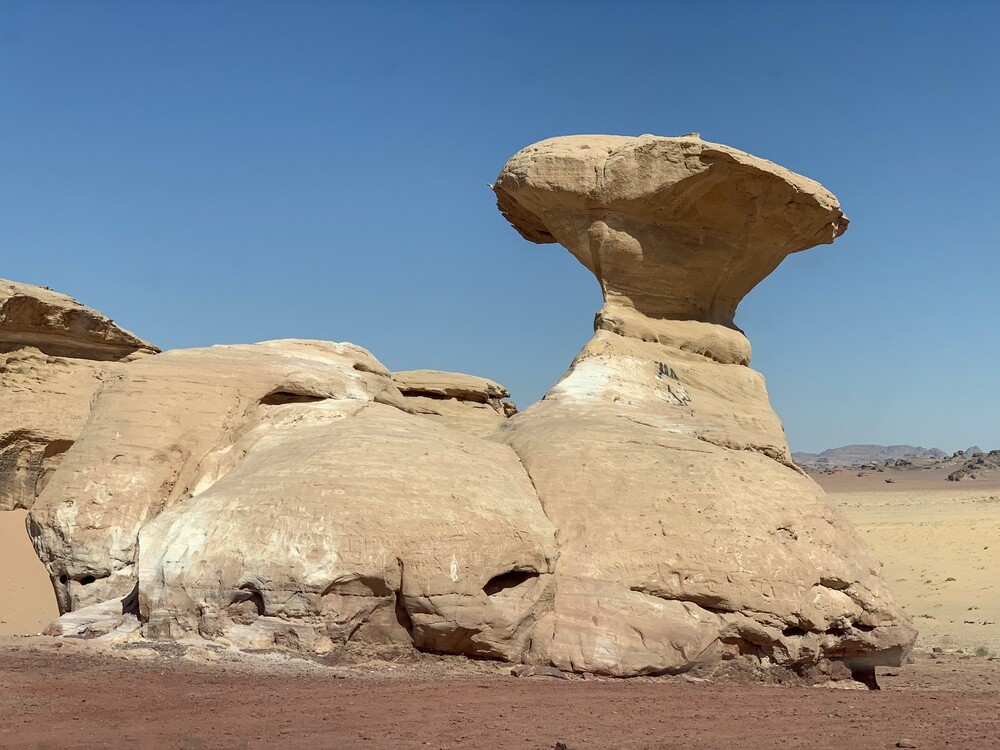
In the morning a fox on the rock above the camp and breakfast from our guide. A few more rocks, a stone mushroom and a rock bridge that the pickup drove up onto. In the afternoon we were near Amman, the last photo of the trip is the IKEA by the motorway, which Hanka had already spotted on the way from the airport on the first day. The plane home left at six in the evening.