6.1.2017 Day ten – crossing the mountains in Bolivia
Tupiza, Bolivia to Oruro, Bolivia
692 km, of which 447 were originally racing kilometres, shortened to 219 because of the weather
If there's one thing that stuck with me from two years of the Dakar, it's definitely this stage. Arriving in Bolivia started with a big battle over a SIM card (basic equipment for a photographer sending the team's photos out to the media), but that was nothing compared to crossing the mountains. It had been raining hard for several days and in 2017 there was no sensible road between Tupiza and Oruro. You could either go around on an insane detour, or risk crossing the mountains on unpaved muddy tracks. Kocour knew perfectly well that you don't go in there with a single car, so we drove together.
To this day I'm so glad it was my turn at the wheel!
It started with a drive through lovely green countryside, farms, rocks, pure idyll. But then the road started climbing steeply into the mountains and it got chilly. Water everywhere, mud, and fords became a normal part of it. Here and there a village or a small town, but mostly complete wilderness and views of the gorgeous mountains all around.
Then for quite a while there was a high plateau straight out of the Bible, the part about the Flood. As far as the eye could see, a flooded plain, with the embankment of our road partly sticking out of it. The fords got longer and deeper, some we only risked because someone in a similar car had gone through ahead of us.
The state of the road kept getting worse, until suddenly the road was cut off. By a river. Which clearly hadn't been there yesterday, because there wasn't a trace of a bridge anywhere and the road carried on on the other side. The new riverbed a couple of metres below us. Not even a Hilux can do this.
The locals advised us to go back a bit, there was a detour. There was, but across an absolutely insane ford. A double river came pouring in from the right and fell off the slope down to the left into a lake. If the current takes the Toyota here, we'll never find it again (assuming we even manage to get out of it in time).
Even Kocour studied it for quite a long time, and he's on his tenth Dakar, the first five or so behind the wheel of a racing truck. But the thought of driving back for 5 hours just to set off on an even longer detour pushed us forward.
Kocour got through. Not entirely easily, but he got through. Now me.
Second gear in low range, camera on and off we go. In a moment the water from the right is pouring over the bonnet, but the Toyota keeps going. At one point she rocked a bit in the current, but so briefly that I didn't even have time to crap myself 😁. She does weigh something after all, so she made it. Phew. Really a memory for life.
Then there was the descent on muddy tracks, a cliff going up on the left, a drop going down on the right. Towards the end of the crossing we found something like a half-built motorway surrounded by a muddy field. There was no slip road onto it, but we sort of made ourselves one, slightly illegally.
A year later the motorway over the mountains will be completely finished, an all-day adventure will turn into a boring hour-long affair and it will be a huge disappointment to me.
We got to the bivouac in Oruro in a crazy downpour and totally late. At the entrance to the bivouac there was an endless queue of trucks, race cars, desperately scurrying raincoats and streams of water.
Kocour sized up the situation very quickly and ordered us to set up camp. That means our trucks are parked in a square, big tents go up in the middle and work starts on preparing the racing truck for tomorrow's stage. Nothing strange about that so far, except maybe for the rain. But at that moment we were in the middle of a motorway! The organisers kept yelling at us that we weren't supposed to park there, but they're no match for Kocour. Of course in the end everybody did the same thing, but we already had a few hours' head start on servicing the truck. It may not seem like it, but servicing a racing truck means 5–12 hours of hard work every single day. Sometimes just tyres and a turbo, but sometimes a driveshaft, or a cracked tank (700 litres) that has to come out, be drained, dried, welded and put back.
7.1.2017 - Day 11 - Armageddon in the bivouac
Oruro, Bolivia to La Paz, Bolivia
786 km in total, of which 527 were supposed to be racing kilometres, but the stage was cancelled because of the floods.
In the morning the rain stopped, a bit of sunshine came out, so I put on my last set of clean dry rags and headed off with the camera to have a look around the bivouac. I had a feeling it wouldn't be great in there after the rain, but I didn't expect this. I wouldn't expect an armageddon like this even in a Bruce Willis film! Knee-deep mud everywhere, mechanics wading through it with plastic bags on their feet, race cars unable to get out of it without help, let alone the support vehicles and the occasional motorhome! It's probably best seen in the photos, but between the "road" and the canteen there was a pontoon made of pallets, the portaloos were floating, everyone totally caked. And me among them, in clean clothes, camera in hand. Right up until the first unfortunate slip. After that it was me among them with my arse marinated in first-class Bolivian mud :-D.
In these conditions even the organisers of the toughest rally in the world had to admit they couldn't pull it off and cancelled the stage. So all that was left was to somehow cover the nearly 800 km to La Paz. We were already looking forward to civilisation, La Paz is the capital after all. The highest-lying one in the world, but still.
What we didn't expect, though, was the number of spectators (and soldiers) along the route! You can see a bit of it in the photos, you just have to imagine that the wall of spectators started about 20 km before the entrance to the city and kept getting denser. Driving through to the bivouac took several hours and our bladders nearly burst! The crowd was so dense you couldn't turn off anywhere, and just try finding a quiet spot when there are (according to the organisers' figures) 1.4 million spectators standing along the route!!
La Paz is an amazingly interesting city, built at the foot of several mountains. Austrian cable cars serve as public transport here! Seriously!
The bivouac was in a huge military base, so unlike yesterday's mud hell there are asphalt roads, proper stone toilets and a canteen, and a shopping centre across the street. But the whole compound is crawling with fans trying to get inside, and getting out and back in is a slow business through police cordons.
8.1.2017 - Day 12 - La Paz, Bolivia, 4100 m a.s.l.
Rest day
Since La Paz is a hugely interesting city, we set off to see it. To prevent cabin fever we split up. The boys took the Toyota and decided to drive up to the highest point reachable by road, which was a bit over 5 km above sea level. They managed it in the end, but it took a lot longer than they expected. They managed to drive through a barrier they mistakenly took for a barrier against fans. A Dakar car opens any gate J. But that barrier was there because once a week they close off several streets and hold a market there. So they spent about an hour squeezing between the stalls, shooing away female fans and waiting for some of the stalls to be cleared away so they could get through J.
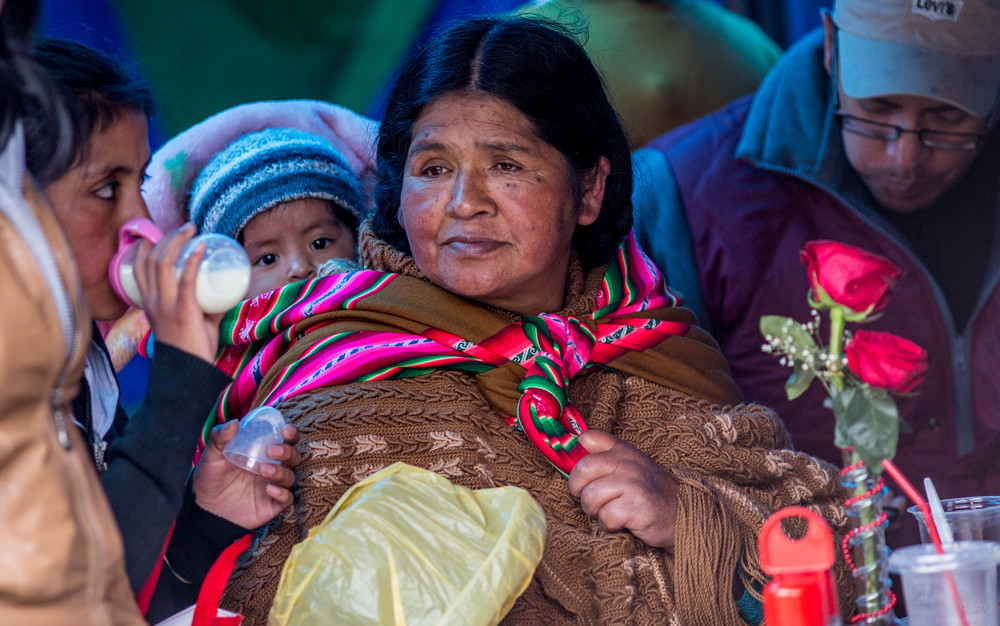
I took my camera and walked around the old town, shooting my favourite portraits of locals and children and riding the cable cars. Beautiful!
In La Paz I was also hunting for condoms (why, in a moment). La Paz is evidently a very Catholic city, because my question in broken Spanish made the shop assistants lower their eyes and go red in the face. And exactly at the moment when I was explaining that I needed the really thick ones, Jiřík (the idiot) came along, put his arm around my shoulders and said in a sweet voice something like "Come on then, sweetie". The shop assistant was so flustered that she sold me 5 boxes of small sachets of lubricating gel instead of condoms J.
I was after the rubbers because I had a hastily built telemetry device in the truck. It collected data on speed, position, temperatures, g-forces and so on. But outside the cab there's constant water, mud, heat, frost, so I needed to protect the device with a rubber J
Meanwhile back at the bivouac the mechanics took František (the truck) apart down to the elementary particles to get him ready for the second half of the Dakar.
9.1.2017 Day 13 – desert and llamas
|
La Paz, Bolivia
|
Uyuni, Bolivia
|
622
801
|
322
161
|
We had plenty of energy and confidence for the next stage, so we decided to set off along the racing route. It went through real desert, sand, dunes and all that. So it was hard to get in there any other way than along the route. In theory we're allowed on the route at any time, but the recommendation is to set off 2 hours before the first biker starts so we don't get in the way. Well, except that at five in the morning nobody is getting us anywhere…
So we got to the desert, saw the first dunes in the distance. Those will be lovely photos, we're driving along the route, there's no other way. By then the first cars had already set off after the bikers. And us, we'll just drive among them.
We know the first ten are sent off at two-minute intervals. So Peterhansel came tearing past, doing maybe 180 across the desert. I'd told the boys I used to drive in the desert in Libya once upon a time, so they entrusted me with the wheel. So I got onto the route and flat out in second the Toyota was doing about 40. We divided up the roles clearly. I drive full steam ahead, Adam watches the mirror for the next maniac coming at us 140 km/h faster than we're going, and Jirka keeps an eye on the stopwatch so we don't miss those two minutes.
That's how we bounded forward, towards the dunes. Unfortunately the route was then fenced off with barbed wire, which I had to break through while fleeing from another lunatic.
Then there was a smallish dune, but steep on the way down. And that's where we got stuck. And there I sweated so much down my back that the groove in my spine couldn't handle it, and then it probably left a streak on my boxers too! Because it was clear that within 45 seconds at most someone would come flying at that dune at a speed that would launch them over it. Onto our roof. So, manoeuvring in the ruts in the sand, forward, back, low range, steering wheel, wet back.
In the end I managed to get the Toyota off the route and I swore: never again on the route among the cars!
We spent the rest of the day driving purely through the desert, off the route. It meant a lot of time with shovels digging out a bogged-down car, but still better than having Despres or Loeb on the roof and then being in the headlines of every news bulletin: "Czech journalists cause the crash of a race favourite, they are now sharing a room with Sébastien Loeb in a field hospital."
In the end the gamble of driving along the route paid off, we found an absolutely LUXURIOUS dune which the trucks hit head-on into the slope, which reliably launched them into the air and made for fantastic photos!
We shared the dune with a local selfie-hunter, his wife and their little girl, who nicely completed the scene.
On top of that, a racing Toyota belonging to some Dutch guys got stuck there and we heroically helped them get it out.
As we were leaving we got beautifully bogged down ourselves and confirmed that "punks", or desert camel grass, have terribly deep roots, and when you get stuck on them, digging them out is the equivalent of digging up the stump of a 100-year-old apple tree!
Satisfied with our photo haul, we thought we'd calmly get to the next bivouac in Uyuni in daylight.
On the way some llamas posed beautifully for me, with the mountains in the background.
10.1.2017 Day 14 - Uyuni – Salta
|
Uyuni
|
Salta
|
892km
|
492km racing
|
During the transfer we came across a support truck flipped onto its roof on the slope below the road. It was one of the support trucks of the "electricians". I think it was a French team, the first to try running a fully electric car in the car category. They had an agreement with the organisers that their charging time was deducted. So we would always come across some enormous diesel generator somewhere in the desert, humming and smoking and charging the race car J. As far as I know, today (March 2020) Ken Block is seriously testing this. But the electricians had the bad luck that by the time they'd charged up, the trucks had set off on the route and carved out such ruts that no car could get through. So in the evening Kolomajz would tell us: "So today I ran into those f***ing electricians! I'm blasting the sentinel at them, nothing! So I picked them up on the bumper and charged them for a good 3 km!" J.
Although the truck crash looked horrific, the driver was running around the slope organising the local Bomberos (firefighters) during the recovery.
But the adventure was set to continue. Just when it should have been a mere 300 km to the bivouac, suddenly a queue of race and support cars. A big, stationary queue. The kind where the little tables and chairs are already out.
For a long time we couldn't find out what was going on. Eventually we managed to find a local who had a photo on his phone of what had stopped the queue. There was a church in the photo. Under water. Only the tip of the tower was showing!
Ahead of us is a village with a single road through it. And it's flooded to the point where the bell is dangling its dick in the water L.
Macík gave the order again, camp was set up and maintenance work on František began. Out of boredom I took my camera up the rocky slope above us to get some aerial shots. It was pretty dicey, but I didn't have a drone yet…
Then came the news from the organisers. They'd worked out a detour. One that would stretch today's already pretty hefty adventure to 801 km!!
Now Jiřík's stamina came in handy. He got behind the wheel and put a brick on the accelerator. And kept it there until morning.
The only two moments that slowed us down were a wall of 3 bikers who'd had it up to here with cars overtaking them and throwing up dust. I actually understand them. After covering a tough racing stage whose difficulty would kill most people, they still have to go around a flooded area on an insane rocky, dusty road through the Bolivian mountains. And on top of that everyone wants to overtake them.
The second stop was even funnier. Jiřík decided to overtake someone right by the verge, where there was a small puddle. It wasn't a puddle, it was a reservoir of about 2 tonnes of top-quality red mud which, at full speed and beautifully evenly, transferred itself onto our windscreen. Total darkness within half a second :-).
We got to Salta sometime after midnight, but there were still steaks :-)